Startup and Venture Investment News Update for July 7, 2026: Global Venture Market Sets New Records as Capital Concentrates in AI, Robotics, Defense Tech, Deep Tech, and AI Infrastructure
By the start of Tuesday, July 7, 2026, the startup and venture investment market enters the second half of the year exhibiting strong but increasingly selective growth. Global venture capital has once again become a major indicator of risk appetite: funds are actively returning to deals, large tech companies are gearing up for IPOs, and investors worldwide are reallocating capital towards artificial intelligence, robotics, autonomous transportation, defense technology, data center infrastructure, and industrial AI solutions.
The focal point of the day is not just the growth in funding volumes, but the changing quality of the market. Venture investments are becoming less reminiscent of a broad speculative boom and are increasingly concentrated around companies that are shaping the foundational infrastructure of the new technology economy. For venture investors and funds, this indicates a shift from a model of "buying growth at any cost" to a more rigorous selection of startups based on revenue, technological advantage, market access, and the likelihood of successful exits through IPOs or M&A.
Global Venture Market: Record-Breaking First Half
The chief macro indicator of the venture market is the record volume of global startup funding in the first half of 2026. Market estimates suggest that global venture investments have reached an all-time high, surpassing the total for all of 2025 in just the first six months. This demonstrates that the startup ecosystem has again become a magnet for institutional capital.
However, the growth is extremely unevenly distributed. The largest AI startups, companies in computing infrastructure, robotics, and autonomous transportation are receiving a disproportionate share of capital. For small and medium-sized tech startups, this creates a dual effect:
- on one hand, the market is again open to strong teams and scalable business models;
- on the other hand, competition for the attention of funds is becoming tougher;
- investors are demanding proven revenue, sustainable unit economics, and a clear path to the next round;
- startups without technological barriers find it harder to defend their valuations.
For venture funds, this is a market of opportunities, but not one of unconditional optimism. There is more money available, but it is concentrating in fewer companies.
AI Startups Remain the Main Magnet for Capital
Artificial intelligence remains the central theme of venture investments in 2026. However, the focus is shifting from consumer AI applications to infrastructure: chips, networking equipment, data centers, cooling systems, tools for training AI agents, corporate automation platforms, and specialized models for industry.
Investors are increasingly looking for not just "another AI service," but for companies that can become the foundational layer for the new data economy. Focus areas include:
- AI infrastructure for enterprise clients;
- startups in generative video and multimodal models;
- solutions for manufacturing automation;
- platforms for AI agents;
- energy-efficient technologies for data centers;
- robotics and physical AI.
Against this backdrop, large funding rounds in the AI sector continue to set the tone for the entire venture market. Deals involving Kling AI, Together AI, Bespoke Labs, and other infrastructure players illustrate that capital is flowing to areas where artificial intelligence is capable of generating not only rapid revenue growth but also a long-term technological advantage.
New Venture Funds: B Capital and the Return of Early Stages
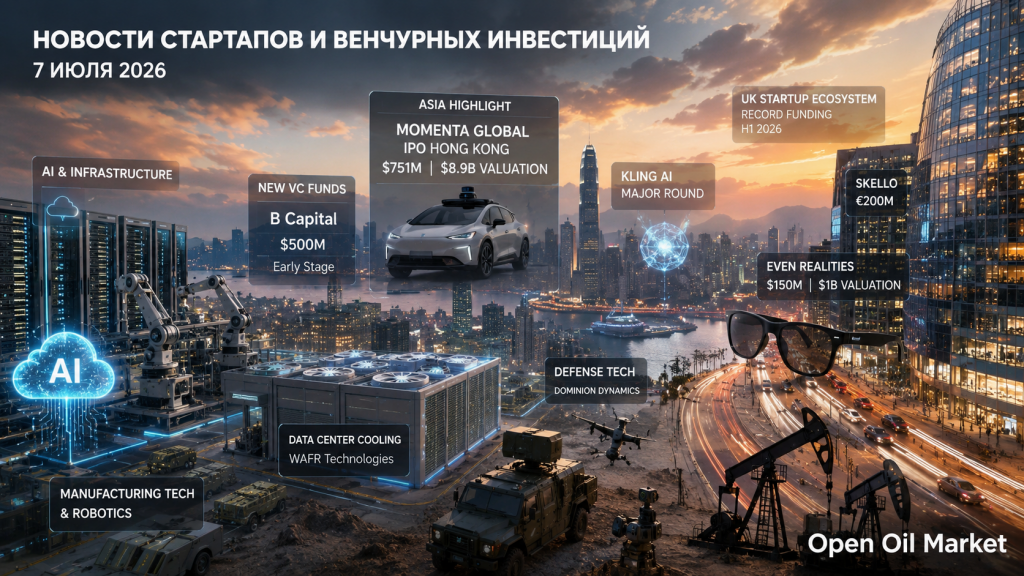
One of the notable events at the beginning of July was the launch of the new early-stage fund B Capital, with a volume of around $500 million. The fund is focused on seed and Series A stages, as well as select Series B opportunities. This sends an important signal to the market: institutional investors are again ready to enter early-stage tech companies despite rising valuations and competition for quality deals.
B Capital is betting on startups in AI, robotics, defense tech, space infrastructure, and other frontier tech domains. This reflects a broader trend: venture capital is returning to early stages, but is opting for technologically complex markets with high barriers to entry rather than mass consumer applications.
For startup founders, this means that an attractive pitch in 2026 must be built not only around audience growth. Funds are increasingly assessing:
- the presence of a proprietary technological core;
- the speed of product commercialization;
- the quality of the team and industry experience;
- the defensiveness of the business model against copying;
- the potential for entry into the global market.
Manufacturing Tech and Physical AI: Venture Capital Returns to Industry
A distinct trend is the interest in manufacturing technologies. New funds focused on manufacturing tech, robotics, sensors, and AI for physical industries are indicating that venture investments are reaching beyond classical software-as-a-service.
The launch of Omni Ventures, created by former Apple engineers, underscores the shift towards the "real sector" of the technology economy. Manufacturing, logistics, energy, semiconductors, defense, and automation are becoming new focus areas for venture capital. For investors, this represents an essential diversification: such startups typically require more time and capital, but if successful, they can create more sustainable competitive positions.
Physical AI is emerging as one of the key terms of 2026. This refers to the transfer of artificial intelligence from the digital realm to real-world production processes, robotic systems, warehouses, factories, energy infrastructure, and transportation.
Europe and the UK: AI Strengthens the Region's Positions
The European startup ecosystem is also showing growth, with the UK maintaining its role as one of the major venture capital centers in the region. In the first half of the year, British startups attracted a record amount of funding, with a significant portion directed towards AI companies, deep tech, autonomous transport, and data infrastructure.
For Europe, this is a pivotal moment. The region has long lagged behind the US in the scale of venture capital, but in 2026, European funds, corporate investors, and government programs are more actively supporting tech companies. Several areas are particularly notable:
- AI and applied models for industry;
- deep tech and scientific spin-offs;
- HR tech and automation of personnel management;
- fintech and embedded finance;
- climate technologies and energy efficiency.
The deal surrounding the French HR tech company Skello, which is raising approximately €200 million for its European expansion and development of AI tools, illustrates that investors are willing to finance not only frontier AI but also mature vertical SaaS platforms with clear revenue and strong market positions.
Asia: Momenta's IPO, Kling AI Round, and New Unicorns
Asia remains one of the most dynamic regions for startups and venture investments. The main deal in the coming days is the preparation of the Chinese company Momenta Global for an IPO in Hong Kong. The autonomous driving startup plans to raise around $751 million at an estimated valuation of approximately $8.9 billion. For the market, this is an important test of demand for tech IPOs in Asia.
Momenta is of interest to investors not only as a robotaxi company but also as a software provider for automakers. Its client base, which includes major global automotive corporations, makes the company more diversified compared to several competitors. If the placement goes well, it may enhance funds' interest in autonomous transport, automotive AI, and mobility tech.
Another significant signal from China is the substantial round for Kling AI, linked to generative video and AI content. The investments from major tech players into such companies demonstrate that China intends to compete with the US not only in foundational models but also in applied AI platforms for media, advertising, and corporate content.
The startup Even Realities, which has developed smart glasses and raised $150 million to reach a valuation of around $1 billion, deserves special attention. This confirms a renewed interest in consumer hardware, but under a new logic: devices are becoming interfaces for AI assistants, augmented reality, and personal computing.
Defense Tech, Data Center Cooling, and Infrastructure: Capital Flows into Strategic Industries
In 2026, venture capital is increasingly moving into sectors that were considered too capital-intensive or state-dependent just a few years ago. Defense tech, energy infrastructure, data center cooling, autonomous systems, and cybersecurity are now full-fledged focus areas for venture funds.
Canadian Dominion Dynamics secured a substantial Series A round to develop defense technologies and autonomous systems. Wafr Technologies received financing for the development of water-efficient cooling systems for AI data centers. These deals illustrate that investors are looking for companies at the intersection of several megatrends: artificial intelligence, energy, security, and infrastructure.
For venture funds, such projects may be more challenging in terms of due diligence, but they have an important advantage: demand for them is supported not only by the private sector but also by government programs, defense budgets, energy transitions, and increasing computational power.
What’s Important for Venture Investors and Funds
The current agenda for startups and venture investments as of July 7, 2026, forms several practical takeaways for funds, family offices, corporate investors, and LPs:
Key Investment Takeaways
- AI remains the leading sector, but infrastructure is winning. The most attractive companies are those providing computation, data, models, security, and automation.
- Early stages are again appealing, but valuations are high. Seed and Series A require stricter discipline regarding entry valuations and ownership sizes.
- The IPO window is gradually opening. Successful listings like Momenta may enhance demand for late rounds and pre-IPO deals.
- Europe is becoming more prominent. The UK, France, and deep tech clusters are strengthening their positions in the global capital competition.
- Hardware is making a comeback. Robotics, smart devices, industrial AI, and defense tech are again in focus for venture investors.
The main risk is the overheating of valuations. In an environment of record capital inflows, it is crucial for investors to distinguish fundamentally strong startups from those growing merely due to trendy AI rhetoric. Revenue, margins, customer retention, IP quality, access to infrastructure, and the ability to scale without continually increasing burn rates come to the fore.
Forecast for Tuesday, July 7, 2026
On Tuesday, the market will be watching three directions: the dynamics of tech IPOs in Asia, new AI rounds in the US and Europe, as well as fund activity at early stages. If the Momenta IPO confirms sustained investor demand, this could serve as an additional argument for reviving pre-IPO and growth rounds in the second half of 2026.
The venture market is entering a phase where capital is again available but is distributed much more strictly. For startups, this means a need to prove commercial viability more quickly. For funds, it presents the opportunity to enter new technological cycles before they are fully re-evaluated by the public market. For global investors, it is a chance to participate in the formation of new infrastructure for artificial intelligence, autonomous transportation, robotics, defense tech, and deep tech.
Therefore, the startup and venture investment news for July 7, 2026, indicates that the market is growth-oriented once again but is maturing. The winners will be not those companies that talk more about AI but those that turn technology into infrastructure, revenue, strategic advantages, and real paths to liquidity.