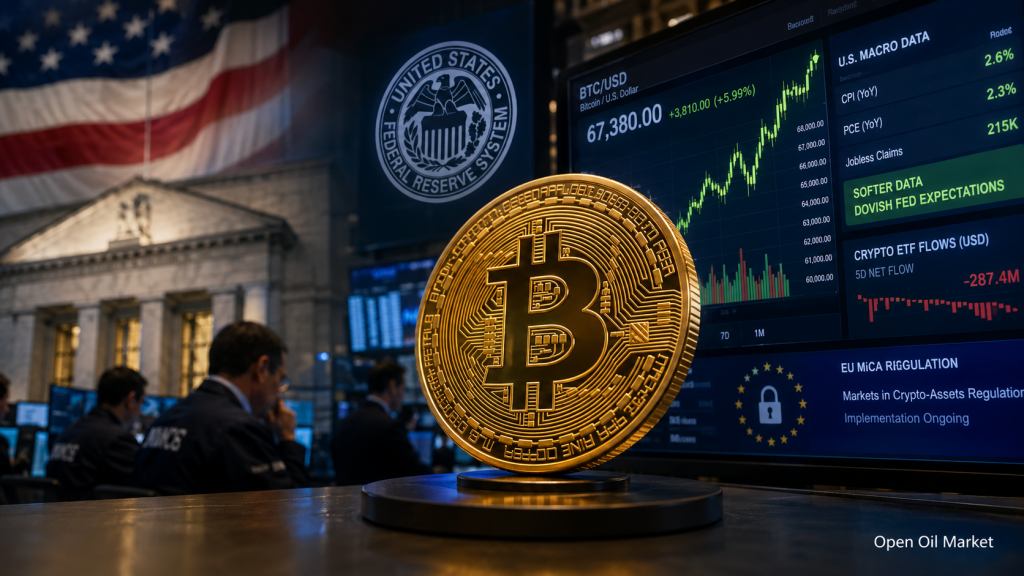
Cryptocurrency News for Thursday, June 25, 2026: Bitcoin Tests Key Zone, Ethereum Under Pressure, Investors Focus on ETFs, Stablecoins, Regulation, and Top-10 Digital Assets
The global cryptocurrency market approaches Thursday, June 25, 2026, with heightened caution. Following a notable decline in Bitcoin and Ethereum, investors are evaluating not only the dynamics of digital assets but also the broader macroeconomic backdrop: a strong US dollar, volatility in the tech sector, uncertainty surrounding flows into cryptocurrency ETFs, and tightening regulations on stablecoins in key jurisdictions.
For global investors, this moment appears to be a test of the maturity of the crypto market. While earlier cycles were often characterized by retail demand, meme coins, and speculative rallies, the focus has shifted in 2026 towards institutional instruments, liquidity, regulation, DeFi infrastructure, and the quality of balance sheets of companies involved in digital assets.
The Big Picture for the Day: The Crypto Market Remains Under Pressure
The key theme of the day is a reduced appetite for risk. Bitcoin is trading near an important psychological zone around $60,000, Ethereum is hovering around the $1,550–$1,700 range, and the global cryptocurrency market capitalization remains above $2 trillion but shows signs of cooling.
For investors, this means that the market has yet to confirm a full reversal upwards. Buyers maintain interest in core assets but are acting cautiously. The main reasons for the pressure include:
- strengthening of the US dollar and increased appeal of safe-haven assets;
- decreased interest in riskier instruments following sell-offs in the tech sector;
- pauses or slowdowns in inflows into cryptocurrency ETFs;
- regulatory news surrounding stablecoins, exchanges, and DeFi platforms;
- technical weakness of Bitcoin after unsuccessful attempts to secure above key resistance levels.
Bitcoin: The Market Tests Long-Term Holders
Bitcoin remains the main indicator of the state of digital assets. As of Thursday, June 25, 2026, investors are concerned not only with short-term price fluctuations but also with the behavior of long-term holders, ETF funds, and publicly traded companies that hold significant volumes of BTC on their balance sheets.
The decline of Bitcoin towards the $60,000 zone has intensified the debate on whether the current correction is the final phase of cooling or the beginning of a deeper downward movement. Some market participants point to the risk of further declines to lower levels if the dollar continues to strengthen and institutional flows into ETFs remain weak.
For investors, the critical question now is not how quickly Bitcoin will recover, but whether demand from large holders will remain. If long-term investors continue to accumulate BTC on dips, this may limit the depth of the correction. Conversely, if profit-taking begins among institutional players, volatility may increase.
Ethereum: Price Pressure and Ecosystem Expectations
Ethereum also remains under pressure. ETH is trading significantly below last year’s highs, and investors are closely evaluating the state of DeFi, staking, Layer 2 networks, and demand for smart contracts. Despite weak price dynamics, Ethereum retains its status as a key infrastructure for decentralized applications, asset tokenization, and digital finance.
The main risk for Ethereum is a decline in network activity and competition from cheaper and faster blockchains. The primary argument in favor of ETH remains the depth of the ecosystem, liquidity, developer presence, and institutional recognition. For long-term investors, Ethereum remains an infrastructure-type asset, but its short-term price is dictated by the overall sentiment in the crypto market.
Top 10 Most Popular Cryptocurrencies in Investors' Focus
In the global cryptocurrency market, investors' attention is focused on major and most liquid assets. The top 10 for observation as of June 25, 2026, include:
- Bitcoin (BTC) — the main digital asset and market cycle indicator.
- Ethereum (ETH) — foundational infrastructure for DeFi, tokenization, and smart contracts.
- Tether (USDT) — the largest stablecoin and a main liquidity instrument on exchanges.
- BNB (BNB) — the token of the Binance ecosystem and BNB Chain.
- USD Coin (USDC) — a regulated dollar stablecoin, in demand by institutional participants.
- XRP (XRP) — an asset linked to cross-border payments and Ripple’s infrastructure.
- Solana (SOL) — a high-speed network for DeFi, NFTs, payments, and consumer applications.
- TRON (TRX) — a network with high activity in the stablecoin transfer segment.
- Hyperliquid (HYPE) — a project related to on-chain derivatives and professional trading.
- Dogecoin (DOGE) — one of the most recognizable speculative assets among retail investors.
For investors, it is essential to categorize these assets by function. Bitcoin is often seen as a digital reserve asset, Ethereum and Solana as technological infrastructure, USDT and USDC as transaction and liquidity tools, while XRP, TRON, BNB, and HYPE represent more specialized ecosystem stories with heightened regulatory and market risks.
Stablecoins: The Main Regulatory Narrative of 2026
Stablecoins are becoming a central theme in the crypto market. In the United States, there exists a federal regulatory framework for payment stablecoins; the UK is relaxing certain requirements for issuers, and Europe continues to strengthen its oversight of crypto companies under MiCA. For investors, this signifies a transition from a free experimental model to a more institutional financial infrastructure.
The growing role of stablecoins is essential for three reasons:
- they provide liquidity for trading pairs on crypto exchanges;
- they serve as a bridge between traditional finance and blockchain payments;
- they enhance the connection between the crypto market and the treasury bond market along with dollar liquidity.
At the same time, regulation on stablecoins can become both a positive and a negative factor. On one hand, transparent reserves and oversight increase trust; on the other hand, strict requirements may limit issuer profitability and reduce flexibility for crypto platforms.
ETFs and Institutional Flows: The Market Awaits a New Impulse
Cryptocurrency ETFs remain a vital channel for institutional investors. Between 2024–2026, it was precisely exchange-traded funds that made Bitcoin and Ethereum more comprehensible for traditional asset managers. However, the market is presently experiencing a pause: inflows into ETFs no longer appear as aggressive, and investors await confirmation that digital assets can once again outperform stocks, gold, and bonds on a risk-return basis.
For global investors, three indicators are crucial:
- the volume of net inflows or outflows from Bitcoin-ETF and Ethereum-ETF;
- the dynamics of demand for multi-cryptocurrency funds;
- the readiness of major asset management companies to increase the allocation of digital assets in model portfolios.
If ETF flows recover, it could provide support for Bitcoin, Ethereum, and large altcoins. Conversely, if institutional demand remains weak, the cryptocurrency market may continue to trade in a defensive mode.
Altcoins: Solana, XRP, BNB, and DeFi Remain High-Risk Areas
Altcoins continue to move more volatilely than Bitcoin. Solana remains one of Ethereum's primary competitors in transaction speed and cost but depends on developer activity and network stability. XRP retains interest from investors focused on payment infrastructure but remains sensitive to regulatory and corporate news. BNB is reliant on Binance ecosystem health, trading activity, and regulatory attitudes toward large centralized exchanges.
The DeFi segment also draws interest. Projects related to lending, derivatives, on-chain trading, and the tokenization of real-world assets are attracting more attention from professional participants. Yet, here lies higher operational, technological, and legal risks.
Cyber Risks and Security: The Achilles' Heel of Mass Adoption
Cryptocurrency news is increasingly linked not only to prices but also to security. Malware, wallet attacks, phishing, compromise of private keys, and address spoofing during transfers remain significant threats for both private and professional investors.
For the market, this is an important maturity factor. The more institutional money flows into digital assets, the higher the requirements for storage, custodial solutions, insurance, compliance, and internal control. For investors, the fundamental rule remains unchanged: the returns of crypto assets should not be viewed in isolation from infrastructure risk.
What to Watch For Investors on June 25, 2026
On Thursday, investors should keep an eye on several key signals:
- Bitcoin: will BTC hold near the current zone, or will the market begin testing lower levels.
- Ethereum: will demand recoup after the decline, or will pressure on the DeFi sector persist.
- Stablecoins: will new regulatory initiatives be perceived as a factor of trust or as a limitation on growth.
- ETFs: will institutional inflows into cryptocurrency funds recover.
- Altcoins: will interest in Solana, XRP, BNB, TRON, and DeFi projects continue.
- Macroeconomics: will the dollar remain strong, and bond yields remain attractive to investors.
Conclusion: The Crypto Market Enters a Phase of Trust Verification
Cryptocurrency news for Thursday, June 25, 2026, illustrates a market that is no longer solely driven by expectations of rapid growth. Bitcoin and Ethereum remain core assets, but investors are becoming more demanding regarding liquidity, regulation, infrastructure quality, and the real use of blockchain projects.
For the global audience of investors, the key takeaway is as follows: the crypto market retains long-term potential but is currently in a phase of risk reassessment. The focus is on Bitcoin as a trust indicator, Ethereum as an infrastructure play, stablecoins as a bridge to traditional finance, and ETFs as a channel for institutional demand.
Until the market demonstrates a sustainable recovery in volumes and capital inflows, a cautious asset selection strategy appears more favorable compared to an aggressive purchase of the entire sector. The strongest positions are held by projects with high liquidity, a clear role in the ecosystem, and stable demand from institutional and professional market participants.