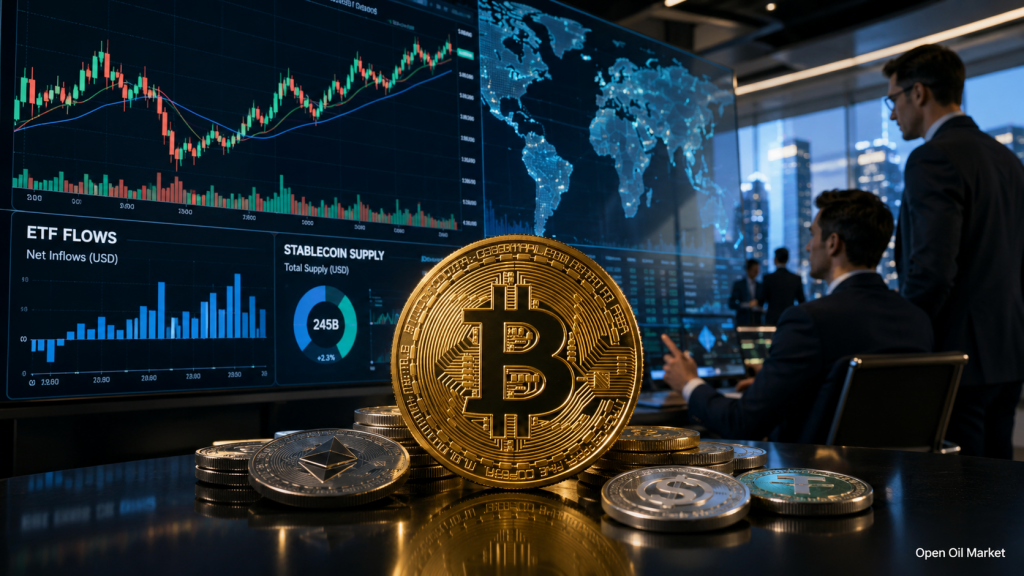
Current Cryptocurrency News for Wednesday, May 27, 2026: Bitcoin Around $77,000, Ethereum, Nasdaq Options, ETFs, Stablecoins, Crypto Funds, and Top 10 Digital Assets for Investors
As of Wednesday, May 27, 2026, the global cryptocurrency market is entering a phase of cautious recovery following a period of heightened volatility. Bitcoin is holding steady near the $77,000 mark, Ethereum is trading around $2,100, and investors are evaluating a number of factors: ETF dynamics, Wall Street's interest in derivative instruments for digital assets, the regulation of stablecoins, and the state of major altcoins.
For global investors, the cryptocurrency market now appears not as a monolithic speculative asset, but as a collection of different segments: Bitcoin remains a macro asset and indicator of risk appetite, Ethereum reflects demand for smart contract infrastructure, stablecoins are becoming part of the payment system, and individual altcoins are competing for capital through technological and institutional drivers.
Bitcoin: Market Holds Key Level Around $77,000
Bitcoin continues to be the benchmark for the entire cryptocurrency market. After experiencing a decline and the exit of some capital from crypto funds, the leading cryptocurrency has stabilized around $76,000 to $77,000. For investors, this is an important zone: it indicates that the market has not yet moved to a panic sell-off, but also does not display a sustainable momentum for rapid growth.
The primary scenario for the coming days is consolidation. Buyers are trying to defend the levels achieved after the recent recovery, while sellers are taking advantage of the rise to secure profits. At the same time, Bitcoin retains its dominant share in the cryptocurrency market, making it the main indicator of sentiment among institutional and retail investors.
Ethereum: Cautious Stabilization and Awaiting New Demand
Ethereum is trading around $2,100 and continues to lag behind Bitcoin in terms of recovery strength. This is an important signal for the market: investors are currently preferring more liquid and understandable assets rather than actively shifting into altcoins. However, Ethereum remains a key infrastructure for DeFi, asset tokenization, stablecoins, and smart contract-based applications.
The main question for Ethereum is whether institutional demand will return through investment products and funds. If the outflow from Ethereum funds slows down, it could support ETH and the entire altcoin sector. Conversely, if pressure persists, the market will continue to concentrate around Bitcoin and stablecoins.
Wall Street Expands Presence: Nasdaq Approved for Bitcoin Index Options
One of the most important events for the market has been the SEC's approval of Nasdaq's proposal for listing Bitcoin index options. For the cryptocurrency industry, this is not just a new trading tool but another step towards integrating digital assets into the traditional financial infrastructure.
For institutional investors, Bitcoin index options can serve as tools for hedging, managing volatility, and constructing more complex strategies. This is especially important for funds, family offices, and asset managers who already work with Bitcoin through ETFs but need regulated instruments for risk management.
- Bitcoin is becoming more accessible for professional strategies;
- regulated derivatives are increasing market liquidity;
- cryptocurrencies are more deeply integrated into the stock market infrastructure;
- institutional investors are gaining more hedging opportunities.
ETFs and Institutional Flows: Investors Become More Cautious
Despite the growing infrastructure, the cryptocurrency market is facing pressure from investment funds. In recent weeks, there has been a capital outflow from Bitcoin and Ethereum products, increasing market participants' caution. This does not indicate a withdrawal of institutional investors from cryptocurrencies, but it shows that capital has become more selective.
For investors, it is essential to distinguish between short-term outflows and long-term trends. In the short term, ETF flows can intensify the volatility of Bitcoin and Ethereum. In the long term, the very infrastructure of funds, options, and regulated products continues to strengthen the status of cryptocurrencies as a separate asset class.
Stablecoins: Tether, USDC, and New Competition from Digital Currencies
Stablecoins remain one of the strongest segments of the crypto market. Tether and USDC rank among the largest digital assets by capitalization and are used as a unit of account, liquidity storage tool, and basis for trading on exchanges. The increasing significance of stablecoins demonstrates that cryptocurrencies are gradually transitioning from a speculative market to a payment and settlement infrastructure.
Investor interest is particularly drawn to projects involving national and regional digital tokens. The launch of stablecoins tied to local currencies could intensify competition between private issuers, banks, and state financial systems. This is an important trend for the market: stablecoins are becoming not only a crypto instrument but also a part of the global discussion about the future of money.
Regulation: The USA, Europe, and Sanction Risks
Regulation remains a key factor for the cryptocurrency market in 2026. In the USA, work continues on rules for digital assets, stablecoins, crypto exchanges, and tokenized instruments. For investors, this has a dual effect: on one hand, regulation reduces uncertainty; on the other hand, it increases pressure on weak and opaque projects.
Sanction risks are also becoming an important part of the crypto agenda. Authorities in various countries are tightening control over cryptocurrency networks that may be used for circumventing restrictions, illegal settlements, or capital outflow. This raises the demands for compliance, operational transparency, and infrastructure quality.
Altcoins: The Market Chooses Liquidity and Real Use Cases
Altcoins remain a heterogeneous segment. Solana, BNB, XRP, TRON, Dogecoin, and Hyperliquid exhibit varying investment logic. Some projects gain due to payment scenarios and stablecoins, while others thrive based on exchange infrastructure, smart contracts, DeFi, or strong communities.
In the current phase, investors are becoming more discerning regarding altcoins. Simple marketing is no longer sufficient: the market evaluates liquidity, protocol revenue, user activity, transaction volumes, ecosystem resilience, and the likelihood of institutional demand. Consequently, capital is increasingly concentrating in major assets with a clear market role.
Top 10 Most Popular Cryptocurrencies by Market Capitalization
As of May 27, 2026, the largest digital assets by market capitalization remain at the forefront of investors’ attention. These assets shape the primary liquidity of the cryptocurrency market and are most often used by global investors to assess the health of the sector.
- Bitcoin (BTC) — the primary digital asset and foundational indicator of the crypto market.
- Ethereum (ETH) — the largest smart contract platform and foundation for DeFi and tokenization.
- Tether (USDT) — the largest stablecoin and key settlement instrument on crypto exchanges.
- BNB (BNB) — the token of the BNB Chain ecosystem and one of the largest exchange assets.
- XRP (XRP) — a digital asset associated with cross-border payments.
- USDC (USDC) — the second-largest dollar stablecoin with a strong institutional base.
- Solana (SOL) — a high-performance blockchain for applications, DeFi, and consumer crypto services.
- TRON (TRX) — a network actively used for transferring stablecoins.
- Dogecoin (DOGE) — the largest meme cryptocurrency with a strong community and high recognition.
- Hyperliquid (HYPE) — one of the most notable new assets in the top 10, reflecting market interest in DeFi infrastructure and trading protocols.
What Investors Should Focus on May 27, 2026
For investors, the upcoming days will be defined by a balance between macroeconomics, capital flows, and regulatory news. Bitcoin must confirm its ability to remain above the recent stabilization zone, Ethereum needs to show signs of renewed demand, and altcoins must prove their growth is based not only on short-term speculation.
Key factors to watch:
- Bitcoin's dynamics around the $77,000 level;
- Changes in flows into Bitcoin and Ethereum ETFs;
- Market reaction to the launch of new regulated instruments;
- Regulation of stablecoins and digital assets in the USA and Europe;
- Performance of major altcoins in the top 10;
- Liquidity and volatility levels on crypto exchanges.
The Crypto Market Enters a More Mature Yet Complex Phase
As of May 27, 2026, the cryptocurrency market appears more mature than in previous cycles, but this does not reduce the risks. Bitcoin remains the main asset for global investors, Ethereum retains its infrastructural significance, stablecoins enhance their role in settlements, and Wall Street continues to expand access to cryptocurrencies through regulated instruments.
The main characteristic of the current moment is caution. Investors are no longer purchasing the entire market indiscriminately; they are selecting liquid assets, understandable business models, and projects with institutional potential. Therefore, the near-term dynamics of cryptocurrencies will depend not only on Bitcoin's price but also on the quality of capital returning to digital assets.