Current Cryptocurrency News as of April 17, 2026: Bitcoin, Ethereum, Altcoins, ETFs, Stablecoins, and the Top 10 Most Popular Cryptocurrencies
The global cryptocurrency market approaches Friday, April 17, 2026, with a cautious equilibrium. After a volatile first quarter, the crypto market shows signs of stabilization: Bitcoin retains its leadership, Ethereum and major altcoins are trying to regain momentum, and the agenda is increasingly driven not only by prices but by institutional decisions. For investors, this is an important signal: the cryptocurrency sector is increasingly transforming from a speculative environment into a fully-fledged segment of global finance, where price dynamics are influenced by ETFs, cryptocurrency regulation, the development of stablecoins, and actions by major exchange and banking players.
Key Highlights of the Day
- Bitcoin remains the main indicator of sentiment in the global cryptocurrency market and maintains a high share of total market capitalization.
- Ethereum retains its status as the primary platform for smart contracts, but lags behind Bitcoin in trend strength.
- Institutional investments in cryptocurrencies are gaining new momentum through ETFs and transactions by traditional financial players.
- Cryptocurrency regulation is becoming a key topic in the U.S. and the U.K., reducing long-term uncertainty for the market.
- Stablecoins are strengthening their positions as a payment and liquidity infrastructure for the global digital market.
Bitcoin Remains the Main Market Benchmark
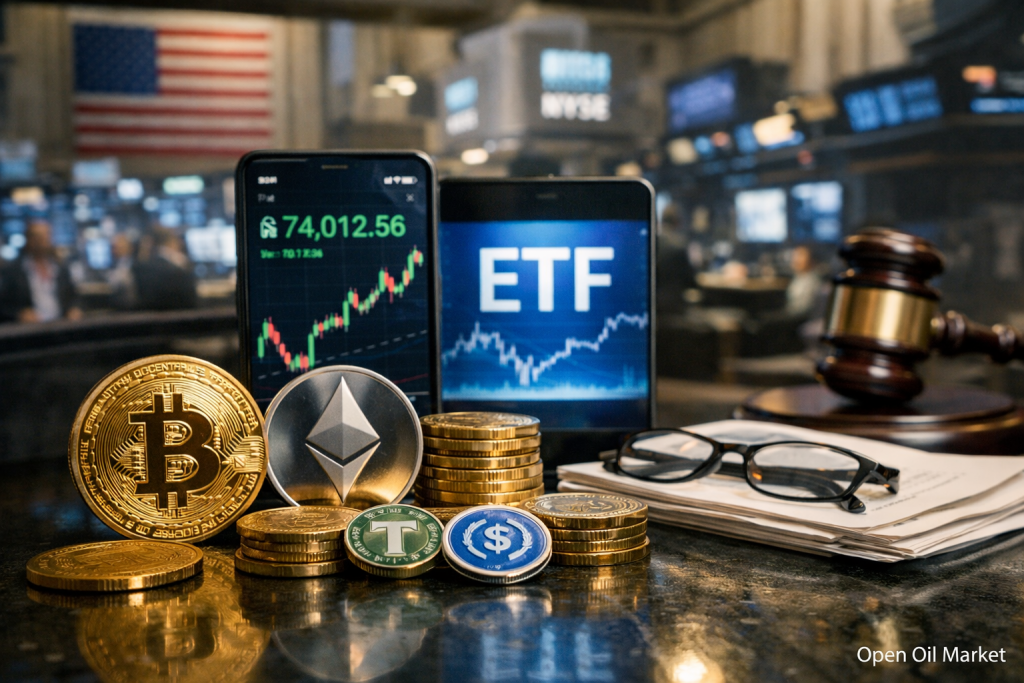
Investors continue to focus on Bitcoin, which sets the tone for the entire cryptocurrency market and dictates how sustainable demand for risk in digital assets can be. At the time of this review, Bitcoin is trading around $74,000, maintaining its leadership in capitalization and dominating most altcoins. For the world’s investor audience, this is an important signal: capital is not leaving the sector entirely but is concentrating in the most liquid and institutionally recognized asset.
Bitcoin's high dominance indicates that the cryptocurrency market has not yet returned to a broad speculative rally. On the contrary, capital is acting selectively. Market participants prefer the largest assets with clear liquidity, developed storage infrastructure, and access through exchange instruments. This makes Bitcoin not only the main asset of the crypto market but also a digital indicator of global risk appetite.
Ethereum and Major Altcoins Seek New Growth Points
Ethereum remains one of the key assets for investors; however, its dynamics appear more restrained than Bitcoin's. This reflects the current demand structure: the market recognizes Ethereum's fundamental importance for DeFi, tokenization, and smart contracts, but does not yet price in the same powerful protective status as BTC. For institutional participants, Ethereum remains a strategic asset in the second tier of the crypto market, especially given the interest in infrastructure blockchain solutions.
Among the largest altcoins, XRP, BNB, and Solana stand out. XRP benefits from sustained demand for cross-border payment scenarios and remains one of the most liquid assets outside the BTC/ETH pair. BNB maintains strong positions due to the large Binance ecosystem, while Solana remains one of the market's key bets on fast-growing infrastructure for applications and trading solutions. At the same time, TRON and Dogecoin confirm that liquidity in the market is distributed not only in favor of technological stories but also recognizable, heavily traded assets.
Institutional Capital Shifts the Demand Structure Again
One of the main news stories in the cryptocurrency agenda is the growing role of traditional financial institutions. The market is increasingly integrating into classic financial architecture through ETFs, custodial services, regulated trading platforms, and partnerships with major exchange groups. This is no longer a peripheral topic; it is one of the key factors shaping the evaluation of the cryptocurrency market in 2026.
For investors, it is particularly important that the launch and expansion of ETF products for Bitcoin and other digital assets continue to change the demand structure. The focus is not only on the prices themselves but also on the quality of capital entering the sector. Whereas previously market growth was often fueled primarily by retail speculation, banks, asset managers, and institutional platforms are playing an increasingly important role now. This enhances market maturity, though it also makes it more susceptible to macroeconomic factors, interest rates, and overall global risk.
Additional significance comes from the deepening ties between the traditional exchange industry and the crypto sector. When major infrastructural players enter the capital of crypto exchanges or expand joint projects in the realm of regulated digital assets, the market receives an important long-term signal: the institutionalization of cryptocurrencies continues even amid unstable price dynamics.
Cryptocurrency Regulation Becomes a Global Driver
Another defining theme for the cryptocurrency market is the acceleration of the regulatory agenda. In the U.S. and the U.K., the crypto market is increasingly moving towards a more formalized control model. For short-term trading, this could mean increased sensitivity to political headlines; for long-term investors, it signals a reduction in legal uncertainty that previously hindered broader institutional demand.
Current discussions in the U.S. are focused around rules for digital assets and stablecoins. This is crucial for the global industry as the U.S. sets the tone for the largest ETFs, custodians, public companies, and exchange providers. If the regulatory architecture is refined, the market could gain a new fundamental driver. Conversely, if the process drags on again, cryptocurrencies will remain hostage to the political cycle and debates over the boundaries of the banking and digital financial sector.
In the U.K., the regulatory line is also becoming more specific. This creates a favorable long-term backdrop for the global market, as major financial jurisdictions gradually cease to view cryptocurrencies as a temporary phenomenon and move towards detailed regulation of trading platforms, storage, staking, and the issuance of individual digital instruments.
Stablecoins Evolve into Infrastructure for the Global Crypto Market
If a few years ago stablecoins were seen primarily as a supporting element for trading, now they are becoming a full layer of financial infrastructure. A significant portion of liquidity in the crypto market now flows through stablecoins, along with a growing share of settlements, cross-exchange transfers, and digital payment scenarios. For the global market, this is one of the most important shifts of 2026.
From an investment perspective, the growing role of stablecoins indicates two things. First, the cryptocurrency market is becoming more deeply embedded in payment and banking logic. Second, the struggle over the regulatory framework for stablecoins is becoming a matter not just of regulation but of control over future digital liquidity. Thus, investors need to monitor not only Bitcoin and Ethereum but also how capital is distributed among USDT, USDC, and other major stablecoins.
Why the Market Remains Cautious
Despite the positive news in cryptocurrency and institutional moves, the crypto market does not appear to be unquestionably bullish. The first quarter of 2026 showed that the market remains vulnerable to geopolitical factors, fluctuations in global risk appetite, and capital outflows from more volatile segments. This means that the growth of cryptocurrencies in the coming weeks will depend not only on internal industry news but also on the state of global stock markets, bond yields, the dynamics of the dollar, and overall uncertainty levels.
This is why the current phase looks less like a classic rally and more like a process of reassessment. The market is testing which assets can genuinely hold capital within the new architecture of digital finance. Currently, Bitcoin, the largest stablecoins, and a limited circle of liquid altcoins are in the lead. For investors, this means a need for greater selectivity and a departure from the previous approach, where the entire market rose in synchrony.
What Investors Should Watch on April 17
- Bitcoin Dynamics: Will BTC maintain its leadership and dominance, or will the market start reallocating liquidity to Ethereum and other altcoins?
- ETF Agenda: Any new signals regarding ETFs and products from major banks will influence institutional expectations.
- Cryptocurrency Regulation: Comments emerging from the U.S. and the U.K. can quickly alter market sentiment.
- Stablecoins: The dynamics of the largest stablecoins increasingly show how liquidity is redistributed within the market.
- State of Altcoins: The stability of Solana, XRP, BNB, and TRON will indicate whether the market is ready for a broader recovery.
Top 10 Most Popular Cryptocurrencies
As of the time of this review, the following assets comprise the most popular cryptocurrencies by market capitalization:
- Bitcoin (BTC) — approximately $73,999. The main asset of the crypto market and primary indicator of institutional demand.
- Ethereum (ETH) — approximately $2,307. The foundational infrastructure platform for smart contracts and DeFi.
- Tether (USDT) — approximately $1.00. The largest stablecoin and key source of liquidity in the global crypto market.
- XRP (XRP) — approximately $1.40. One of the main liquid altcoins with a strong payment history.
- BNB (BNB) — approximately $618.65. The systemic asset of the largest crypto exchange ecosystem.
- USDC (USDC) — approximately $0.9997. One of the main regulated stablecoins.
- Solana (SOL) — approximately $84.88. A key market bet on fast blockchain infrastructure.
- TRON (TRX) — approximately $0.3278. A strong asset in the segment of network transfers and stablecoin liquidity.
- Dogecoin (DOGE) — approximately $0.0953. Maintains mass recognition and stable market liquidity.
- Hyperliquid (HYPE) — approximately $44.54. One of the notable new major assets amidst rising interest in trading infrastructure.
For Investors
As of Friday, April 17, 2026, the cryptocurrency market remains in a transitional phase. This is no longer a crypto market where sentiment is solely driven by retail hype. Institutional investments, ETFs, cryptocurrency regulation, and the struggle for control over stablecoin infrastructure are now coming to the forefront. For investors, this means that cryptocurrencies are becoming more deeply integrated into the global financial system, and thus evaluating the market should now extend beyond volatility to include capital structure, regulatory quality, and demand resilience.
In the short term, attention remains focused on Bitcoin, Ethereum, and the largest altcoins. In the medium term, decisive factors will be regulatory clarity, ETF development, and further convergence of traditional finance with digital assets. These processes are shaping the new investment map of the global cryptocurrency market.