Cryptocurrency News, Saturday, April 18, 2026: Bitcoin Maintains Leadership as Wall Street Intensifies Focus on Digital Assets
The cryptocurrency market heads into April 18 in a more composed state compared to the previous week. Following a volatile start to the month, investors are refocusing on the largest assets, with institutional demand, the development of exchange products, competition within the stablecoin market, and expectations for clearer regulation becoming the main themes for the global market. For investors, this signifies a transition from speculative momentum to a phase of more selective positioning, where capital favors liquid and infrastructurally significant coins.
Key Trends in the Crypto Market as of April 18, 2026
The Market Enters the Weekend with a Focus on Quality and Liquidity
As the weekend approaches, cryptocurrencies maintain their status as one of the most sensitive segments of the global risk-on market. Amid improving sentiments in global assets and declining panicked expectations surrounding geopolitics, investor attention is once again shifting towards the largest digital assets. This is an important signal: the market does not display unqualified euphoria, but neither is it returning to a phase of capitulation. Instead, market participants are selecting cryptocurrencies that possess:
- high liquidity;
- sustained institutional demand;
- clear infrastructure for storage and trading;
- a role in the future digital financial system.
Consequently, Bitcoin, Ethereum, major stablecoins, and the most recognizable first-tier altcoins remain in the spotlight.
Bitcoin Remains the Main Benchmark for the Global Crypto Market
Bitcoin continues to set the overall direction for the entire cryptocurrency market. Its role is particularly pronounced at this moment: investors view BTC not merely as a speculative asset, but as a primary indicator of capital's outlook on digital assets overall. The strengthening of Bitcoin's dominance suggests that the market is not yet ready for a wide-ranging and aggressive rally across the altcoin spectrum. Conversely, capital is first consolidating in the most understood and institutionally recognized asset.
For investors, this leads to two conclusions. Firstly, Bitcoin remains the first choice for large portfolios when the market starts to recover post-correction. Secondly, Bitcoin's resilience above key levels becomes an important psychological factor for Ethereum, Solana, XRP, and other major coins. As long as Bitcoin retains its leadership, the market maintains a chance for a gradual expansion of demand for riskier segments.
Ethereum and Major Altcoins Get a Chance for Gradual Capital Rotation
Ethereum ranks as a key beneficiary in the current demand structure. While Bitcoin is perceived as a basic digital reserve, Ethereum remains an infrastructure asset for DeFi, tokenization, smart contracts, and new financial applications. In this context, interest in ETH appears more fundamental than in most second-tier altcoins.
Among the major altcoins, market focus also includes:
- XRP — as a leading payment and cross-border asset in discussions about future transactions;
- Solana — as a high-speed network with strong retail and ecosystem support;
- BNB — as a token closely associated with the largest cryptocurrency infrastructure;
- TRON — as a network with a strong role in the stablecoin economy;
- Dogecoin and Cardano — as indicators of broader interest in altcoins.
However, the current phase still does not appear as a full-fledged alt season. It is rather a cautious expansion of interest in quality coins following the resurgence of demand for market leaders.
Wall Street Intensifies Presence in Cryptocurrencies
One of the most significant themes for the cryptocurrency market in mid-April is the continuing movement of traditional financial institutions toward digital assets. This is no longer a story of external observation. Major players are directly expanding their range of crypto products and access infrastructure for clients.
Three signals are particularly noteworthy for the market:
- Major financial groups continue to launch and promote Bitcoin ETFs;
- Traditional brokers are preparing for direct trading of the largest cryptocurrencies for retail clients;
- Digital assets are increasingly being integrated into the familiar investment architecture alongside stocks, bonds, and ETFs.
This shift is significant not only from a marketing perspective. It creates a more sustainable channel for capital inflow into cryptocurrencies, increases trust among conservative investors, and makes the market less marginal in the eyes of the global financial system.
Stablecoins Evolve into a Field of Global Monetary Competition
Where stablecoins were once primarily viewed as a technical tool within crypto exchanges, they are now becoming a geo-economic theme. The competition is no longer just among issuers, but between currency zones, payment systems, and financial blocs.
The most important takeaway for investors is that the stablecoin market is becoming one of the key areas for the next stage of cryptocurrency industry development. Against this backdrop, interest in dollar-based solutions is increasing, discussions about the expansion of euro-stablecoins are underway, and in Asia, the topic of currency tokens aimed at cross-border settlements is gaining momentum.
This elevates the strategic importance of assets like USDT and USDC, as well as strengthening the role of networks through which the majority of stablecoin transactions occur.
Regulation Remains Both a Driver and a Limiter
The cryptocurrency market today exists in two realities. On one hand, institutional adoption is strengthening. On the other, the final regulatory architecture is still unfinished. This is why any progress in regulation could serve as an additional growth driver, while any delays may exert pressure on valuations.
For global investors, three areas are particularly significant:
- The legal status of digital assets and the delineation between securities and commodities;
- Rules for stablecoins and digital payment instruments;
- Access for banks, brokers, and asset management companies to crypto infrastructure.
As long as the crypto market has not gained full clarity on these issues, large capital will move cautiously, preferring the largest and most transparent coins.
Top 10 Most Popular Cryptocurrencies in the Spotlight for Investors
As of the evening of April 17, the following assets remain at the center of the global cryptocurrency market:
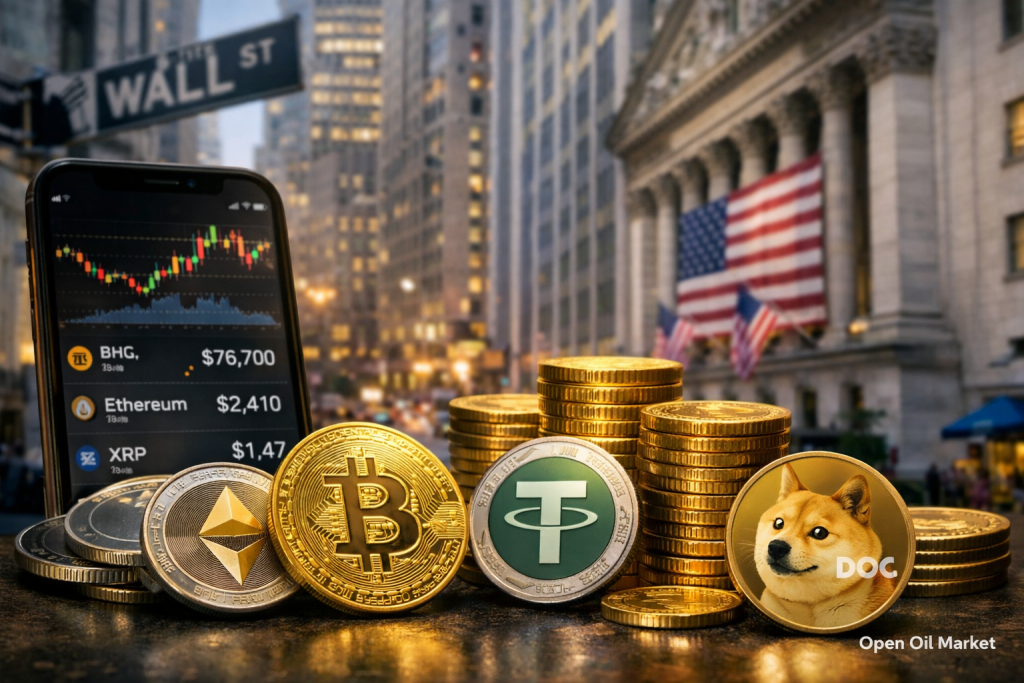
- Bitcoin (BTC) — approximately $76,700;
- Ethereum (ETH) — approximately $2,410;
- Tether (USDT) — approximately $1;
- XRP (XRP) — approximately $1.47;
- BNB (BNB) — approximately $640;
- USD Coin (USDC) — approximately $1;
- Solana (SOL) — approximately $90;
- TRON (TRX) — approximately $0.324;
- Dogecoin (DOGE) — approximately $0.101;
- Cardano (ADA) — approximately $0.264.
This group of assets contributes to the primary informational backdrop, determines the liquidity of the cryptocurrency market, and frequently becomes the object of attention for both retail and institutional investors.
What This Means for Investors on April 18
As of April 18, the cryptocurrency market appears as a system where short-term news impulses are increasingly intertwined with long-term institutional restructuring. The main idea at this moment is not that the market has entered into an unconditional rally, but rather that its structure is maturing. Bitcoin holds its status as the market core, Ethereum continues to play a fundamental role in digital infrastructure, and stablecoins are transforming into a strategic instrument for global transactions.
For investors, this signals the need to focus not only on price movements but also on the architecture of demand. The near-term focus will remain on:
- The dynamics of Bitcoin and Ethereum as indicators of institutional trust;
- The expansion of access to cryptocurrencies through traditional brokers and ETFs;
- The competition surrounding stablecoins and future digital transactions;
- The speed of regulatory decisions in major jurisdictions.
These factors will not only shape cryptocurrency news in the coming days but also influence the broader trend of the digital asset market in the second quarter of 2026.