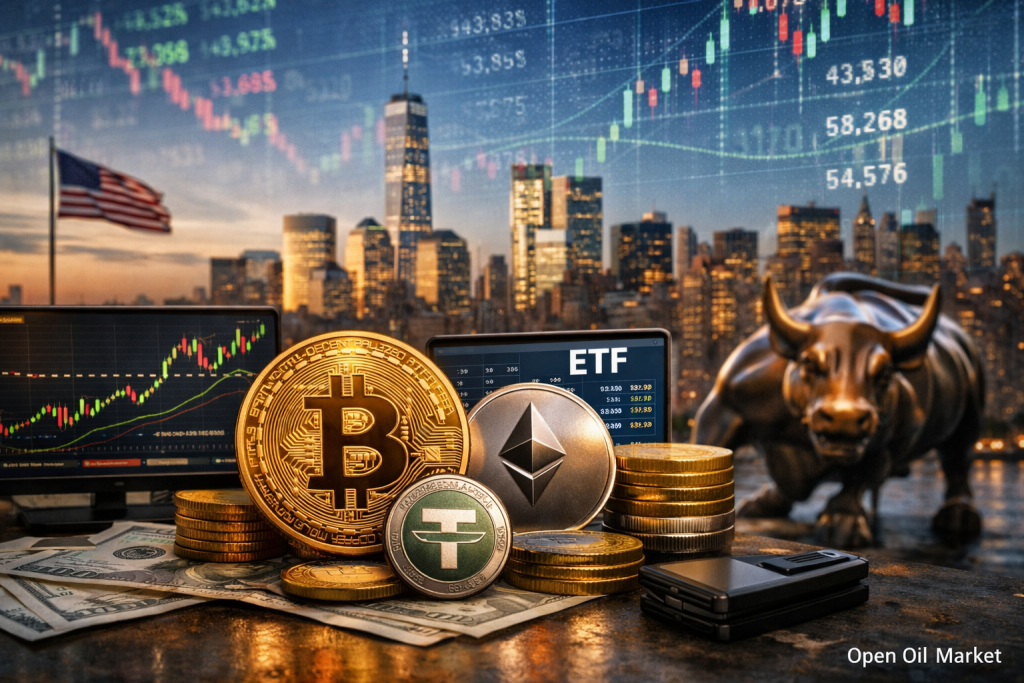
Current Cryptocurrency News as of April 3, 2026: Bitcoin, Ethereum Market Analysis and the Top 10 Digital Assets with a Focus on Global Trends and Institutional Demand
Early April reveals that cryptocurrencies remain closely tied to global risk appetite. Following a brief recovery attempt in March, the digital asset market has shifted to a new phase of caution. Cryptocurrency pressure has intensified amid a tense geopolitical situation and deteriorating sentiment in global stock markets.
This is an important signal for investors: Bitcoin has long ceased to be solely an alternative store of value and increasingly behaves as part of a global portfolio of risk assets. This means that cryptocurrency dynamics in the short-term horizon depend not only on industry news but also on macroeconomics, liquidity, interest rate expectations, and geopolitical risks.
- Bitcoin remains the primary risk indicator in the digital asset sector;
- Ethereum and major altcoins move in sync with overall market sentiment;
- The correlation of the crypto market with traditional assets remains significant for institutional investors.
Bitcoin Remains the Center of Liquidity and the Focus of Institutional Investment
Even amidst volatility, Bitcoin maintains its status as the main asset of the cryptocurrency market. It is still around this asset that the largest capital flows concentrate, capturing the attention of management companies and significant investors. Bitcoin's market dominance confirms that in 2026, institutional capital prefers to enter cryptocurrencies through the most liquid and understandable instrument.
This does not exclude interest in other digital assets, but it underscores a key market reality: during periods of instability, capital tends to flow into the largest and structurally mature cryptocurrencies. For global investors, Bitcoin remains the primary indicator of how prepared the market is for the next growth phase.
Ethereum Holds a Strategic Role, but the Market Awaits New Catalysts
Ethereum retains its second position in the global cryptocurrency economy and remains the primary infrastructure asset for smart contracts, tokenization, DeFi, and part of institutional solutions. However, at the beginning of April, the market evaluates Ethereum more cautiously than during periods of strong speculative growth.
Investors are increasingly viewing Ethereum not only as a price growth object but also as a foundation for a broader class of digital financial services. This makes it a significant asset in strategic portfolios, but simultaneously raises the requirements for fundamental drivers: network activity, development of real use cases, and growth of the fee base.
- Ethereum maintains a critical role in the infrastructure of the crypto market.
- Institutional interest in it remains high but more selective.
- The further dynamics of ETH largely depend on actual network activity and the expansion of the product lineup around the ecosystem.
Regulation Takes Center Stage and Alters Crypto Asset Valuation
One of the most important topics for the cryptocurrency market remains regulatory clarity. In the U.S., investor attention is focused on the development of a legislative framework for digital assets and new interpretations of rules by regulators. This is of fundamental significance for the global market, as the American regulatory landscape continues to set the standard for risk assessment, capital admission, and future institutional integration.
In 2026, the market is increasingly responding less to abstract promises and more to specific legal frameworks. The clearer the regulations governing digital assets become, the higher the willingness of major players to expand their presence in the sector. This is especially crucial for exchanges, custodians, ETF issuers, market makers, and banking platforms exploring tokenized products.
ETFs and Institutional Flows Remain the Main Mid-Term Catalysts
Despite short-term nervousness, the cryptocurrency market continues to closely watch the exchange-traded fund (ETF) sector. ETFs remain the primary bridge between traditional capital and digital assets. Even amid heightened volatility, this infrastructure defines how sustainable the next phase of cryptocurrency market growth will be.
For investors, the key fact is that interest in cryptocurrencies from the traditional financial sector has not disappeared. On the contrary, it is becoming more systemic. We are no longer discussing one-time speculative flows, but rather a gradual institutionalization of the crypto market through regulated products, custodial solutions, and integration into traditional investment mandates.
- ETFs support the legitimacy of cryptocurrencies in the eyes of global capital;
- Bitcoin remains the main beneficiary of institutional flows;
- Interest in Ethereum and other major assets depends on the depth of regulation and product liquidity.
Stablecoins Strengthen Their Position as a Separate Strategic Segment
The growing role of stablecoins deserves individual attention. By 2026, they are perceived not only as a technical instrument for settlements within crypto exchanges but also as a standalone infrastructural layer of the global digital asset market. The expansion of the dollar stablecoin segment enhances liquidity, simplifies international settlements, and increases the velocity of capital movement between cryptocurrencies and the fiat system.
For investors, this means that the cryptocurrency market is becoming more mature and functional. Stablecoins reduce transaction barriers, accelerate entry and exit from positions, and strengthen the cross-border nature of the industry. In an environment of global uncertainty, this segment could prove to be one of the most resilient in terms of infrastructural demand.
Top 10 Most Popular Cryptocurrencies: What the Market is Watching
At the time of this article's preparation, the largest digital assets by capitalization and market significance are at the forefront of investor attention. These cryptocurrencies set the liquidity, sentiment, and distribution of global capital within the cryptocurrency sector.
- Bitcoin (BTC)
- Ethereum (ETH)
- Tether (USDT)
- XRP
- BNB
- USDC
- Solana (SOL)
- TRON (TRX)
- Dogecoin (DOGE)
- UNUS SED LEO (LEO)
This list demonstrates a significant shift in the structure of the cryptocurrency market. Within the top ranks, there are:
- Classic investment assets — Bitcoin and Ethereum;
- The largest stablecoins — USDT and USDC;
- Infrastructure and payment tokens — XRP, BNB, TRON;
- Speculatively popular assets with strong communities — Dogecoin.
For the global investor, this means that the cryptocurrency market is no longer a homogeneous story. It consists of several thematic baskets: digital gold, blockchain infrastructure, stablecoins, payment solutions, and community assets.
What This Means for Investors on April 3, 2026
The main takeaway for Friday, April 3, 2026, is that the cryptocurrency market is not facing an idea crisis, but rather a phase of risk reevaluation. On one hand, short-term pressure is created by geopolitics, volatility in global markets, and investor caution. On the other hand, structural drivers in the industry remain intact: institutionalization, ETF development, the strengthening role of stablecoins, gradual regulatory clarification, and the continued high significance of Bitcoin and Ethereum.
For investment strategy, this provides several guidelines:
- Bitcoin remains a foundational asset for assessing the overall state of the cryptocurrency market;
- Ethereum retains strategic value but requires a more fundamental approach;
- Major cryptocurrencies appear more resilient during periods of external turbulence than the speculative segment;
- Regulatory news and institutional flows continue to have a decisive impact on the market valuation of digital assets.
If external tensions ease, cryptocurrencies may quickly regain momentum. Conversely, if global risk-off conditions persist, the market will likely continue to concentrate around the most liquid and structurally significant digital assets. This is why investors should pay attention not only to Bitcoin's price but also to the health of the entire institutional framework within the cryptocurrency market.