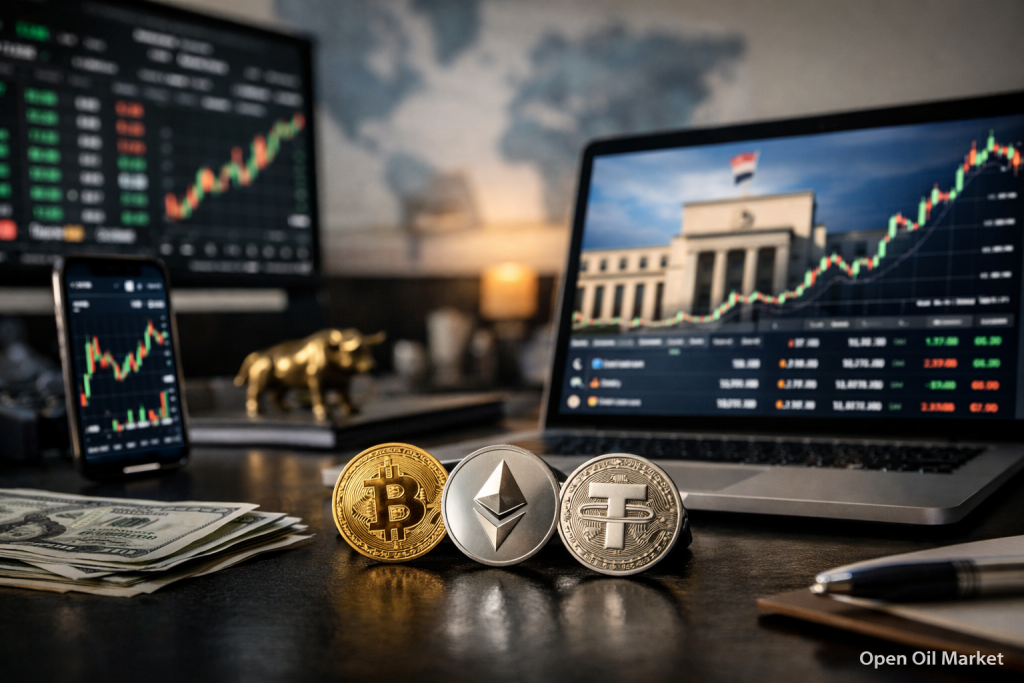
Current Cryptocurrency News as of April 4, 2026, with Analysis of Bitcoin, Ethereum, Macroeconomics, and Key Market Trends
Bitcoin remains the main benchmark for investors managing capital in digital assets. The behavior of the leading cryptocurrency dictates whether the market is prepared to extend risk in favor of Ethereum, Solana, XRP, and other major coins, or if it prefers to concentrate on the most liquid and institutionally recognized asset.
At this stage, the market exhibits several important signs:
- Capital continues to gravitate toward the largest cryptocurrencies;
- The share of Bitcoin in the overall market structure remains high;
- Investors are cautiously increasing positions following March's stabilization;
- Altcoins are rising selectively, rather than broadly, as happens in a full speculative rally phase.
For investors, this is an important signal. When Bitcoin maintains its leadership and the market does not transition into a state of unconditional excitement across the entire spectrum of tokens, it usually indicates a more mature and selective phase of the cycle. In other words, capital in the market is present, but it is being allocated cautiously.
The Macroeconomics of the U.S. Underscores Cryptocurrency Movements
Recent macroeconomic data from the U.S. has amplified the impact of traditional financial factors on the cryptocurrency market. A strong employment report has prompted the market to reassess the trajectory of the Federal Reserve's interest rates and, consequently, the liquidity prospects for risk assets globally.
This has direct implications for cryptocurrencies for several reasons:
- Tighter rate expectations limit aggressive capital inflows into risk assets;
- A strong dollar typically complicates momentum growth for certain digital assets;
- Rising yields and nervousness in global markets increase Bitcoin and Ethereum's sensitivity to external factors;
- Investors are increasingly viewing cryptocurrencies not in isolation but as part of a broader capital allocation framework.
Hence, today's agenda for digital assets encompasses not just blockchain, exchanges, and tokens, but also inflation, employment, rates, oil, the dollar, and global monetary conditions.
Regulatory Topics Remain Key for Sector Assessment
The cryptocurrency market continues to closely monitor legislative initiatives in the U.S., as the American regulatory architecture can significantly impact the sector's valuation worldwide. For institutional investors, predictable rules of the game, rather than mere slogans supporting the industry, are what matter.
The attention remains focused on:
- The delineation of powers among various regulators concerning digital assets;
- The legal status of stablecoins;
- Disclosure requirements, platform registration, and investor protection;
- Conditions under which certain tokens may be perceived as digital goods rather than investment contracts.
This is critical for the entire cryptocurrency market. The clearer the regulatory framework, the higher the likelihood of sustained participation from banks, funds, payment companies, and large brokerage platforms. For Bitcoin, this is a factor of institutional demand; for Ethereum and ecosystem coins, it is a factor of expanding infrastructural use; and for stablecoins, it is a legitimization factor as a payment instrument.
Stablecoins Emerge as a Separate Strategic Market Segment
Previously viewed primarily as a service layer for crypto exchanges, stablecoins have significantly broadened in scope. They are becoming a key element of the global digital payment infrastructure as well as an important bridge between traditional finance and the blockchain economy.
Investors should consider several trends:
- The growing significance of dollar stablecoins is driving demand for blockchain settlement infrastructure;
- Regulation of stablecoins is becoming part of financial policy, not just crypto policy;
- Payment scenario ecosystems, tokenization, and cross-border settlement initiatives are gaining additional momentum;
- The durability of major stablecoins increasingly influences large-cap perceptions of the cryptocurrency market.
Practically, this means that the stablecoin segment can no longer be considered a secondary market. It impacts turnover, liquidity, trading activity, and market depth no less than price movements of major tokens.
Ethereum Retains Its Status as a Key Infrastructure Asset
Ethereum remains the second most significant asset in the cryptocurrency market, but for investors, its role extends beyond that of just being altcoin #1. It serves as a foundational infrastructure layer for DeFi, tokenization, smart contracts, asset issuance, and numerous applied blockchain models.
The current market logic surrounding Ethereum pivots around three key questions:
- How quickly will user and transaction activity recover?
- What volume of capital will flow into infrastructure products surrounding the network?
- Will the market perceive Ethereum as undervalued in relation to Bitcoin in the new phase of the cycle?
For the global investor, this means that Ethereum is not merely a speculative asset but a bet on the development of digital financial infrastructure. However, unlike Bitcoin, which is increasingly viewed as the most secure and institutionally credible asset, Ethereum demands a more nuanced assessment: technological parameters and real network usage dynamics are critical.
Top 10 Most Popular Cryptocurrencies: Insights from the Global Market
In terms of global investment interest and liquidity, the following cryptocurrencies remain in focus:
- Bitcoin (BTC) — the main indicator of sentiment and liquidity within the sector;
- Ethereum (ETH) — the basic infrastructure asset for smart contracts;
- Tether (USDT) — the key stablecoin for settlements and trading flows;
- XRP (XRP) — one of the most discussed assets for cross-border settlements;
- BNB (BNB) — an important ecosystem coin with a large user base;
- USD Coin (USDC) — one of the main dollar stablecoins perceived as regulated;
- Solana (SOL) — the largest high-speed network with a strong speculative and infrastructural agenda;
- TRON (TRX) — a notable player in the transaction and stablecoin segment;
- Dogecoin (DOGE) — a highly liquid speculative asset with strong retail attention;
- Cardano (ADA) — a major platform that maintains interest from long-term audiences.
This list is crucial not only for observation but also for risk management. Significant capital liquidity is concentrated in these assets, meaning they respond first to changes in capital flows, ETF sentiment, regulatory expectations, and central bank agendas.
Institutional Demand for Cryptocurrencies: Current Trends
Following a turbulent and volatile phase, the market is again attempting to gauge whether sustainable institutional demand has returned. This question will determine whether cryptocurrency movements will be lasting or merely a technical rebound.
Currently, the constructive scenario is supported by the following factors:
- Interest in exchange-traded products based on digital assets remains strong;
- Bitcoin is increasingly viewed as a distinct class of highly liquid alternative assets;
- Major financial institutions continue to explore tokenization and digital market infrastructure;
- Stablecoins and blockchain settlements are becoming more deeply integrated into strategic planning in the financial sector.
However, institutional capital remains sensitive to monetary policy, regulation, and political risks. Therefore, cryptocurrency growth in 2026 looks more rational than in classic retail euphoria phases: the market demands confirmation through numbers, flows, and regulatory clarity.
Main Risks for Investors This Weekend
Despite a notable improvement in sentiment compared to the most nervous periods of the first quarter, the cryptocurrency market remains vulnerable to external shocks. For investors worldwide, the following risks are critical in the coming days:
- Sudden changes in expectations regarding Federal Reserve rates;
- Strengthening dollar and deteriorating conditions for global liquidity;
- Escalating geopolitical tensions and fluctuations in commodity markets;
- New regulatory disputes surrounding digital assets and stablecoins;
- Weakness in altcoins while Bitcoin remains strong.
In such a market, it is especially important for investors to distinguish between short-term trading impulses and mid-term investment trends. The rise of individual tokens does not necessarily indicate sustainable market expansion. True confirmation of sector strength will come from collective improvements in flow structures, market breadth, and the quality of institutional demand.
Implications for Global Investors
As of April 4, 2026, the cryptocurrency market appears significantly more mature than in previous cycles. It no longer solely thrives on internal industry narratives. Bitcoin, Ethereum, stablecoins, ETF flows, and major altcoins are now integrated into the global financial agenda.
The key takeaway for investors is:
- Bitcoin remains the primary barometer of the cryptocurrency market's resilience;
- Ethereum retains its infrastructure core status within the digital economy;
- Stablecoins are becoming a systemically important segment;
- Regulation in the U.S. and major financial jurisdictions will directly impact market assessments;
- Top cryptocurrencies maintain priority over more risky peripheral segments.
Therefore, the strategy for the near term for most participants in the global market remains selective. Investors are monitoring not only the price of Bitcoin or Ethereum but also verifying whether the current resilience is fundamentally supported: through flows, regulation, institutional participation, and quality of liquidity. While the market provides grounds for a cautiously constructive outlook, a full acceleration still requires new confirmations.