Cryptocurrency News for February 24, 2026: Bitcoin Under Pressure from Global Risk-Off, Market Volatility, Ethereum and Altcoin Dynamics, Institutional Flows, and Key Risks for Investors.
The cryptocurrency market enters Tuesday in a state of heightened volatility: investors are simultaneously digesting global asset risk-off sentiments, short-term capital flows between BTC and altcoins, and cues from exchange liquidity and derivatives. For investors, the key question over the coming sessions is whether the current drawdown will continue as part of a broader decline or if the market will establish technical stabilization amid partial buybacks and reduced leverage.
Market Sentiment: Why Risk-Off Dominates Again
The main driver in recent hours has been a deterioration in risk appetite across global asset classes. In such an environment, cryptocurrencies often behave like high-beta assets: sell-offs are exacerbated by margin positions, and recoveries depend on how quickly flows and volatility normalize. Practically, this leads to two effects: (1) increased importance of technical levels and liquidations, (2) heightened sensitivity to macro news and headlines.
- Short-term: the dynamics of derivatives (liquidations, funding, open interest) are more critical than the “fundamental” agenda.
- Medium-term: the market will reassess the resilience of institutional capital inflows and the behavior of long-term holders.
Bitcoin: Headline Pressure + Liquidation Mechanics
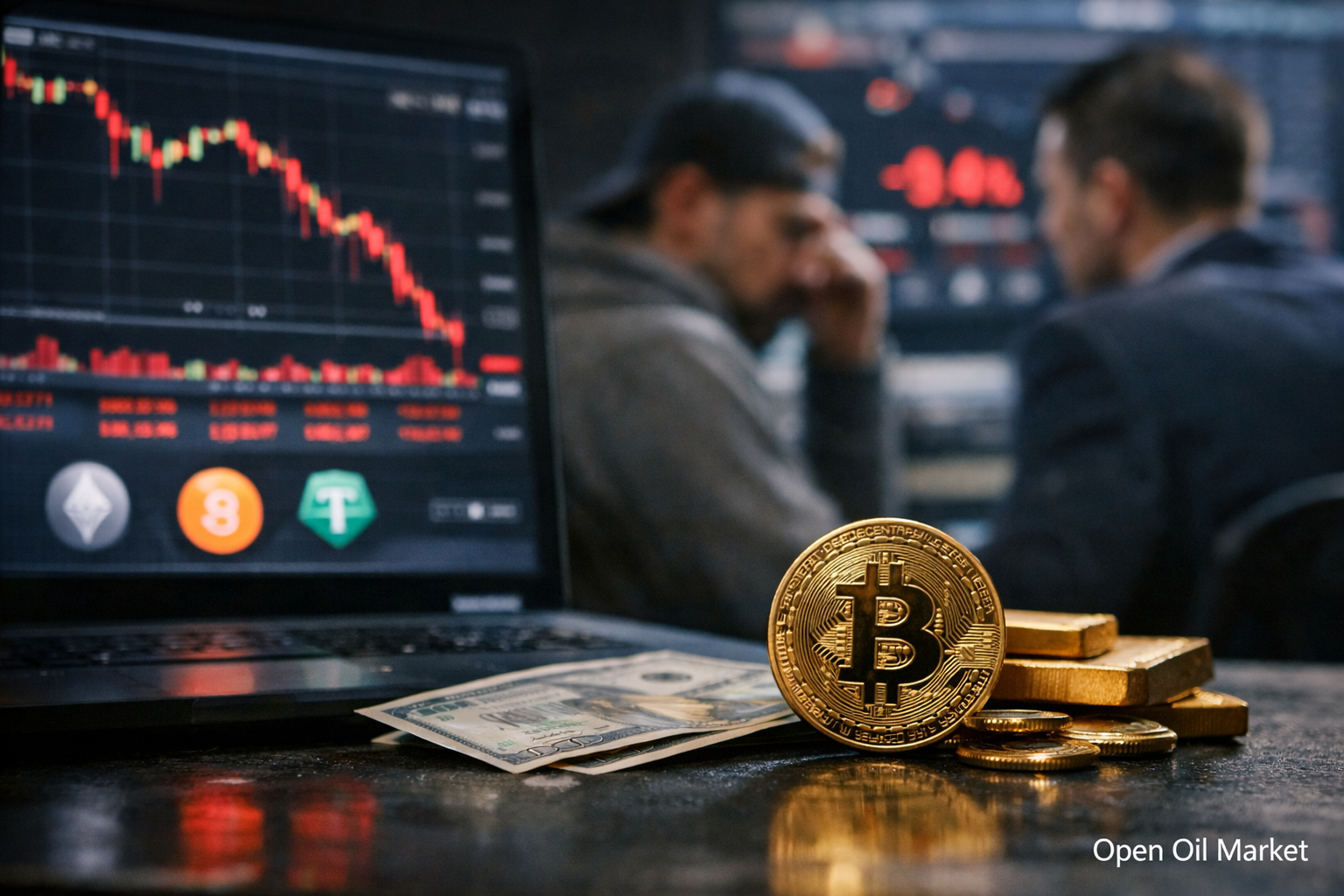
Bitcoin showed a sharp decline at the start of the week, dipping below psychologically significant levels, after which part of the movement was mechanically exacerbated through a cascade of liquidations and reduced leverage. For the investor, this signals an important consideration: when movement is explained not only by news but also by market structure, the reverse movement (stabilization/rebound) can also be swift—if the pressure from liquidations subsides.
- Trigger: a surge in uncertainty around the trade/tariff agenda and an overarching tendency towards defensive assets.
- Accelerator: forced closures of long positions and increased selling amid heightened volatility.
- Risk Marker: heightened concentration of liquidity near round levels, where stop-loss orders and margin positions are often targeted.
The strategy for a portfolio investor in such phases typically involves strict risk discipline: avoid chasing momentum, watch for signs of exhaustion in selling (decrease in liquidation pace, stabilization of funding), and differentiate horizons (speculative/investment).
ETFs and Capital Flows: What Investors Should Monitor
The theme of flows through exchange-traded products remains one of the central indicators of the "institutional thermometer." When flows turn negative, the market often shifts into "capital preservation" mode, and recovery requires either an improvement in external conditions or the emergence of a local catalyst (e.g., stabilization of macro risks or a shift in positioning).
- If outflows accelerate: volatility generally persists, and rebounds become more “technical” and short-lived.
- If outflows decelerate: the likelihood of base formation and a return of spot demand increases.
- If flows are neutral: the market tends to shift towards internal drivers—L2/DeFi/protocol upgrades and sector rotations.
Exchange Liquidity and Participant Behavior: Why It Matters
In times of stress, traders closely monitor exchange balances and signs of preparing for sales/purchases. An increase in available supply on exchanges can signal bearishness, but interpretation always depends on context: part of the movements may be collateral for derivatives, while others may be preparing for rebalancing.
Practical approaches for investors include:
- Correlating exchange metrics with derivatives (liquidations, open interest)—this reduces the risk of misinterpretation.
- Assessing the "quality" of recoveries: a rise on declining volume and without improvements in market structure is often fragile.
- Not overvaluing single signals: in crypto, a "basket of indicators" tends to be more reliable than a single metric.
Ethereum: Institutional Interest, Staking, and Infrastructure Competition
Ethereum remains the foundational infrastructure for Web3 and tokenization, but competition is intensifying: traditional financial consortiums and corporate initiatives periodically attempt to build their own networks and standards. For the market, this sends mixed signals. On one hand, recognition of the technology’s value supports a long-term narrative. On the other hand, some activity may shift to private/permitted frameworks, altering the distribution of fees and demand for public blockchains.
- Staking Factor: large holders and corporate structures are increasing their staking positions, raising the relevance of yield and operational risks (slashing, counterparty risk, regulatory interpretations).
- Ecological Factor: demand for L2 and modular solutions continues to form a “second layer” economy around ETH.
- Competition Factor: in a weak market, capital becomes more discerning regarding usage metrics (fees, active users, TVL, revenue stability).
Altcoins: Rotation, Leader Resilience, and "Sector Selection"
Amid pressure on BTC, investors often rotate within the crypto basket: some capital flows into the most liquid alternatives or into tokens that benefit from specific narratives (ETF expectations, institutional narratives, technological upgrades). However, it is crucial to remember that in a risk-off environment, correlations increase, and even robust narratives may decline along with the market.
- Solana: market participants monitor support levels and buyer reactions after sharp movements; short-term, this story is about technique and liquidity.
- XRP and Other Major Players: demand may be fueled by expectations surrounding products and flows, but sensitivity to the broader market remains high.
- DeFi/AI/Meme Segment: usually the most volatile—suitable only for clearly limited risk.
Top 10 Most Popular Crypto Assets: What Investors Should Focus On
Below is a reference for the most popular and liquid assets that most often form the "core" of the market (based on combined capitalization, trading volumes, and representation on major platforms). The order may change over time—it is more important to understand the role of each asset in the portfolio and risk scenarios.
- Bitcoin (BTC) — the "baseline" market benchmark.
- Ethereum (ETH) — smart contract infrastructure and ecosystem asset.
- Tether (USDT) — key stablecoin for trading liquidity.
- BNB (BNB) — ecosystem token of one of the largest infrastructures.
- Solana (SOL) — high-performance L1 with an active ecosystem.
- XRP (XRP) — high-liquidity asset with its infrastructure narrative.
- USD Coin (USDC) — stablecoin critical for corporate and DeFi cases.
- Cardano (ADA) — L1 focusing on formal approaches and lengthy development cycles.
- Dogecoin (DOGE) — high-beta asset sensitive to sentiment.
- TRON (TRX) — infrastructure notable for transaction activity of stablecoins.
Risks and Strategy for February 24: Investor Checklist
As the market remains driven by news and liquidity, it is more practical to act through scenarios and risk management, rather than trying to "guess the bottom."
- Stabilization Scenario: the pace of liquidations decreases, volatility contracts, BTC holds key zones, altcoins stop synchronously making new local lows.
- Continued Pressure Scenario: new macro headlines heighten risk-off sentiments, outflows/leveraging continue, the market fails to maintain technical levels, and there’s a quick "spill" on low depth in the order book.
- Tactics: stagger entries, set stop-loss limits, avoid excessive leverage, keep some liquidity in stablecoins for flexibility.
The main focus for Tuesday should be monitoring not just the price but also the quality of movements: the nature of volumes, dynamics of derivatives, and signs that the market is transitioning from panic-driven risk reduction to a more rational rebalancing. In such a configuration, the disciplined investor who manages risk and utilizes volatility as a tool rather than a stress factor gains the advantage.