Cryptocurrency News for Monday, January 5, 2026: Bitcoin Near Historical Highs, Dynamics of Top 10 Cryptocurrencies, Key Market Trends, Institutional Demand, and Investor Expectations in the Global Market.
Cryptocurrency Market at the Beginning of 2026
At the start of 2026, the global cryptocurrency market shows cautious optimism following a remarkable growth in 2025. The total market capitalization of digital assets stands at about $3 trillion, slightly below the peak of $4 trillion reached last year. After a period of high volatility, the market has stabilized: Bitcoin is trading near record levels, and many altcoins have recovered some of their previous losses.
An improvement in the macroeconomic environment and a rise in institutional investments are bolstering confidence in the sector. Investors are increasingly focusing on leading cryptocurrencies with strong fundamentals and real use cases, indicating a maturation of the market.
Bitcoin: Consolidation Around $90,000
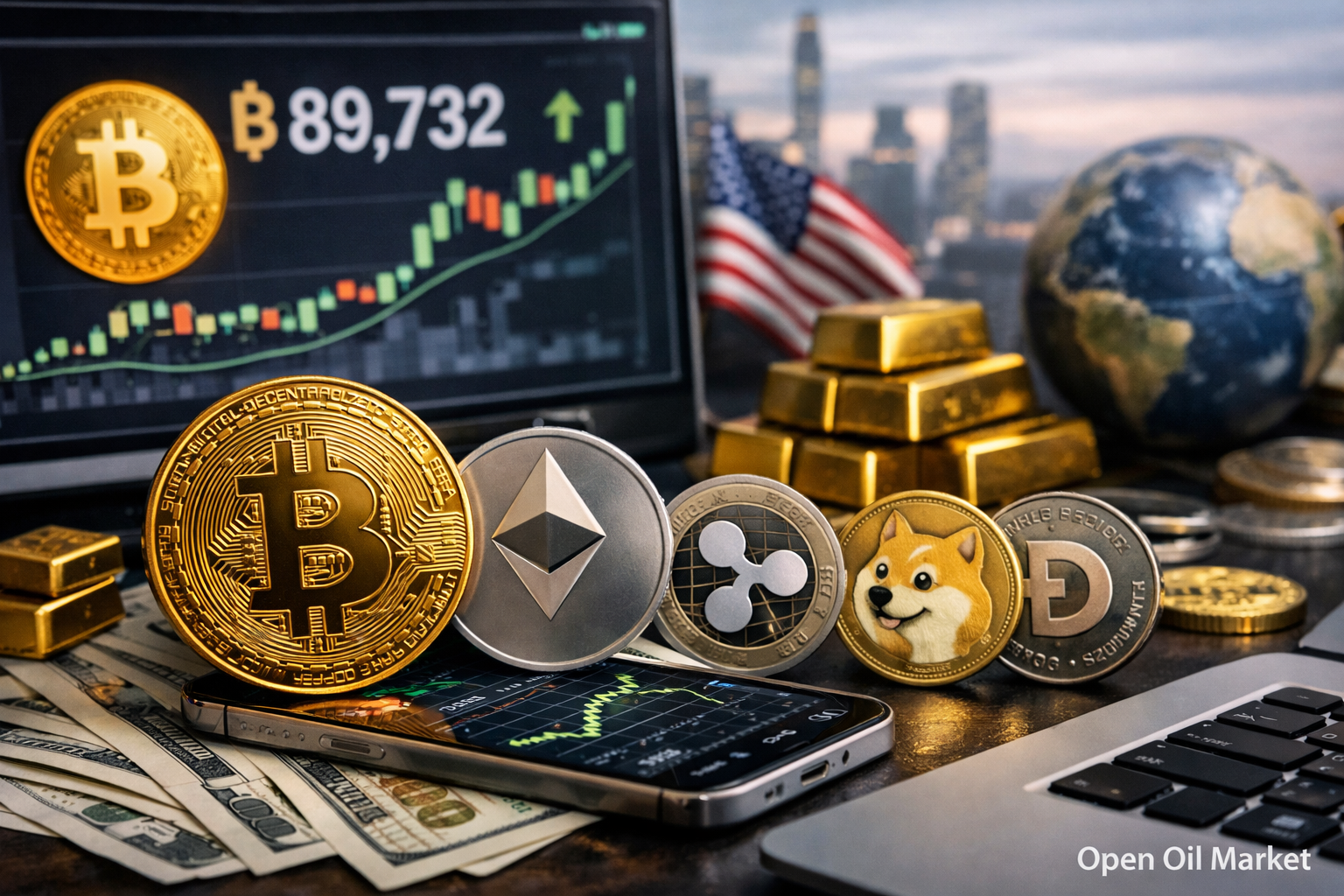
Bitcoin (BTC) remains at the center of the cryptocurrency market. The price of the leading cryptocurrency is hovering around $90,000, having slightly retreated from its historical high of over $120,000 achieved last year. Throughout 2025, Bitcoin has more than doubled in value, boosting its market share: BTC now accounts for over 50% of the total cryptocurrency market capitalization.
A key driver of Bitcoin's growth has been the influx of institutional investments. The launch of the first spot Bitcoin ETFs in the US and Europe has opened the market to major Wall Street players, ensuring a flow of new capital. Bitcoin has firmly established itself in the eyes of investors as "digital gold" and a hedge against inflation. Additionally, several countries have begun considering BTC as part of their national reserves, highlighting its increased global stature.
- Limited Supply: About 19.5 million of the maximum possible 21 million BTC has been issued — the coin shortage continues to support Bitcoin's long-term value.
- Institutional Demand: In 2025, public companies and funds collectively accumulated over 5% of the total Bitcoin issuance. By early 2026, approximately $110 billion is staked in spot Bitcoin ETFs. Despite recent minor outflows from these funds, their emergence has been a significant driver of market growth.
- Macroeconomic Factors: Expectations of a looser monetary policy in the US in 2026 (amid possible Federal Reserve rate cuts) are fueling interest in risk assets, including BTC. Concurrently, record high gold prices (over $4,500 per ounce) indicate demand for safe-haven assets, indirectly supporting Bitcoin as a digital counterpart.
- High Volatility: Price swings remain sharp. Analysts do not rule out a correction for Bitcoin to the $70,000–$75,000 range if liquidity in the markets deteriorates. However, a confident breakout above ~$94,000–$95,000 could restore bullish momentum and attract a new wave of buyers.
Ethereum and Major Altcoins
Ethereum (ETH), the second-largest cryptocurrency by market capitalization, has solidified its position as a fundamental platform for decentralized applications. In 2025, Ethereum successfully underwent a series of updates that increased the network's scalability (including the implementation of sharding and zk-rollup technologies). By the end of the year, the price of ETH remains around $3,000 — below its all-time highs (near $5,000 at the market peak), however, Ethereum consistently retains second place due to its extensive DeFi and NFT ecosystem. Institutional investors are also showing interest in Ethereum, considering staking opportunities and the growth prospects of the network. In 2025, the first spot ETFs on Ethereum were launched, attracting additional capital to the ETH market.
Among the largest altcoins, Binance Coin (BNB), XRP, Solana, and Cardano stand out. BNB — the internal token of the Binance exchange ecosystem — maintains high market capitalization due to a wide range of applications within this ecosystem (from fee payments to decentralized applications). XRP has significantly recovered after regulatory uncertainty in the US was lifted, rekindling banks’ interest in utilizing the token for cross-border payments. Solana (SOL) has left behind the technical issues of previous years and gained attention due to the increase in tokenization of real assets on its high-speed blockchain platform. Cardano (ADA) continues its phased development of a research-based protocol, maintaining its place in the top 10 thanks to its dedicated community and regular network updates.
The top 10 also includes Tron (TRX) and Dogecoin (DOGE). Tron attracts users with low fees and high transaction speeds, becoming one of the primary networks for issuing and transferring stablecoins. Dogecoin, which began as a joke coin, is still in the top 10 due to its active community support and periodic attention from prominent entrepreneurs.
DeFi and Web3: A New Growth Cycle
The decentralized finance (DeFi) sector is experiencing a new upswing. By the end of 2025, the total value locked (TVL) in DeFi protocols surpassed $160 billion, increasing by over 40% over the year. This growth is largely due to technical improvements: the Ethereum ecosystem has implemented layer two solutions (e.g., zk-rollups) to speed up transactions and lower fees, while alternative blockchains like Solana have enhanced the reliability and throughput of their networks. DeFi applications offer investors new income opportunities — from liquid staking to crypto lending — attracting both retail and institutional market participants.
Simultaneously, the concept of Web3 — decentralized internet services based on blockchain — is evolving. In 2025, there was a continued influx of users into Web3 applications: decentralized exchanges, play-to-earn gaming projects, metaverses, NFT marketplaces, and other services became more accessible due to improvements in user experience. Tokenization of real-world assets (RWA) is gaining momentum: digital analogs of traditional financial instruments are emerging on blockchain platforms, expanding the application of crypto technologies in the real world. Moreover, integration with artificial intelligence technologies has intensified: AI algorithms are being used to optimize trading and asset management, while blockchain projects are incorporating AI elements to enhance efficiency and security.
Regulation and Institutional Interest
The past year has been marked by significant changes in cryptocurrency regulation and a surge in interest from traditional finance. In the US, a specialized stablecoin law (GENIUS Act) was passed in the summer of 2025 that established rules for issuers of dollar-pegged tokens and allowed licensed companies to offer yield products based on stablecoins to clients. Analysts estimate that this innovation could divert part of the liquidity from the banking system: large banks warn that the growth of the stablecoin market could withdraw hundreds of billions of dollars from deposits, especially in developing countries. In the European Union, the MiCA regulation came into effect, establishing uniform rules for crypto assets and providing companies with clearer operational frameworks. Many countries around the world are seeking to balance innovation support and risk control: some countries are simplifying access for citizens to cryptocurrencies, while others are launching their own Central Bank Digital Currencies (CBDCs) in response to the proliferation of private crypto assets.
Meanwhile, institutional investors are increasingly entering the crypto market. Major asset managers and banks — from BlackRock and Fidelity to JPMorgan — emphasize the growing role of cryptocurrencies in their strategic forecasts for 2026. Below are some examples of their positions:
- Fidelity: notes that a number of countries are already adding Bitcoin to their national reserves (for example, Brazil and Kyrgyzstan have recently authorized BTC purchases at the state level).
- JPMorgan: indicates that despite the decrease in total capitalization from $4 trillion to $3 trillion in 2025, the industry retains growth potential due to softer regulation in the US and the emergence of legal investment products.
- Coinbase: forecasts an increase in demand for anonymous cryptocurrencies (Monero, Zcash) amid heightened attention to data privacy in the digital space.
Overall, 2025 has shown that cryptocurrencies are definitively transitioning from experimental assets to mainstream acceptance within the global financial system.
Stablecoins: From Niche to Mainstream
In 2025, stablecoins firmly established themselves as a key component of the crypto-economy. The total volume of issued stablecoins surpassed $300 billion, with the leading dollar tokens Tether (USDT) and USD Coin (USDC) accounting for the majority of this capitalization. Initially serving as a means to facilitate cryptocurrency trading, stablecoins are now actively utilized beyond exchanges. In countries with unstable national currencies, digital "dollars" in the form of stablecoins have become a popular means of savings and transactions. International transfers in stablecoins allow for significant savings on fees and expedite transactions compared to traditional banking channels.
Fintech giants have also joined this sector: for example, PayPal launched its own stablecoin, and payment networks Visa and Mastercard are testing operations using stable digital currencies. The expanding use of stablecoins is attracting regulatory attention as their scale begins to intersect with the traditional financial system. Nevertheless, for the crypto market, stablecoins have become an indispensable liquidity tool, bridging the gap between fiat money and digital assets. Their widespread adoption in 2025 vividly illustrates how quickly innovations are being integrated into everyday financial practices worldwide.
Top 10 Most Popular Cryptocurrencies
Despite the existence of thousands of digital coins, the largest and most recognized cryptocurrencies remain market leaders. Below are the ten most popular crypto assets by market capitalization at the beginning of 2026:
- Bitcoin (BTC) — approximately $90,000. The original and largest cryptocurrency, often referred to as "digital gold." It sets the tone for the entire market; its capitalization accounts for about half of the total cryptocurrency market capitalization.
- Ethereum (ETH) — around $3,000. The second-largest crypto asset and the leading platform for smart contracts. The DeFi and NFT ecosystems are based on Ethereum, providing infrastructure for thousands of decentralized applications.
- Tether (USDT) — ~$1 (stablecoin). The largest stablecoin, pegged to the US dollar at a 1:1 ratio. Widely used for trading and transactions, serving as a bridge between fiat currencies and the crypto market.
- Binance Coin (BNB) — around $400. The internal token of the largest crypto exchange Binance and its blockchain ecosystem. Used for fee payments, participation in DeFi applications, and access to various services within the Binance ecosystem.
- XRP (XRP) — approximately $0.80. Cryptocurrency developed by Ripple for fast international payments. After regulatory restrictions in the US were lifted, it is regaining popularity among banks and payment systems.
- USD Coin (USDC) — ~$1 (stablecoin). The second most popular dollar stablecoin, issued by the Centre consortium (companies Circle and Coinbase). Known for its reserve transparency, it is actively used in trading and DeFi.
- Solana (SOL) — around $180. A high-performance blockchain, one of the main alternatives to Ethereum. It has high transaction speeds; the DeFi application ecosystem and tokenized assets are growing on the Solana platform.
- Tron (TRX) — around $0.10. A blockchain platform focused on entertainment content and decentralized applications. It features low fees and high throughput; widely used for the issuance and transfer of stablecoins.
- Dogecoin (DOGE) — around $0.07. The most well-known meme token, which started as a joke but has grown into an asset with a multi-billion dollar market capitalization. DOGE's popularity is maintained by its vibrant community and the attention of prominent entrepreneurs.
- Cardano (ADA) — around $0.45. A blockchain platform developed based on scientific research. It offers smart contracts and aims for high reliability; it has a dedicated user community and consistently ranks among the largest cryptocurrencies.
Market Prospects
Thus, the cryptocurrency market enters 2026 more robust and matured. Institutional participation, thoughtful regulation, and technological innovations are forming the foundation for further growth in the sector. Despite potential periods of volatility, the overall trend remains positive: the influx of new capital through ETFs and other investment products, as well as the expansion of real use cases for blockchain, will support demand for key crypto assets. Experts believe that in 2026, cryptocurrencies will further solidify their role in the global financial system, continuing their shift toward full mainstream adoption.
At the same time, sharp price spikes may not occur in the coming weeks, and volatility remains an inherent feature of this market. Accordingly, caution and a well-thought-out strategy remain essential for investors worldwide as they enter the new year.