Global Cryptocurrency Market on June 13, 2026: Bitcoin, Ethereum, ETFs, Stablecoins, and Top 10 Digital Assets for Investors
The global cryptocurrency market enters Saturday, June 13, 2026, in a state of cautious recovery following a volatile week. Bitcoin remains around a critical psychological zone after a sharp decline, Ethereum is still under pressure from weak institutional demand, and investors are increasingly focusing on stablecoins, payment infrastructure, asset tokenization, and regulated ETF products. For the global investment audience, the key question now is not only whether Bitcoin, Ethereum, XRP, Solana, or BNB will rise in the coming days, but which segments of the crypto market will maintain long-term investment appeal following another phase of correction.
Market Overview: Cryptocurrencies Recovering, But Momentum Remains Weak
The main news in cryptocurrency for June 13, 2026, is that the market is attempting to stabilize after a strong decline; however, a confident turnaround is not yet in sight. Bitcoin remains the key indicator of market sentiment, but its dynamics do not appear as independent as in previous cycles. Digital assets are increasingly dependent on global liquidity, risk appetite, bond yields, the U.S. stock market, Federal Reserve interest rate expectations, and competition from technological megatrends, including artificial intelligence.
For investors, this means that cryptocurrency news can no longer be considered in isolation. Bitcoin, Ethereum, Solana, XRP, and other digital assets have become part of a broader risk curve: when capital shifts to technology shares, IPOs, AI infrastructure, and the money market, cryptocurrencies receive less inflow. Conversely, when global investors seek high returns and are willing to take risks, the crypto market quickly returns to focus.
Bitcoin: Market Tests the Resilience of the Largest Cryptocurrency
Bitcoin remains the central asset of the cryptocurrency market, but its role is changing. After a period of turbulent institutional interest and growth of ETF products, the market is facing the downside of financial institutionalization: when ETFs face outflows, the pressure on price increases faster than in previous cycles.
At the time of writing, Bitcoin was trading near the $63,000 zone, making the current range particularly significant for short-term and medium-term investors. On one hand, holding this area demonstrates that demand for the largest cryptocurrency remains. On the other hand, the lack of strong inflows into Bitcoin ETFs indicates that institutional investors are not yet rushing to return to this asset aggressively.
What Investors Should Consider Regarding Bitcoin
- Holding key support levels after the recent decline;
- Inflow and outflow dynamics of capital from Bitcoin ETFs;
- Behavior of public companies holding Bitcoin on their balance sheets;
- Correlation of Bitcoin with Nasdaq, AI stocks, and global risk assets;
- Decline in Bitcoin's market dominance amid the growth of stablecoins and select altcoins.
Ethereum: ETF Weakness and Pending Drivers
Ethereum also remains under pressure. Despite its status as the second-largest cryptocurrency and key platform for smart contracts, DeFi, tokenization, and blockchain infrastructure solutions, ETH is yet to demonstrate sustained independent momentum. Investors continue to assess Ethereum not only as a digital asset but also as a technology platform from which the market expects actual usage growth.
The key risk for Ethereum is the weak dynamics of spot ETFs and insufficient demand from major institutional players. Nevertheless, the long-term investment thesis surrounding Ethereum remains intact: the tokenization of real assets, DeFi infrastructure, corporate blockchain solutions, and settlements in stablecoins are still tied to smart contract ecosystems.
Cryptocurrency ETFs: A Key Indicator of Institutional Demand
One of the most critical factors for the cryptocurrency market remains the behavior of ETFs. In 2024-2025, ETFs became a bridge between traditional finance and digital assets. By 2026, this tool is functioning in both directions: it can not only attract capital but also accelerate outflows during times of poor sentiment.
For investors, it is particularly important to monitor three areas:
- Bitcoin ETFs — a gauge of trust in the largest digital asset.
- Ethereum ETFs — an indicator of institutional interest in smart contracts and Web3 infrastructure.
- ETFs on Solana and XRP — a signal of potential capital rotation from major cryptocurrencies to riskier but potentially more rewarding assets.
Should outflows from Bitcoin and Ethereum ETFs persist, the market may remain under pressure. However, if a sustained inflow begins, it would be one of the first signs of recovering trust among global investors.
Stablecoins: The Primary Structural Theme of the Crypto Market
Against the volatility of Bitcoin and Ethereum, stablecoins are playing an increasingly vital role. Tether, USDC, and other dollar-backed digital assets are becoming not just tools for trading within the crypto market but integral parts of global payment infrastructure. Their significance is growing in cross-border payments, remittances, corporate payments, DeFi, and markets with limited access to banking services.
For investors, it is not only the issuance of stablecoins that matters but also the entire infrastructure surrounding them: wallets, custodial services, compliance platforms, payment gateways, blockchain analytics, and reserve management systems. This segment may emerge as one of the most resilient growth areas in the crypto industry, even if Bitcoin and Ethereum prices remain volatile.
Top 10 Popular Cryptocurrencies in Focus of the Global Market
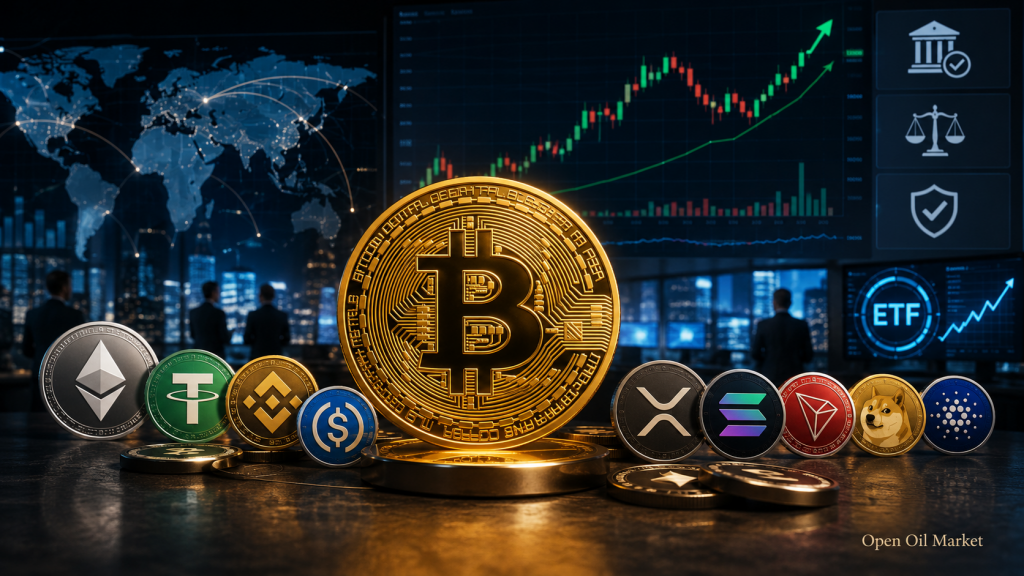
For investors keeping track of cryptocurrency news and forming a global watchlist, the largest and most liquid digital assets remain in the spotlight. Their roles vary: some are used as a means of preserving value, others as payment infrastructure, and others as technology platforms.
| Cryptocurrency | Ticker | Market Role |
|---|---|---|
| Bitcoin | BTC | The primary digital asset and market indicator |
| Ethereum | ETH | Smart contract, DeFi, and tokenization platform |
| Tether | USDT | The largest dollar-backed stablecoin for liquidity and settlements |
| BNB | BNB | Ecosystem token of a major exchange and blockchain infrastructure |
| USDC | USDC | Regulated stablecoin for institutional settlements |
| XRP | XRP | Asset for payment solutions and cross-border transfers |
| Solana | SOL | High-performance blockchain for applications, DeFi, and tokens |
| TRON | TRX | A network with high activity in stablecoin transfers |
| Dogecoin | DOGE | Memecoin with high recognition and speculative demand |
| Cardano | ADA | Blockchain platform focused on scalability and research |
Solana and XRP: Capital Rotation into Altcoins
Solana and XRP remain two key altcoins for investors seeking opportunities beyond Bitcoin and Ethereum. Solana garners attention for its high throughput, developer activity, DeFi applications, and interest from ETF investors. XRP remains in focus due to transnational payment solutions, institutional use, and increased liquidity.
However, in the current phase of the market, it is crucial for investors to differentiate between temporary capital rotation and sustainable trends. The rising interest in Solana and XRP may not only relate to fundamental factors but also to the search for higher yields following weak momentum in Bitcoin and Ethereum. Therefore, these assets require more stringent risk management.
Regulation: The Crypto Market Becomes Part of the Global Financial System
Global regulation of digital assets is gradually intensifying. The U.S., Europe, Asia, and the Middle East are adopting diverse approaches to cryptocurrencies, stablecoins, tokenization, and custodial services. For investors, this creates a dual effect. On one hand, regulation mitigates some infrastructure risks and paves the way for significant capital. On the other hand, it raises requirements for issuers, exchanges, payment companies, and DeFi projects.
The topic of stablecoins remains particularly important. As their use in settlements becomes more active, the focus on reserves, transparency, liquidity, cybersecurity, and the ability of issuers to maintain dollar pegs in stressful conditions intensifies.
What Investors Should Pay Attention to on June 13, 2026
For global investors, the cryptocurrency market on June 13, 2026, appears not as a clear rally market, but a market of selection. In such a phase, it is more important to understand where long-term value is forming rather than to predict short-term movements.
- Bitcoin remains the principal indicator of trust in the crypto market.
- Ethereum depends on the demand for smart contract infrastructure and tokenization.
- Stablecoins are becoming a central part of global digital settlements.
- ETFs reflect real institutional capital behavior.
- Solana and XRP may benefit from rotation, but carry increased risk.
- BNB, TRON, Dogecoin, and Cardano remain assets to watch, but require distinct valuation approaches.
The key takeaway for investors is that the cryptocurrency market is transitioning from an era of simple speculation to an era of infrastructure, regulation, and institutional selection. Bitcoin and Ethereum remain the foundational assets of the sector, but increasingly, investment opportunities are emerging around stablecoins, payment solutions, tokenization, custodial services, and regulated financial products. These areas could define the next growth phase of the global cryptocurrency market.