Cryptocurrency News for Sunday, June 14, 2026: Bitcoin Holds Key Levels, ETFs and Stablecoins Remain in the Spotlight for Investors, and the Top 10 Cryptocurrencies Indicate Which Digital Assets are Shaping the Global Market Agenda
The cryptocurrency market approaches Sunday, June 14, 2026, in a state of cautious recovery after a volatile week. Bitcoin is holding around the key zone of $64,000, Ethereum remains under pressure from weak institutional demand, and investors are increasingly focusing on stablecoins, ETFs, asset tokenization, and the cryptocurrency derivatives market. The main theme of the day is the search for a balance between the recovery of risk appetite and the prevailing caution of major players.
For global investors, cryptocurrencies are once again becoming an indicator of sentiment at the intersection of technology, liquidity, and macroeconomics. While the market in 2025 was largely driven by expectations of new highs, by June 2026, the focus has shifted to the resilience of infrastructure, the quality of regulation, and the ability of digital assets to attract capital beyond speculative waves.
Bitcoin Remains the Key Barometer of Risk
Bitcoin remains the central asset of the cryptocurrency market and a key benchmark for institutional investors. After a dip at the start of the week, the market attempted to stabilize: the largest cryptocurrency is holding around $64,000, which participants view as an important psychological milestone.
Demand for Bitcoin is supported by three factors:
- A renewed interest in risk assets following a decrease in geopolitical tension;
- Expectations of easing macroeconomic pressure in the second half of 2026;
- Bitcoin’s role as the most liquid digital asset for funds, traders, and long-term investors.
However, the market cannot yet be termed confidently bullish. Flows into spot Bitcoin ETFs remain unstable, and capital is diverting to tech IPOs, private markets, and derivative products. For investors, this means Bitcoin is currently trading not only as "digital gold," but also as a high-beta asset susceptible to interest rates, stock indices, and global liquidity.
Ethereum: Strong Infrastructure, Ambiguous Demand
Ethereum is trading around $1,670 and remains the second most significant asset in the market. Its investment case differs from that of Bitcoin: Ethereum is assessed not only as a cryptocurrency but also as the foundational infrastructure for smart contracts, tokenization, DeFi, stablecoins, and corporate blockchain solutions.
A weak spot for Ethereum in June 2026 remains institutional demand. Ethereum ETFs have not exhibited the sustained momentum that many market participants had anticipated. Nevertheless, the long-term logic persists: if the tokenization of real assets, transactions in stablecoins, and DeFi infrastructure continue to develop, Ethereum may gain traction as a technological layer for new financial architecture.
ETFs: The Main Indicator of Institutional Capital
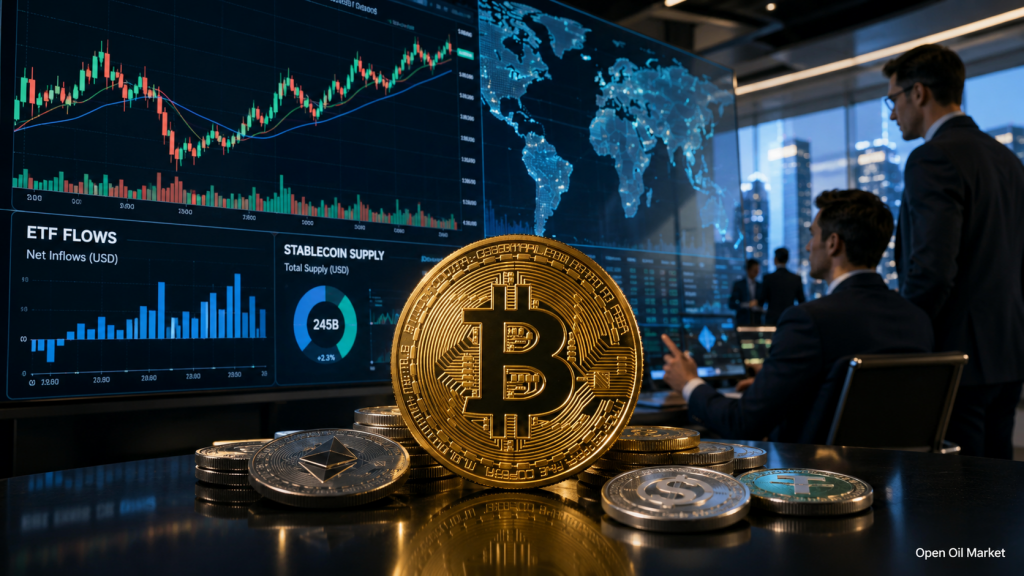
Cryptocurrency ETFs remain one of the key channels for regulated capital to enter digital assets. Following a series of significant outflows, the market received a small signal of stabilization: spot Bitcoin ETFs and Ethereum ETFs managed to break prolonged outflows. However, the scale of new inflows is still insufficient to indicate a full reversal in sentiment.
For investors, not only the quotes of Bitcoin and Ethereum matter but also the dynamics of fund products. If ETFs begin showing sustained inflows again, this could increase demand for the underlying assets. Conversely, if outflows resume, pressure on the cryptocurrency market will persist, particularly in the large altcoin segment.
Stablecoins Become the Center of Global Crypto Infrastructure
One of the most important themes in the crypto market remains stablecoins. USDT and USDC have long ceased to be mere tools for traders. They are increasingly used in international settlements, treasury operations, cross-border transfers, and trading digital assets.
Investor interest is shifting from stablecoins themselves to the surrounding infrastructure. The following are coming to the forefront:
- Payment gateways and processing platforms;
- Custodial services;
- Compliance and transaction monitoring tools;
- Wallets and corporate solutions for liquidity management;
- Bridges between traditional finance and blockchain.
For the global market, this represents an important structural shift. Stablecoins are becoming not only a part of the cryptocurrency ecosystem but also a competitor to outdated payment rails. In the long term, it is perhaps the infrastructure companies that will emerge as the primary beneficiaries of the growth in digital money.
Top 10 Most Popular Cryptocurrencies for Investors
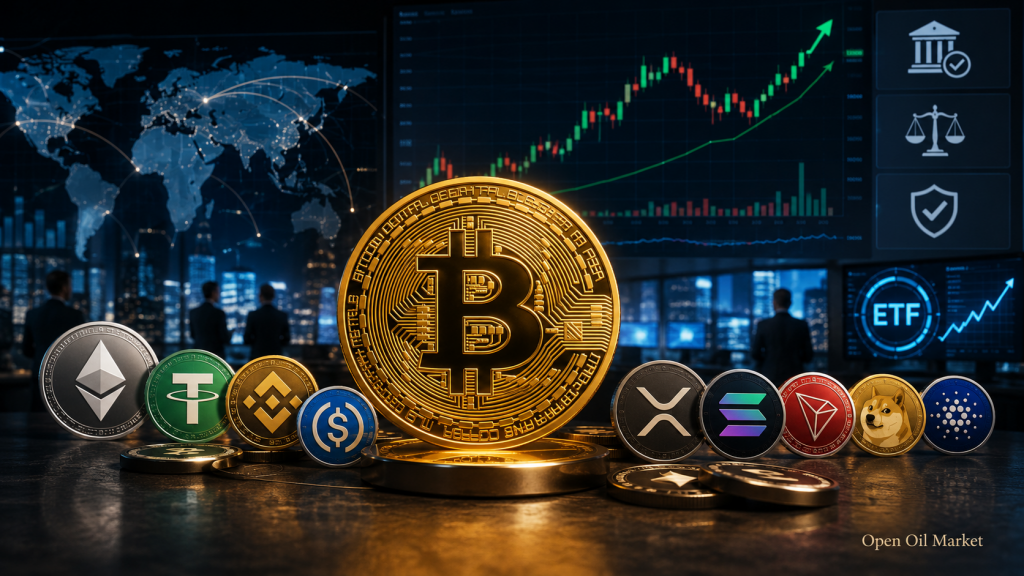
As of June 14, 2026, global investors are focusing on the largest and most liquid cryptocurrencies. The top 10 cryptocurrencies by market capitalization and market interest include:
- Bitcoin (BTC) — the main digital asset and foundational indicator of sentiment in cryptocurrencies.
- Ethereum (ETH) — the largest smart contract platform and infrastructure for DeFi and tokenization.
- Tether (USDT) — the largest stablecoin and key tool for crypto liquidity.
- BNB (BNB) — the Binance ecosystem token and one of the largest exchange assets.
- USDC (USDC) — a regulated stablecoin valued by institutional participants.
- XRP (XRP) — an asset associated with cross-border payments and banking infrastructure.
- Solana (SOL) — a high-performance blockchain aimed at applications, DeFi, and retail activity.
- TRON (TRX) — a network actively used for stablecoin transfers and digital dollar settlements.
- Hyperliquid (HYPE) — a rapidly growing DeFi token linked to the perpetual futures market.
- Dogecoin (DOGE) — the largest memecoin, maintaining liquidity due to strong retail interest.
Notably, Hyperliquid deserves special attention. The rise of HYPE to the upper echelons of the cryptocurrency rankings indicates that the market is beginning to assess not just old blockchains and memecoins but also projects with real trading revenue, an active derivative infrastructure, and token buyback mechanisms.
Solana, XRP, BNB, and TRON: Selective Trading for Altcoins
In June 2026, altcoins are moving unevenly. Solana is drawing attention due to its high network throughput, active developer engagement, and role in consumer blockchain applications. XRP remains an asset for investors betting on payment infrastructure and institutional adoption of digital assets. BNB maintains its status as a major ecosystem token, while TRON strengthens its position thanks to the active use of stablecoins within its network.
However, it is essential for investors to note that the altcoin market remains riskier than Bitcoin and Ethereum. Liquidity is lower, volatility is higher, and dependence on news, regulation, and specific ecosystem activities is significantly stronger.
Pre-IPO Derivatives and Hyperliquid: The New Frontier of the Crypto Market
One of the most discussed topics of the week has been the rising interest in pre-IPO perpetual futures — derivatives that allow speculation on the valuations of large private companies before they go public. Notably, there has been substantial interest around SpaceX, with trading volumes on crypto exchanges reaching billions.
For the crypto market, this presents a double-edged signal. On one hand, such products demonstrate that digital platforms are beginning to compete with traditional exchanges for traders' attention. On the other hand, they increase risks: many tools do not provide direct ownership of the underlying stocks, have limited liquidity, and may be complex for retail investors.
The growth of Hyperliquid and interest in perpetual futures confirm that the next stage of cryptocurrency development could involve not only coins but also markets where digital infrastructure is used to trade new asset classes.
Regulation: The Market Awaits Clearer Rules
Regulation remains one of the primary factors for cryptocurrencies in 2026. In the U.S., efforts continue towards a clearer classification of digital assets, stablecoins, tokens, and investment contracts. This is critically important for the market: major banks, funds, payment companies, and public exchanges cannot scale operations involving crypto assets without clear rules.
Globally, regulation is becoming less of an obstacle and more of a condition for the next growth phase. The clearer the rules governing cryptocurrencies, ETFs, stablecoins, and tokenized assets, the easier it will be for institutional capital to enter the market. However, this also means that weaker projects will face increased demands for reporting, reserve transparency, and corporate governance quality.
What is Important for Investors on June 14, 2026
On Sunday, investors should focus not only on cryptocurrency prices but also on a broader set of indicators. Key signals for the market will include:
- Will Bitcoin hold the $64,000 level;
- Will there be sustained inflows into Bitcoin ETFs and Ethereum ETFs;
- Will demand for Solana, XRP, BNB, TRON, and HYPE persist;
- How will interest in stablecoins and payment infrastructure develop;
- Will macroeconomic and stock market pressures increase;
- Will regulators tighten assessments of pre-IPO derivatives and cryptocurrency derivatives.
The overarching conclusion for investors: the cryptocurrency market is still in a phase of reevaluation. A simple bet on the growth of all digital assets no longer works as it did in previous cycles. Capital is becoming more selective: it is flowing into Bitcoin as the most liquid asset, into Ethereum as an infrastructure platform, into stablecoins as a transactional layer, and into select projects with transparent economics.
As of June 14, 2026, cryptocurrencies remain one of the most dynamic segments of the global financial market. However, the investment logic is changing: the winners will not only be the most popular coins but also those ecosystems capable of demonstrating sustainable liquidity, real utility, regulation, and the ability to integrate with the traditional financial system.