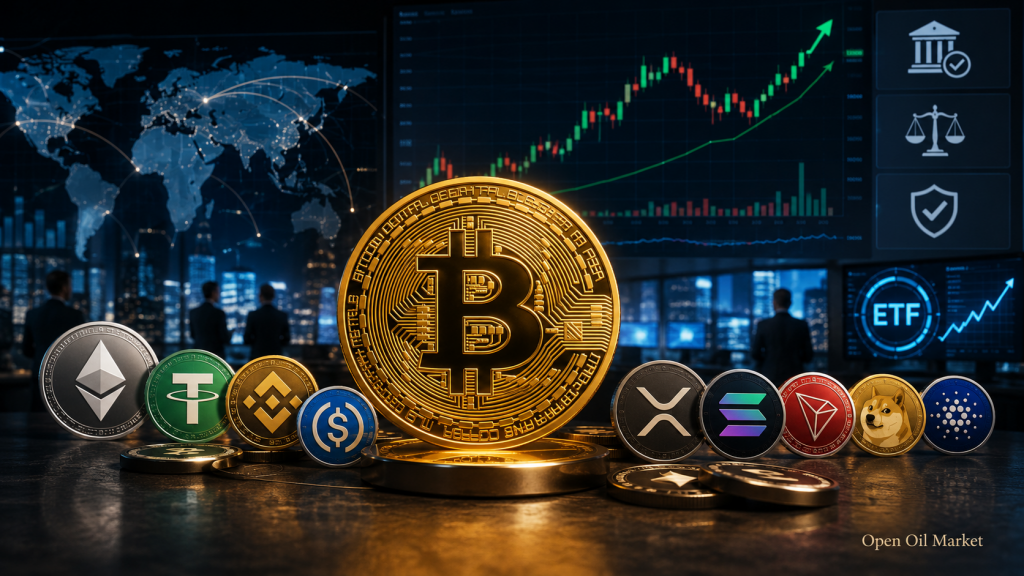
Cryptocurrency News for Tuesday, June 16, 2026: Bitcoin Surpasses Key Levels, Ethereum, ETF Flows, Federal Reserve Decision Anticipation, Stablecoins, and the Top 10 Popular Cryptocurrencies for Investors
The cryptocurrency market enters Tuesday, June 16, 2026, with a more constructive sentiment following a resurgence in demand for risk assets. The main topic of the day for investors is a combination of geopolitical relief, renewed interest in Bitcoin, increased activity in Ethereum, and anticipation of the U.S. Federal Reserve's decision. The global digital asset market is once again intensifying its focus on ETFs, stablecoins, real asset tokenization, and liquidity in the major cryptocurrencies.
For the global audience of investors, cryptocurrencies remain not an isolated speculative segment but rather part of a broader financial system. Bitcoin, Ethereum, Solana, XRP, BNB, USDT, USDC, TRON, Hyperliquid, and Dogecoin are increasingly viewed through the lens of institutional capital, regulation, dollar liquidity, and global risk appetite.
Global Background: Crypto Market Reacts to Reduced Geopolitical Premium
The key market momentum is linked to improved sentiment in global markets. The easing of tensions in the Middle East has supported stocks, dampened demand for safe-haven assets, and enabled Bitcoin to rise above a crucial psychological level. For cryptocurrencies, this signifies not just a short-term influx of liquidity but also a shift in market discourse: investors are again discussing not only risks but also the potential for recovery.
However, the rise remains cautious. The cryptocurrency market has experienced several instances where geopolitical news has provided a quick jolt, only for the momentum to fade due to macroeconomic risks. Therefore, for investors, the main question is not how quickly Bitcoin rises, but whether that rise will be confirmed by capital inflows into ETFs, a reduction in volatility, and improved demand for altcoins.
Bitcoin: The Main Indicator of Risk Appetite
Bitcoin remains the central asset of the crypto market and the primary benchmark for institutional investors. At the time of writing, BTC is trading above $66,000, making it a key indicator of sentiment in digital assets. Bitcoin's recovery supports the stocks of crypto companies, interest in miners, public holders of BTC, and products based on spot Bitcoin ETFs.
For investors, three factors are crucial:
- Staying above major psychological levels;
- Sustained inflows into ETFs following a period of outflows;
- The market's reaction to the Federal Reserve's decision and comments on inflation.
If Bitcoin maintains its position and shows resilience in the lead-up to the Federal Reserve meeting, this could bolster the broader cryptocurrency market. Conversely, if the regulatory or macroeconomic backdrop proves stricter than expected, investors may revert to profit-taking.
Ethereum: Renewed Interest in ETH through Infrastructure and Corporate Treasuries
Ethereum is also showing improved dynamics. ETH is trading around $1,800, and interest in the network is strengthening amid the development of tokenization, DeFi infrastructure, and corporate strategies for accumulating Ethereum. Unlike Bitcoin, which is viewed as a digital reserve asset, Ethereum remains a bet on infrastructure: smart contracts, tokenized assets, stablecoins, payment systems, and on-chain finance.
For global investors, Ethereum is significant not just as a cryptocurrency but also as a technological foundation for the future financial market. While Bitcoin's key role hinges on supply scarcity and its status as "digital gold," Ethereum shifts the focus to the network's utility, developer activity, and application-driven demand.
ETF Flows and Institutional Capital: The Market Seeks Confirmation of Trends
ETFs remain the primary channel for institutional entry into cryptocurrencies. After a period of outflows, the return of positive flows into Bitcoin ETFs is perceived as a signal of stabilizing demand. This is particularly important for the market because ETFs turn cryptocurrencies into a familiar tool for asset managers, family offices, pension structures, and individual investors with brokerage accounts.
The spotlight is also on corporate cryptocurrency holders. Strategy continues to increase Bitcoin reserves, while Ethereum-oriented corporate structures are accumulating positions in ETH. This enhances the institutional narrative but simultaneously raises the market's dependence on the behavior of large public players. Continued purchases by these companies instill confidence; any reductions in positions could signal caution.
Stablecoins: USDT and USDC Remain the Foundation of Liquidity
Stablecoins remain a crucial part of the cryptocurrency infrastructure. USDT and USDC rank among the largest digital assets by market capitalization and serve as a transactional layer for trading, DeFi, cross-border transfers, and maintaining dollar liquidity within the crypto market.
For investors, stablecoins are important for several reasons:
- They indicate the level of free liquidity within the crypto ecosystem;
- They serve as a bridge between fiat currencies and digital assets;
- They're part of the global discussion on the regulation of digital money;
- They support demand for blockchain infrastructure and tokenized assets.
The increasing role of stablecoins brings the cryptocurrency market closer to traditional finance. However, it also heightens demands for reserves, transparency, oversight, and the management of operational risks.
Top 10 Most Popular Cryptocurrencies for Investors
As of June 16, 2026, the focus of the global market centers on the largest and most liquid digital assets. For investors, it's essential to view these assets not just in terms of short-term dynamics but also their roles within the ecosystem.
1. Bitcoin (BTC)
The leading digital asset and primary indicator of institutional demand. Bitcoin remains the foundational cryptocurrency for portfolio analysis.
2. Ethereum (ETH)
The key smart contracts platform, DeFi, tokenization, and on-chain infrastructure. ETH continues to be a bet on the development of digital financial applications.
3. Tether (USDT)
The largest stablecoin and one of the main sources of liquidity on cryptocurrency exchanges.
4. BNB (BNB)
An asset of the Binance ecosystem and BNB Chain. Interest in BNB is linked to exchange infrastructure, trading activity, and applied services.
5. XRP (XRP)
One of the key assets in the cross-border payments segment. XRP remains sensitive to regulatory news and institutional interest.
6. USD Coin (USDC)
A regulated dollar stablecoin vital for institutional calculations, DeFi, and tokenized financial instruments.
7. Solana (SOL)
A high-performance blockchain network focused on rapid transactions, DeFi, NFTs, consumer applications, and exchange infrastructure.
8. TRON (TRX)
A network actively used for stablecoin transfers. TRON retains significance due to high transactional activity.
9. Hyperliquid (HYPE)
A notable asset in the new cycle related to derivatives and trading infrastructure. Interest in HYPE reflects the demand for on-chain trading.
10. Dogecoin (DOGE)
A highly liquid meme asset that continues to capture the attention of retail investors and traders due to its recognizability and volatility.
Altcoins: Growth Exists, but is Selective
Despite the recovery of Bitcoin and Ethereum, altcoins are currently demonstrating uneven dynamics. Solana, XRP, and certain infrastructure sector tokens are receiving support due to expectations of new ETF products, growth in on-chain activity, and interest in tokenization. However, the broader altcoin market remains dependent on liquidity and Bitcoin's behavior.
For investors, this means the "buy everything" strategy remains risky. A more rational approach is to highlight assets with robust capitalization, high liquidity, a clear role in the ecosystem, and genuine institutional demand.
Macroeconomics: The Federal Reserve and Bank of Japan May Shift Market Sentiment
On Tuesday, June 16, the Federal Reserve meeting begins, with the decision to be published on June 17. This is a key event of the week for cryptocurrencies. If the Fed maintains rates and provides a dovish signal on inflation, the digital asset market could receive additional support. Conversely, if the rhetoric is hawkish, investors may reduce risk in Bitcoin, Ethereum, and altcoins.
Special attention should also be paid to the Bank of Japan. Possible tightening of policy could affect global carry trade strategies, liquidity in risk assets, and currency flows. For cryptocurrencies, this is crucial as the market remains sensitive to dollar liquidity, bond yields, and global demand for risk.
What is Important for Investors on June 16, 2026
The cryptocurrency market approaches June 16 with a state of cautious recovery. Bitcoin has once again become the main beneficiary of improved global risk appetite, Ethereum receives support through infrastructure demand, and stablecoins remain the foundation of liquidity. However, future movements will depend on macroeconomics, ETF flows, and the behavior of large institutional players.
Investors should pay attention to the following factors:
- Will Bitcoin be able to sustain above current levels after the Fed's decision;
- Will inflows continue into spot Bitcoin ETFs;
- Will Ethereum retain interest from corporate treasuries and the DeFi sector;
- How will demand for Solana, XRP, and other leading altcoins change;
- Will the capitalization of stablecoins increase as an indicator of free liquidity;
- Will regulatory clarity for cryptocurrencies in the U.S., Europe, and Asia improve.
The main takeaway for global investors: the crypto market is gaining support from macroeconomic background again, but a sustainable bullish trend will require confirmation from ETF flows, institutional capital, and reduced interest rate risks. Until the Federal Reserve decision, cryptocurrencies might maintain increased volatility, with Bitcoin, Ethereum, USDT, BNB, XRP, USDC, Solana, TRON, Hyperliquid, and Dogecoin remaining in the spotlight.