Cryptocurrency Market May 22, 2026: Bitcoin Maintains Leadership, Ethereum Remains Key Infrastructure, Stablecoins Strengthen Role in Global Settlements, and Investors Track Regulation, Crypto Company IPOs, and Top 10 Digital Assets
The cryptocurrency market is approaching Friday, May 22, 2026, in a state of cautious recovery. Following a period of volatility, investors are again evaluating digital assets as part of the global financial market, not merely as speculative instruments. The focus remains on Bitcoin, Ethereum, stablecoins, potential crypto IPOs, regulation in the US, and infrastructure development for institutional investors.
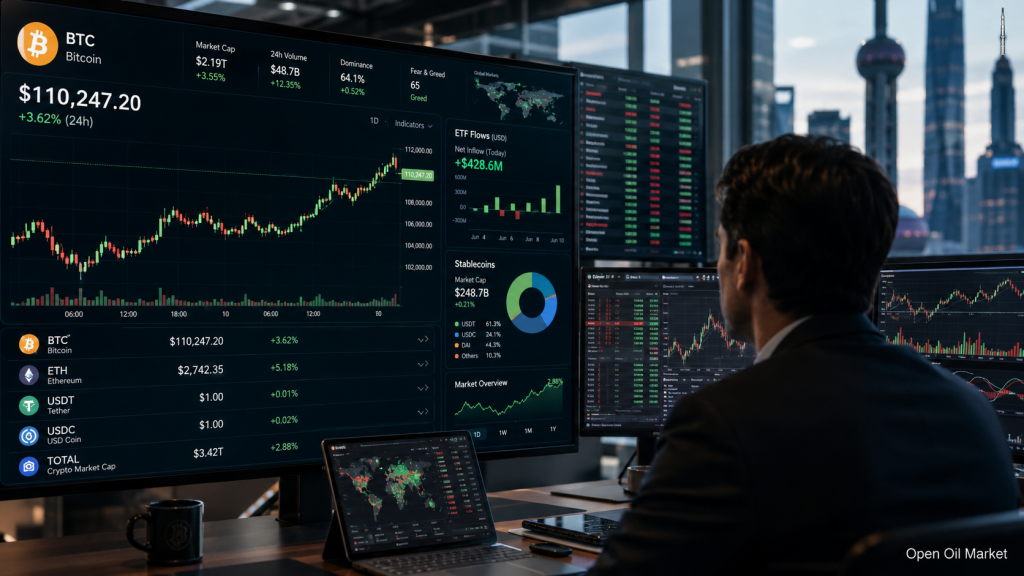
According to current market data, Bitcoin is trading near $77,000–$78,000, Ethereum holds around $2,100, Solana is in the region of $87, and BNB is around $650–$660. These levels are important not only for short-term traders but also for long-term investors assessing the resilience of demand for cryptocurrencies after strong movements in previous months.
Bitcoin Remains the Primary Indicator of Risk Appetite
Bitcoin retains its status as the key asset in the cryptocurrency market. Its market dominance remains high, and its price movement continues to set the direction for most altcoins. For global investors, Bitcoin increasingly functions not just as a cryptocurrency but also as a distinct macro asset, sensitive to the US dollar, Treasury yields, liquidity, and stock market sentiment.
The current situation shows that the crypto market is increasingly dependent on the behaviour of institutional capital. If demand from asset management funds, corporate holders, and other institutional players persists, Bitcoin gains support even during periods of caution in global markets. However, the high concentration of attention around a single asset also creates a risk: when the macroeconomic backdrop deteriorates, pressure on Bitcoin quickly transmits to the entire digital asset sector.
Ethereum: Market Watches Fees, DeFi, and Infrastructure Development
Ethereum remains the second-most significant cryptocurrency and the leading blockchain for smart contracts, DeFi, asset tokenisation, and infrastructure projects. For investors, Ethereum is important not only as a coin but also as a technological platform on which a large portion of the digital asset market is built.
In the coming days, market participants will follow three factors:
- activity dynamics on the Ethereum network and demand for DeFi applications;
- institutional investor interest in Ethereum as a base infrastructure for tokenisation;
- competition from Solana, BNB Chain, Tron, and other networks.
For long-term investors, Ethereum remains a key asset in a crypto portfolio, but its performance increasingly depends on actual network usage, not just expectations of overall crypto market growth.
Top 10 Most Popular Cryptocurrencies for Investors
The list of the largest and most popular cryptocurrencies by market capitalisation and significance as of May 22, 2026, is as follows:
- Bitcoin (BTC) — the leading digital asset and primary indicator of the crypto market.
- Ethereum (ETH) — the largest smart contract platform and foundational asset for DeFi.
- Tether (USDT) — the largest stablecoin and critical liquidity tool.
- BNB (BNB) — the token of the Binance ecosystem and BNB Chain.
- XRP (XRP) — an asset tied to cross-border payments and banking infrastructure.
- USD Coin (USDC) — a regulated stablecoin sought after by institutional participants.
- Solana (SOL) — a high-performance blockchain for DeFi, NFTs, memecoins, and consumer applications.
- TRON (TRX) — a network actively used for stablecoin transfers.
- Dogecoin (DOGE) — the largest memecoin with high retail investor visibility.
- Cardano (ADA) — a blockchain platform emphasising a research-driven approach and ecosystem development.
For investors, it is important to understand that the top 10 cryptocurrencies are not a ready-made buy recommendation but an indicator of liquidity, market stability, and capital interest. Within this list, there are different asset categories: Bitcoin as a digital store of value, Ethereum and Solana as infrastructure networks, USDT and USDC as stablecoins, and more volatile altcoins.
Stablecoins Become Part of Global Financial Infrastructure
One of the main market themes remains stablecoins. USDT and USDC continue to play a key role in crypto trading, settlements, cross-border transfers, and liquidity management. For global investors, stablecoins matter because they link the crypto market to the dollar-based financial system.
The growth in stablecoin market capitalisation shows that digital assets are gradually shifting from a speculative segment to an infrastructure one. At the same time, regulators in the US, Europe, and Asia are paying closer attention to reserves, issuer transparency, risk management, and investor protection. The stricter the regulation, the more likely the largest stablecoins will be viewed as a full-fledged element of the payments system.
Cryptocurrency Regulation in the US Remains a Key Driver
Cryptocurrency news in May 2026 is largely tied to regulation. The market closely monitors US initiatives, given that the American jurisdiction remains the primary centre for institutional capital, ETF products, public crypto companies, and venture funding.
Several directions are important for investors:
- the legal status of cryptocurrencies and digital tokens;
- regulation of stablecoins and issuer reserves;
- the possibility of launching new crypto ETFs;
- fintech and crypto company access to payment infrastructure;
- requirements for exchanges, brokers, and custodial services.
The clearer the rules become, the greater the chance of capital inflows from large funds, banks, and asset managers. However, strict regulation could also increase pressure on small crypto projects and tokens lacking transparency.
Blockchain.com and Interest in Crypto IPOs
Special market attention has been drawn by news about Blockchain.com preparing for an IPO in the US. For the crypto industry, this is an important signal: major players are again evaluating the public market as a potential source of capital and confirmation of the sector's maturity.
If crypto companies can successfully list on exchanges, it will strengthen the link between traditional finance and digital assets. For investors, this means new instruments: one can invest not only directly in cryptocurrencies but also in shares of companies earning from infrastructure, brokerage services, asset custody, trading, and payment solutions.
However, crypto IPOs also carry risks. Their financial results are highly dependent on the market cycle, trading volumes, regulatory requirements, and the value of major cryptocurrencies. Therefore, investors need to assess not only industry growth but also the sustainability of each company's business model.
Solana, BNB, XRP, and Altcoins: Where Interest Remains
Among altcoins, investors continue to highlight Solana, BNB, XRP, TRON, Dogecoin, and Cardano. Solana remains interesting due to its high network speed and application activity. BNB is supported by the Binance ecosystem. XRP retains attention due to cross-border payment narratives. TRON is in demand in the stablecoin transfer segment, while Dogecoin remains an asset with high retail recognition.
However, altcoins carry higher risk than Bitcoin and Ethereum. Their performance depends on liquidity, project-specific news, developer activity, and retail investor sentiment. During market upturns, altcoins may show outperformance, but during corrections, they typically fall harder.
What Investors Should Track on May 22, 2026
For global investors, Friday, May 22, 2026, could be a day of assessing the balance between market recovery and lingering risks. Key indicators to watch:
- whether Bitcoin holds the range around $77,000–$78,000;
- whether demand for Ethereum and infrastructure blockchains persists;
- whether stablecoin market capitalisation continues to grow;
- whether new signals emerge on US crypto regulation;
- whether interest in crypto company IPOs continues;
- whether demand for Solana, BNB, XRP, and other major altcoins strengthens.
The main takeaway for investors: the cryptocurrency market is becoming more mature but no less volatile. Bitcoin remains the core asset, Ethereum an infrastructure bet on the development of the blockchain economy, and stablecoins a bridge between crypto and traditional finance. As of May 22, 2026, the most relevant theme for the market is not just Bitcoin's price but the institutionalisation of the entire crypto industry through regulation, ETFs, IPOs, and global payment infrastructure.