Global Cryptocurrency Market on May 30, 2026: Pressure on Bitcoin and Ethereum, ETF Withdrawals, Stablecoins, Solana, XRP, and Hyperliquid
The cryptocurrency market enters Saturday, May 30, 2026, with heightened caution. After several weeks of recovery, investors are reassessing digital assets through the lens of macroeconomic risks, geopolitical tension, outflows from cryptocurrency ETFs, and declining appetite for risk. The primary focus remains on Bitcoin and Ethereum; however, a more interesting dynamic is emerging in the stablecoin segment, along with Solana, XRP, and new infrastructure projects like Hyperliquid.
For the global investment audience, the current situation is significant not only in terms of short-term price fluctuations. News in the cryptocurrency space is increasingly linked to monetary policy, regulation, institutional capital flows, and competition between jurisdictions for control over digital money. Thus, on May 30, 2026, the cryptocurrency market appears not as a singular speculative asset but as a collection of various investment narratives: Bitcoin continues to be an indicator of global risk, Ethereum reflects the demand for smart contracts, stablecoins are becoming the payment infrastructure, and individual altcoins are striving to prove their fundamental value.
Bitcoin Remains the Primary Barometer of Risk
Bitcoin remains under pressure following a decline to around $73,000 at the time of writing. For investors, this is not merely a technical correction but a signal that the digital asset market is once again reliant on external factors: bond yields, interest rate expectations, geopolitical risks, and stock market dynamics.
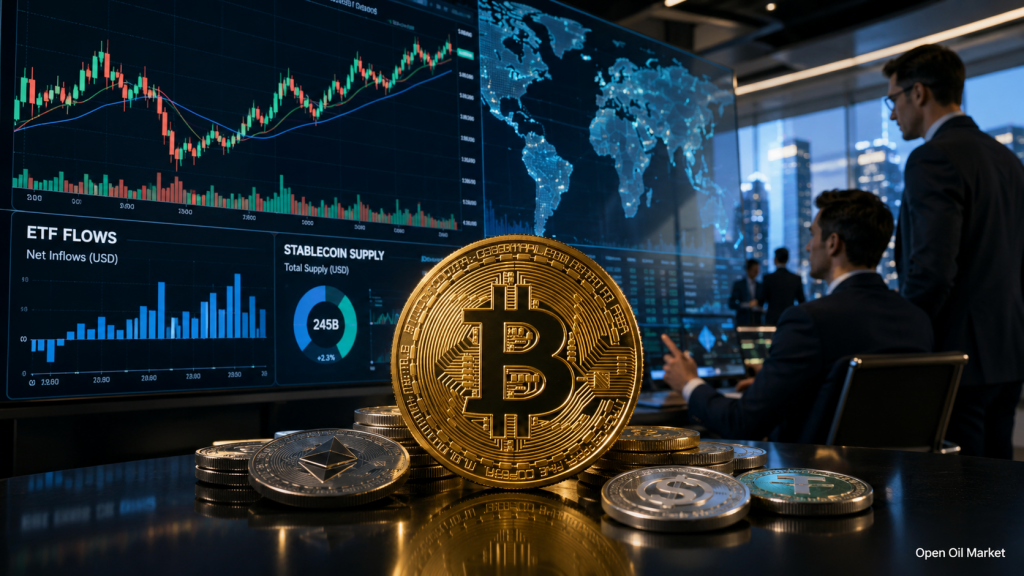
A key issue for Bitcoin has been the outflows from spot ETFs. After a period of strong institutional demand, some large investors have begun to reduce their positions. This does not indicate the demise of the long-term investment thesis for Bitcoin but shows that institutional capital has become more sensitive to volatility. While the launch of ETFs in 2024-2025 was viewed as a structural driver of demand, by 2026, the market is evaluating not just the existence of funds but the stability of cash flows within them.
- Bitcoin remains the largest cryptocurrency by market capitalization.
- ETF flows have become the primary indicator of institutional demand.
- The rise in geopolitical tension amplifies pressure on riskier assets.
- A return of stable inflows into funds is needed for market recovery.
Ethereum: Price Weakness But Retaining Its Infrastructure Role
Ethereum is also under pressure; however, its investment role differs from that of Bitcoin. While Bitcoin is perceived as a digital reserve asset, Ethereum continues to serve as the foundational platform for smart contracts, tokenization, DeFi, stablecoins, and corporate blockchain solutions. The decline in ETH prices does not negate the fact that a significant portion of global crypto infrastructure continues to be built around Ethereum and compatible networks.
For investors, the balance between price dynamics and network economics is crucial. On one hand, Ethereum suffers from ETF outflows and overall market caution. On the other hand, the growth of tokenized assets, the development of stablecoins, and banks' interest in programmable money support long-term demand for blockchain infrastructure. Therefore, in 2026, Ethereum remains an asset where short-term weakness does not necessarily equate to a deterioration of its fundamental position.
Stablecoins Become a Central Theme in Crypto Market
The most important theme at the end of May is not just the drop in Bitcoin but the accelerating competition in the stablecoin sector. Stablecoins are gradually transforming from a supportive tool for cryptocurrency trading into a standalone financial infrastructure for international settlements, digital payments, and tokenized assets.
The global market is witnessing an increasing struggle between dollar-based and non-dollar models of digital money. Dollar-backed stablecoins maintain dominance, but Europe, certain developing countries, and major fintech platforms are attempting to establish alternative solutions. For investors, this means that the stablecoin sector is becoming one of the key growth areas of the crypto industry, but simultaneously a zone of heightened regulatory scrutiny.
The launch of new nationally oriented stablecoins and discussions around central bank digital currencies hold particular significance. Private issuers can introduce products more quickly, but regulators are wary of risks to banking liquidity, monetary sovereignty, and financial stability. As a result, stablecoins are emerging not only as a cryptocurrency but also as a geo-economic topic.
XRP and Solana Benefit from Selective Capital Rotation
Amidst pressure on Bitcoin and Ethereum, investors are increasingly turning their attention to individual altcoins. XRP and Solana remain in the spotlight due to inflows into related investment products and expectations for the further development of ETF infrastructure. This does not automatically signify the onset of a broad altcoin season, but it points to a more selective approach to capital.
Solana continues to be perceived as a high-performance network for applications, payments, DeFi, and consumer crypto products. XRP maintains investment interest due to its role in payment infrastructure and sustained attention from exchange-traded products. For global investors, this is an important signal: the market is no longer buying all altcoins simultaneously but instead choosing assets with clear liquidity, usage history, and institutional access.
- Solana is attractive to investors as an infrastructure blockchain with high throughput.
- XRP remains connected to payment-related assets and institutional products.
- Capital rotation is selective rather than widespread across the altcoin market.
- Liquidity and regulatory clarity are becoming more important than short-term hype.
Hyperliquid Enters the Top 10 and Reshapes Market Structure
One of the most notable events at the end of May is Hyperliquid's emergence among the largest cryptocurrencies by market capitalization. For the market, this is an important signal: investors are ready to assess not only classic first-tier blockchains but also projects related to trading infrastructure, derivatives, liquidity, and on-chain finance.
Hyperliquid reflects a new phase in DeFi development, where value is created not just through the promise of scalability, but also through the actual use of the trading platform. For investors, this elevates the significance of the decentralized exchange and on-chain derivatives sector. However, the growth of such assets requires caution: a high rate of revaluation can amplify volatility, especially if the Bitcoin market remains weak.
Top 10 Most Popular Cryptocurrencies as of May 30, 2026
As of the time of writing, the largest cryptocurrencies by market capitalization are forming the following market structure. This list is important for investors as it shows where the main liquidity is concentrated and which assets the global market perceives as most significant.
- Bitcoin (BTC) — the main digital asset and fundamental indicator of sentiment in the crypto market.
- Ethereum (ETH) — the key platform for smart contracts, DeFi, and tokenization.
- Tether USDt (USDT) — the largest dollar-backed stablecoin and primary unit of account in crypto trading.
- BNB (BNB) — an asset of the Binance ecosystem and one of the largest exchange tokens.
- XRP (XRP) — cryptocurrency linked to payment infrastructure and institutional interest.
- USDC (USDC) — a regulated dollar-backed stablecoin important for DeFi and corporate transactions.
- Solana (SOL) — a high-performance blockchain for applications, DeFi, and payment solutions.
- TRON (TRX) — a network with high activity in stablecoin transfers.
- Dogecoin (DOGE) — the largest meme token with stable liquidity and strong retail demand.
- Hyperliquid (HYPE) — a rapidly growing project in on-chain trading and decentralized liquidity.
Regulation: The Cryptocurrency Market Becomes Part of Larger Politics
The regulatory agenda remains a primary factor for cryptocurrencies in 2026. In the United States, there is a more favorable approach to parts of the crypto business, including a reevaluation of certain claims against exchanges and the development of financial products. In Europe, however, discussions surrounding stablecoins remain more cautious: regulators are concerned about the outflow of banking deposits, increased reliance on dollar tokens, and potential risks to monetary policy.
For investors, this creates a heterogeneous picture. The American market may launch new crypto products more quickly, while the European model emphasizes control, banking resilience, and the digital euro. In the long term, projects that can operate across multiple jurisdictions, complying with reserve requirements, disclosure standards, and client protection, will benefit.
What Investors Should Monitor in the Coming Days
Saturday, May 30, 2026, could mark a day of risk reassessment for the cryptocurrency market following a volatile week. Investors should not only watch Bitcoin's price but also ETF behavior, liquidity in derivative markets, stablecoin dynamics, and the resilience of top 10 altcoins.
- ETF Flows: The return of inflows could improve sentiment towards Bitcoin and Ethereum.
- Geopolitics: Rising tensions support the demand for safe-haven assets and dampen crypto risk appetite.
- Stablecoins: New products and regulatory decisions will impact the entire market infrastructure.
- Solana and XRP: Continued inflows could confirm selective rotation into altcoins.
- Hyperliquid: Investors will evaluate whether HYPE's growth is sustainable or speculative.
Cryptocurrency Market Shifts from Euphoria to Selective Selection
The key takeaway for investors on May 30, 2026, is that the cryptocurrency market has matured and demands higher quality assets. The simple strategy of buying the market after Bitcoin's growth no longer appears universal. Investors are increasingly categorizing digital assets by function: Bitcoin as a reserve asset, Ethereum as the smart contract infrastructure, stablecoins as the payment layer, Solana and XRP as selective narratives of institutional demand, and Hyperliquid as a bet on on-chain trading.
Today's cryptocurrency news suggests that the global market is caught between two forces. On one hand, ETF outflows, geopolitical tensions, and macroeconomic uncertainty limit the appetite for risk. On the other hand, the development of stablecoins, tokenization, DeFi, and regulated investment products confirms that digital assets remain part of the long-term transformation of the financial system. For investors, this is a market not for emotional decisions but for disciplined analysis of liquidity, regulatory risks, and each asset's fundamental role in the new financial infrastructure.