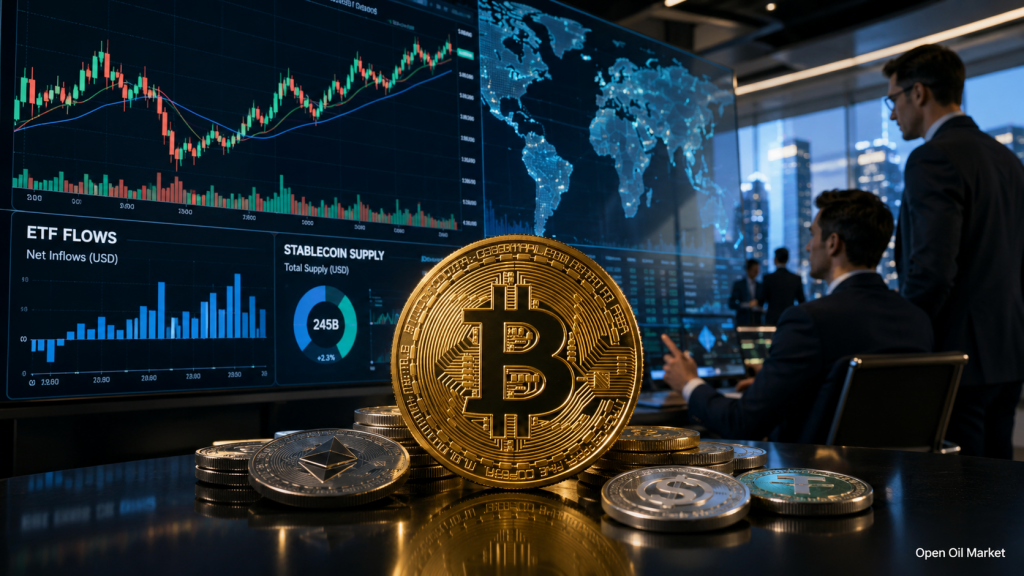
Current Cryptocurrency Market Overview for Saturday, 6 June 2026: Pressure on Bitcoin, ETF Dynamics, Growing Role of Stablecoins, Ethereum, Solana, XRP, BNB and Other Key Digital Assets for Global Investors
The cryptocurrency market enters Saturday, 6 June 2026, in a state of heightened volatility. Following an extended period of institutional interest, investors are once again assessing digital assets not only as a technological bet but also as a high-risk segment of the global capital market. The main theme of the day is weakening demand for Bitcoin, pressure on Ethereum, declining interest in some crypto ETFs, and capital reallocation toward artificial intelligence, technology stocks, and anticipated major IPOs.
For investors, this is a critical moment: the crypto market is increasingly less isolated from traditional finance. Bitcoin, Ethereum, stablecoins, Solana, XRP, BNB, Dogecoin, and other major digital assets now often respond to the same factors as growth stocks: cost of capital, liquidity, regulatory signals, risk appetite, and the flow dynamics of exchange-traded funds.
Bitcoin Loses Status as the Sole Centre of the Crypto Market
Bitcoin remains the largest digital asset and the primary sentiment indicator in cryptocurrencies, but its dominance is gradually becoming less absolute. Investors are increasingly viewing the market not as "Bitcoin versus everything else" but as a set of distinct segments: payment stablecoins, infrastructure blockchains, DeFi, real-world asset tokenisation, corporate solutions, and speculative altcoins.
The current weakness in Bitcoin is not solely due to technical correction. Three factors are weighing on the market:
- declining interest in cryptocurrencies amid rising appeal of the AI sector;
- outflows from certain spot Bitcoin ETFs;
- caution among institutional investors following the strong rally of 2025.
For long-term investors, this means Bitcoin remains the foundational asset of the crypto market, but it is no longer the only focus for analysis. Increasingly, capital is being distributed among stablecoins, Ethereum, Solana, BNB, XRP, and infrastructure tokens.
Ethereum Remains a Key Infrastructure Bet
Ethereum enters June under pressure alongside the broader market, but its investment profile differs from Bitcoin. While Bitcoin is perceived as a digital reserve asset, Ethereum remains the infrastructure for smart contracts, tokenisation, DeFi, NFTs, corporate blockchain solutions, and a portion of stablecoin turnover.
The key question for investors is whether Ethereum can maintain its status as the primary platform for institutional tokenisation amid competition from Solana, BNB Chain, Tron, and new high-performance networks. The pressure on Ethereum's price does not negate its fundamental role, but it compels investors to scrutinise fees, developer activity, transaction volume, and the network's share in stablecoin issuance.
Stablecoins Become a Distinct Centre of the Crypto Economy
One of the major developments of 2026 remains the strengthening role of stablecoins. Tether, USDC, and other dollar-pegged tokens are evolving beyond mere tools for crypto trading to become part of the global payment infrastructure. Their significance is especially pronounced in countries with high inflation, limited access to dollar liquidity, and growing demand for fast cross-border settlements.
For investors, the rise of stablecoins is important for several reasons:
- they enhance crypto market liquidity;
- they generate demand for short-term treasury instruments and money markets;
- they strengthen the link between cryptocurrencies and the banking sector;
- they become subject to stringent regulation in the US, Europe, and the UK.
Stablecoins are also reshaping market structure: whereas previously the main capital flow passed through Bitcoin and Ethereum, a significant portion of turnover now concentrates in dollar-denominated digital assets. This makes the crypto market more liquid but simultaneously increases its dependence on regulation, bank reserves, and central bank policies.
ETFs Are No Longer a Unanimous Growth Driver
The launch of spot cryptocurrency ETFs was one of the main catalysts for market institutionalisation, but in June 2026, investors are increasingly seeing the flip side of this process. ETFs simplified entry into cryptocurrencies for funds, family offices, and retail investors, but they have also made the market more sensitive to capital flows.
When inflows enter ETFs, Bitcoin and Ethereum receive support. When investors withdraw funds, the pressure rapidly transmits to the spot market. This is especially relevant for short-term dynamics: cryptocurrencies are becoming similar to other public risk assets, where fund flow movements sometimes matter more than industry-specific news.
The key takeaway for investors is simple: crypto analysis must now incorporate not only charts and on-chain metrics but also ETF data, the behaviour of major asset managers, growth stock yields, dollar liquidity, and interest rate expectations.
Top 10 Popular Cryptocurrencies for Investor Monitoring
The global market's focus remains on the largest digital assets by market capitalisation, liquidity, and institutional interest. They cannot be treated as a homogeneous group: each coin serves a distinct function and carries its own set of risks.
Key Market Assets
- Bitcoin (BTC) — the benchmark indicator for the crypto market and the primary digital reserve asset.
- Ethereum (ETH) — infrastructure for smart contracts, DeFi, and tokenisation.
- Tether (USDT) — the largest dollar stablecoin and main liquidity instrument.
- BNB (BNB) — the token of the Binance ecosystem and related blockchain services.
- USDC (USDC) — a regulated dollar stablecoin with a strong institutional role.
- XRP (XRP) — an asset linked to cross-border payments and payment infrastructure.
- Solana (SOL) — a high-performance blockchain for applications, tokens, and payments.
- TRON (TRX) — a network with high activity in the stablecoin and transfer segment.
- Dogecoin (DOGE) — the largest memecoin with high retail recognition.
- Cardano (ADA) — a blockchain platform focused on scalability and a research-driven approach.
For investors, it is important to differentiate these assets by function: Bitcoin as a reserve bet, Ethereum and Solana as infrastructure, USDT and USDC as liquidity, XRP and TRON as payments, Dogecoin as retail risk appetite, and Cardano as a long-term technological hypothesis.
Regulation Becomes the Primary Valuation Factor
Cryptocurrencies are increasingly coming under regulatory scrutiny. The US, European Union, UK, and Asian financial centres are formulating rules for stablecoins, exchanges, custodial services, tokenised assets, and crypto funds. For the market, this is a dual-edged factor.
On one hand, regulation reduces legal uncertainty and paves the way for institutional capital. On the other hand, it raises costs for issuers, exchanges, and DeFi projects. Particularly sensitive issues remain stablecoin reserves, disclosure requirements, anti-money laundering measures, investor protection, and the legal status of individual tokens.
The global emphasis is shifting from the idea of a "completely unregulated market" toward a model where cryptocurrencies become part of the financial infrastructure. This makes the sector more mature but less permissive for aggressive experimentation.
Risks: Volatility, Security, and Technological Failures
The June volatility reminded investors that the cryptocurrency market remains technologically complex and risky. Beyond price fluctuations, important risks include protocol security, code vulnerabilities, bridge issues, network outages, and errors in privacy mechanisms or token issuance.
The most vulnerable assets remain those with low liquidity, weak infrastructure, opaque tokenomics, and high reliance on retail demand. Therefore, investors should assess not only potential returns but also ecosystem quality: developers, audits, decentralisation, liquidity depth, network resilience, and regulatory risks.
What Matters to Investors on 6 June 2026
As of Saturday, 6 June 2026, the baseline scenario for the crypto market remains cautious. Pressure on Bitcoin and Ethereum, outflows from some ETFs, competition from the AI sector, and the growing role of stablecoins paint a more complex picture than a typical post-rally correction.
Investors should focus on several key indicators:
- changes in flows into Bitcoin ETFs and Ethereum ETFs;
- dynamics of Bitcoin dominance and stablecoin share;
- behaviour of Ethereum, Solana, and BNB as infrastructure assets;
- regulatory news from the US, Europe, and the UK;
- risk appetite in global equities, especially the AI sector;
- liquidity levels on crypto exchanges and in DeFi protocols.
The main takeaway for global investors: cryptocurrencies remain an important but more mature asset class requiring deeper analysis. The market can no longer be evaluated solely through Bitcoin growth expectations. In 2026, the key themes are institutional flows, regulation, stablecoins, tokenisation, blockchain competition, and the ability of digital assets to compete for capital with artificial intelligence stocks and traditional financial instruments.