Overview of Economic Events and Corporate Reports for the Week of June 29 — July 5, 2026: US Labor Market, Non-Farm Payrolls, PMIs from China, Europe, and the US, Inflation in the Eurozone, Germany, and Russia, Financial Congress of the Central Bank of Russia, Reports from Nike, General Mills, FactSet, and OPEC+ Meeting
The week from June 29 to July 5, 2026, will be one of the most eventful for global investors at the intersection of the month, quarter, and the first half of the year. The focus will be on economic events in the United States, labor market data, PMIs, inflation in the Eurozone, Germany, Switzerland, Russia, and Turkey, as well as comments from major central banks. For markets like S&P 500, Euro Stoxx 50, Nikkei 225, and MOEX, this week is significant not only in terms of macroeconomics but also as a period for reassessing expectations for interest rates, corporate profits, and capital flows.
The main risk of the week is the combination of US employment statistics, June PMIs, and geopolitical news concerning negotiations between the US and Iran, the trade deadline between the US and EU, as well as the OPEC+ meeting. Corporate reports will be fewer than during peak season, but among large public companies, Nike, Constellation Brands, General Mills, FactSet, Prosus, Naspers, AeroVironment, Concentrix, MSC Industrial, UniFirst, Greenbrier, and Lindsay stand out. For investors, this means the market will assess not only actual profits but also the state of consumer demand, the defense sector, industry, food companies, and technology assets.
Economic Events Monday, June 29, 2026: US-Iran Negotiations, Eurozone Inflation Expectations, and Lagarde's Speech
Monday will kick off the week cautiously, but the political and economic backdrop will be tense. The anticipated new round of US-Iran negotiations in Burgenstock is important for the oil market, gas quotes, commodity currencies, and energy company stocks. Any signals of de-escalation could reduce the geopolitical risk premium in Brent and WTI, while a breakdown in talks could drive demand for safe-haven assets.
- Eurozone — Consumer Inflation Expectations for June, 12:00 MSK. This indicator is important for assessing inflation resilience and further ECB actions.
- US — Dallas Fed Manufacturing Business Index for June, 17:30 MSK. The regional indicator will show the state of the industry in the energy-crucial state of Texas.
- Speech by ECB President Christine Lagarde, 20:30 MSK. Investors will look for signals regarding the trajectory of interest rates and the resilience of the European economy.
Corporate Reports of the Day. Among major public companies, Prosus will attract attention as it publishes its annual results for FY2026; along with it, Naspers will also disclose its financial reports. These releases are important for investors in European and emerging market technological assets, as Prosus remains one of the largest shareholders in Tencent and an indicator of demand for digital platforms. In the US, after market close, reports from AeroVironment and Concentrix are expected. AeroVironment is significant as a representative of defense technologies and unmanned systems, while Concentrix serves as a bellwether for corporate spending on outsourcing and customer services.
What to pay attention to as an investor: oil, safe-haven assets, shares of European tech holdings, the US defense sector, and the response of the euro to ECB comments.
Economic Events Tuesday, June 30, 2026: China's PMIs, UK GDP, Germany's CPI, JOLTS, and Nike Report
Tuesday will be one of the key days of the week. The last day of the month and the quarter traditionally increases the likelihood of window-dressing: fund managers may adjust positions in stocks, bonds, gold, oil, and currencies to improve the appearance of portfolios on the reporting date. This is particularly significant for S&P 500, Euro Stoxx 50, Nikkei 225, and MOEX, where quarterly rebalancing may increase intraday volatility.
- China — Manufacturing, Services, and Composite PMIs for June, 04:30 MSK. The data will show the state of the second-largest economy in the world and demand for commodities.
- Australia — Minutes from the last RBA meeting, 04:30 MSK. Important for AUD and commodity currencies.
- UK — GDP for Q1 2026, 09:00 MSK. The market will assess whether growth continues after a period of high borrowing costs.
- Germany — CPI for June, 15:00 MSK. One of the main benchmarks ahead of pan-European inflation.
- Canada — GDP for April, 15:30 MSK. Important for the Canadian dollar and oil and gas companies.
- US — Case-Shiller, Chicago PMI, JOLTS, and Consumer Confidence, 16:00–17:00 MSK. The main focus will be on JOLTS vacancies and consumer confidence.
- US Oil — API Inventories, 23:30 MSK. The data will set the tone ahead of the EIA report.
Corporate Reports of the Day. The main release will be Nike, the only representative of Dow Jones among the key reports of the week. Investors will evaluate sales dynamics, margins, the situation in China, the impact of the World Cup, and the pace of business model adaptation after brand pressure. Constellation Brands is also reporting, significant for analyzing the US consumer sector, demand for premium beverages, and American consumer behavior. Additionally, the report from Progress Software is expected, which will give signals regarding corporate demand for software.
What to pay attention to as an investor: JOLTS data, CPI in Germany, PMI in China, Nike shares, the US consumer sector, and dollar movements at the end of the quarter.
Economic Events Wednesday, July 1, 2026: Global PMIs, Eurozone CPI, ADP, ISM, and First Day of the Financial Congress of the Central Bank of Russia
Wednesday will be the most jam-packed macroeconomic day of the week. There will be no trading in Canada and Hong Kong, but the global calendar includes Manufacturing PMIs from nearly all key economies: Australia, Japan, China, India, Russia, Switzerland, Germany, the Eurozone, the UK, and the US. For investors, this serves as a synchronized test of global industry, logistics, export demand, and price pressures.
- China — Caixin Manufacturing PMI, 04:45 MSK. This private indicator is especially important for assessing small and medium-sized businesses.
- Russia — Manufacturing PMI, 09:00 MSK. The indicator is vital for evaluating the industrial cycle and MOEX stocks.
- Germany and Eurozone — Manufacturing PMI, 10:55–11:00 MSK. A key signal for the Euro Stoxx 50.
- Eurozone — Preliminary CPI for June, 12:00 MSK. The main European inflation release of the week.
- US — ADP Nonfarm Employment, 15:15 MSK, S&P Manufacturing PMI, 16:45 MSK, ISM Manufacturing PMI, 17:00 MSK. These data will shape expectations ahead of NFP.
- Russia — Protocol from the Central Bank of Russia meeting, 15:30 MSK, and CPI, 19:00 MSK. Important for the ruble, OFZ, and banking sector.
- US Oil — EIA Inventories, 17:30 MSK. A key indicator for energy stocks and the oil sector.
A special focus will be on the first day of the Financial Congress of the Central Bank of Russia in St. Petersburg. For investors in Russian assets, comments on monetary policy, inflation, the ruble exchange rate, the banking sector, the capital market, and regulation of digital financial assets are crucial. At the global policy level, the forum is expected to feature a panel involving leaders of major central banks, including the ECB, the Bank of England, the Bank of Canada, and the Federal Reserve.
Corporate Reports of the Day. In the US, key releases include General Mills and FactSet. General Mills will show the state of food consumption, pricing discipline, and margins in the essentials segment. FactSet is important for assessing the demand for financial analytics, data, and terminal services from banks, asset managers, and investment companies. Also among notable reports are MSC Industrial Direct, UniFirst, National Beverage, and Greenbrier. In Russia, the Moscow Exchange will publish trading volume data for the previous month, which will be important for assessing investor activity and commission income of the exchange infrastructure.
What to pay attention to as an investor: ISM Manufacturing, Eurozone CPI, Russian inflation, the Central Bank of Russia protocol, General Mills and FactSet reports, as well as trading volumes on MOEX.
Economic Events Thursday, July 2, 2026: Non-Farm Payrolls, US Unemployment Rate, and Second Day of the Financial Congress of the Central Bank of Russia
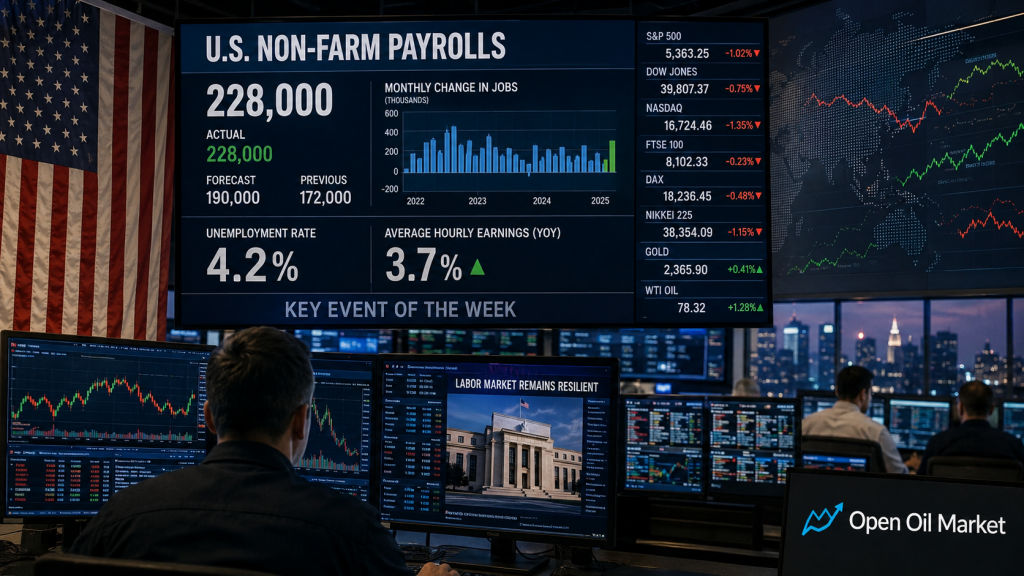
Thursday will be the main day of the week for global markets. Due to the closing of trading in the US on Friday, the labor market report is released earlier than usual. Non-Farm Payrolls, the unemployment rate, and initial jobless claims will simultaneously shape the picture of employment, wage pressure, and resilience of the US economy.
- Switzerland — CPI for June, 09:30 MSK. Important for the Swiss franc and expectations regarding SNB policy.
- US — Non-Farm Payrolls, unemployment, and Initial Jobless Claims, 15:30 MSK. The main block of the week for the dollar, Treasuries, gold, and S&P 500.
- Canada — Manufacturing PMI, 16:30 MSK. Important for CAD and the commodity sector.
- US — Factory Orders for May, 17:00 MSK. An additional signal for industry.
- US — EIA Natural Gas Inventories, 17:30 MSK. Important for gas quotes and energy companies.
In Russia, the Financial Congress of the Central Bank of Russia continues. The second day could be particularly significant for banks, brokers, insurers, fintech companies, and bond issuers. Investors will monitor discussions on monetary policy, banking regulation, financial market development, and potential changes in the capital circulation infrastructure.
Corporate Reports of the Day. The reporting agenda will be noticeably more modest than on Wednesday. Among public companies, Lindsay, a manufacturer of irrigation equipment and infrastructure solutions, and Park Aerospace stand out. For the European consumer sector, investors will track publications and comments from Sodexo through over-the-counter instruments and corporate disclosures. In major indices like Euro Stoxx 50 and Nikkei 225, there are fewer significant mass reports on this day, so the focus will shift to macro data and bond yields.
What to pay attention to as an investor: NFP, the US unemployment rate, the reaction of UST yields, gold, the dollar, the banking sector, and Russian financial companies.
Economic Events Friday, July 3, 2026: US Markets Closed, Services PMI, and Currency Operations by the Central Bank of Russia
Friday will see no trading in the US due to the observed Independence Day, so liquidity in global markets may be lower than usual. This increases the risk of sharp movements in individual assets, especially if unexpected data on services, inflation, or currency operations are released. For investors worldwide, Friday will be a day of assessing the state of the services sector, which remains a key driver of inflation and employment.
- Australia, Japan, China, India, Russia, Eurozone, and UK — Services and Composite PMIs for June. This data will reflect the state of the services sector, domestic demand, and business activity.
- Turkey — CPI for June, 10:00 MSK. An important release for emerging markets and currencies of developing countries.
- Central Bank of Russia — Volumes of currency purchases or sales in July, 12:00 MSK. A key factor for the ruble, OFZ, and the Russian stock market.
- Brazil — S&P Services and Composite PMI, 16:00 MSK. An important signal for Latin American markets.
- Speech by Bank of England Governor Andrew Bailey, 18:00 MSK. Investors will look for inflation and rate signals from the UK.
Corporate Reports of the Day. Due to the closure of the US market, there are virtually no major reports from S&P 500 companies. Focus shifts to corporate news, preliminary trading updates, dividend decisions, and management comments from companies across Europe, Asia, and Russia. For MOEX, potential reactions to the parameters of the Central Bank of Russia's currency operations and the outcomes of the first days of the Financial Congress of the Central Bank of Russia will be important.
What to pay attention to as an investor: Services PMI, actions by the Central Bank of Russia in the currency market, low liquidity due to the US market closure, the British pound, and European bonds.
Economic Events Saturday, July 4, 2026: US Independence Day and Trade Deadline for Europe
Saturday is not formally an active trading day, but the news backdrop may influence market openings on Monday. The US celebrates Independence Day, while for Europe, the deadline related to trade agreements with Washington is crucial. If negotiations on the trade regime between the US and EU conclude constructively, this could reduce risks for European exporters, the automotive industry, industrial companies, and the consumer sector. However, if there is a threat of increased tariffs, pressure may shift onto the Euro Stoxx 50, European auto manufacturers, the chemical industry, and global supply chains.
Corporate Reports of the Day. There are virtually no regular quarterly reports from large public companies on Saturday. However, investors should track statements from governments, trade offices, the European Commission, and major industrial groups, as political signals may become the main driver of Monday's opening.
What to pay attention to as an investor: trade risks between the US and EU, the European auto sector, industrial stocks, the euro, the dollar, and inflation expectations for imported goods.
Economic Events Sunday, July 5, 2026: OPEC+ Meeting and Commodity Market Sentiment Ahead of the New Week
Sunday will conclude the week with an OPEC+ meeting. For investors, this is a key event in the commodity market, especially amid geopolitical uncertainty surrounding Iran, supply routes through the Middle East, and the balance of oil supply and demand. OPEC+ decisions on quotas and comments from major participants may influence Brent, WTI, oil and gas stocks, inflation expectations, and currencies of resource-exporting countries.
For the Russian market, the OPEC+ meeting is particularly significant, as the oil and gas sector remains one of the main components of the MOEX index, a source of export revenues, and a factor for the budget. Any signals regarding an increase in production could suppress oil prices, while a cautious stance from the alliance might support commodity prices and shares of oil and gas companies.
Corporate Reports of the Day. There are virtually no publications from large companies on Sunday; however, oil and gas issuers, oil service companies, equipment manufacturers, carriers, and commodity currencies may gain momentum at the opening of the following week.
What to pay attention to as an investor: OPEC+ decision, dynamics of Brent and WTI, Russian oil and gas sector, inflation expectations, and demand for safe-haven assets.
Week Summary: What to Pay Attention to as an Investor
The week of June 29 — July 5, 2026, encompasses multiple market narratives: the US labor market, global PMIs, inflation in Europe and Russia, central bank policies, corporate reports, and commodity risks. For S&P 500 investors, the main event will be Non-Farm Payrolls and reports from Nike, Constellation Brands, General Mills, and FactSet. For Euro Stoxx 50, key factors will be Eurozone CPI, PMIs from Germany, ECB forum, and trade negotiations with the US. For Nikkei 225, important aspects include Japan's PMIs, demand dynamics in Asia, and the Japanese Prime Minister's visit to India. For MOEX, the focus shifts to the Financial Congress of the Central Bank of Russia, Russia's inflation, currency operation parameters of the Central Bank of Russia, and the OPEC+ meeting.
- Rates and Bonds. A strong US labor market may heighten expectations for the Fed's hawkish policy and raise Treasuries yields.
- Stocks. Reports from Nike, General Mills, and FactSet will showcase the resilience of consumer demand, margins, and corporate spending.
- Currencies. The euro will depend on CPI and ECB comments, while the ruble will rely on inflation, the Central Bank of Russia, and oil prices.
- Commodities. Oil will remain sensitive to US-Iran negotiations, inventory data, and OPEC+ decisions.
- Risks. Low liquidity at the end of the week due to the US closure may amplify movements in gold, oil, currency pairs, and futures.
For the global investor, the strategy for the week should be cautious: avoid overloading the portfolio with unilateral bets ahead of the NFP, closely monitor inflation releases, and evaluate corporate reports not only based on earnings per share but also on management forecasts. The main question of the week is whether macro data will confirm the scenario of a soft landing for the global economy or reignite fears over inflation, interest rates, and geopolitics in the markets.