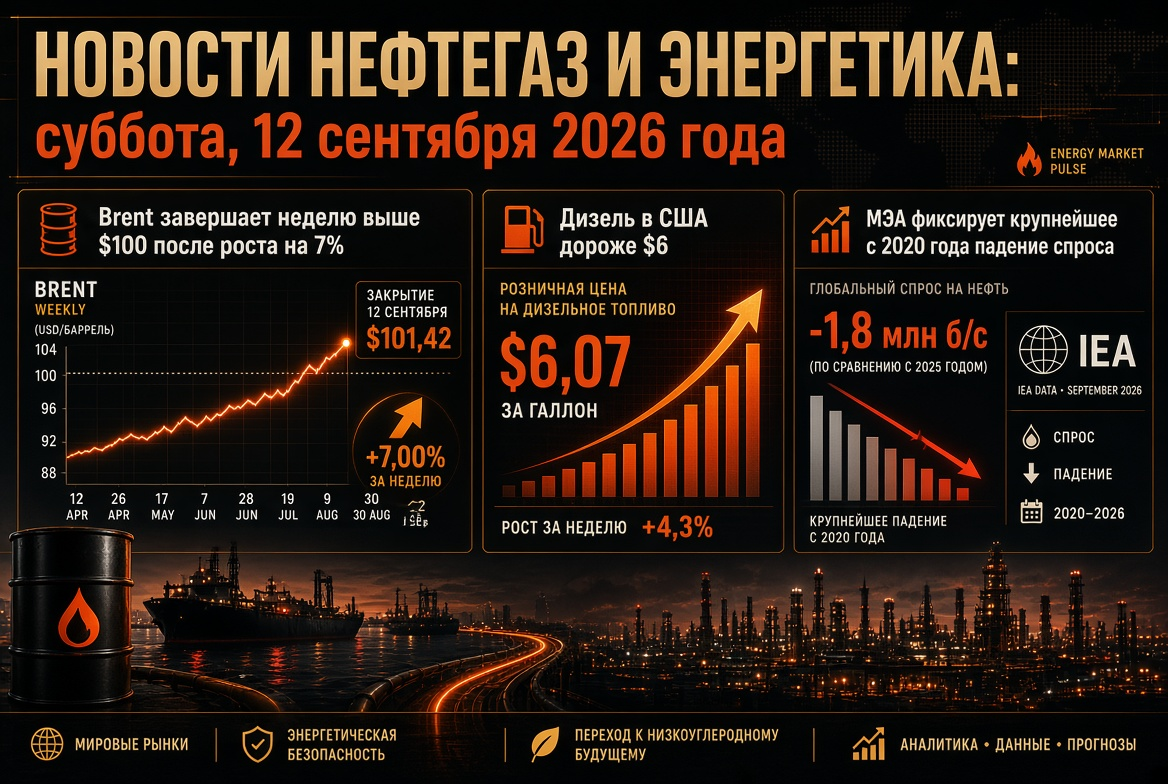
The global fuel and energy complex is entering a price shock environment on September 9, 2026. Brent crude has surpassed the $99 per barrel mark for the first time since late July, the European gas hub TTF is trading near $900 per thousand cubic meters, and gas storage facilities in the EU are filled to levels lower than any year since 2011. For investors, fuel companies, refinery operators, and participants in the global energy market, the key question of the day is straightforward: will the geopolitical premium in oil and gas prices lead to a full-blown physical supply shortage.
Global Energy Market Overview: Oil, Gas, Electricity, Coal, and Renewables as of September 9, 2026
Main Topic of the Day: Hormuz Strait at the Point of No Return
The escalation around the Hormuz Strait remains the central driver of the entire raw materials sector — a maritime corridor through which approximately one-fifth of global oil supplies passed before the crisis. Following a series of American strikes on facilities in the strait zone in September, Tehran has declared its intention to respond and threatened to halt shipping completely, while also announcing the creation of a "forbidden zone" outside the strait, which directly impacts tanker insurance.
The physical picture is already critical. According to vessel tracking estimates, only about ten vessels carrying raw materials have been passing through the strait daily over the past ten days. The transit of crude oil and petroleum liquids in Q2 2026 averaged about 4.9 million barrels per day, down from 21.6 million barrels per day in Q4 2025. Global oil inventories decreased by approximately 4.2 million barrels per day in Q2, and an additional decline of 3.8 million barrels per day is expected in Q3.
Oil: Brent at $99, WTI above $93 — Risk Premium in Action
Key oil market benchmarks as of Wednesday morning:
- Brent (November Future, ICE Futures): traded in the range of $97.9–99.2 per barrel, gaining over 2% on Tuesday and reaching a high not seen since late July.
- WTI (October Contract, NYMEX): settled above $93 per barrel, increasing by about 2% during the session.
- Weekly Dynamics: Brent rose about 8%, while WTI increased nearly 10%, marking one of the strongest weekly gains of the current year.
- Annual High 2026: $126.41 per barrel for Brent, recorded on April 30 — the peak since March 2022.
Forecast disparities among investment banks today are unusually wide. As attacks on vessels in the region escalate, the target scenario for Brent shifts to $120 per barrel; with a normalization of exports from the Persian Gulf — back to $80. Analysts warn that supply restrictions from the Gulf may persist until the end of 2026, and a full recovery in maritime traffic through Hormuz is not expected before the end of Q1 or early Q2 of 2027.
Another vulnerability factor is the U.S. strategic petroleum reserve, which has fallen to approximately 286.6 million barrels. This is a multi-year low, significantly reducing Washington's ability to absorb external supply shocks.
OPEC+ Takes a Breather: October Oil Production Quotas Unchanged
Seven OPEC+ countries involved in voluntary cuts — Russia, Saudi Arabia, Iraq, Kuwait, Kazakhstan, Algeria, and Oman — extended the September quotas into October without changes following an online meeting on September 6, halting a series of increases. Target levels: Russia — 9.949 million barrels per day, Saudi Arabia — 10.478 million barrels per day, Oman — 841 thousand barrels per day.
The logic behind the decision is clear: in September, the alliance completed the phased return of 1.65 million barrels per day in voluntary cuts, leaving no room for further increases without revisiting base levels for 2027, and a reduction in production would contradict market conditions amid the ongoing Middle Eastern crisis. The next meeting is scheduled for October 4, 2026. For oil companies, this signals predictability in supply from the cartel amid complete unpredictability in transportation corridors.
European Gas Market: Underground Storage at Minimum Since 2011, TTF at $900
The European gas market enters the heating season in the worst shape in a decade and a half. According to operators of gas infrastructure, as of September 1, EU storage was filled to 65.39% (69.73 billion cubic meters), rising to 66.59% (about 72.9 billion cubic meters) by September 5. This is approximately 16.6 percentage points lower than the five-year average and nearly 12 points lower than last year's level.
The situation across key markets is extremely uneven:
- Germany — about 53%, the worst result among major EU economies.
- Austria — around 67%.
- France — approximately 71%.
- Italy — over 83%, the only large market near a comfortable zone.
October futures for TTF exceeded $900 per thousand cubic meters at the beginning of September for the first time since late December 2022 and are holding in the range of $860–900. European operators are virtually injecting gas at price peaks, while some analysts are openly warning that it will not be possible to fill storage to safe levels by winter at current prices.
LNG and Coal: Gas Shortage Returns Coal Generation to Play
The tightening of the liquefied natural gas market is reshaping the global energy balance. The LNG deficit in 2026 is estimated at around 35 million tons, forcing import-dependent countries in Asia to increase coal generation. Global demand for coal may rise by approximately 3%, or 274 million tons, to around 9.1 billion tons.
The reaction in Northeast Asia is particularly telling: coal output in South Korea has increased by nearly 40% to the highest level since 2019, and in Japan, it has risen by over 11% while gas generation has simultaneously decreased. At the same time, several countries in Asia and Europe have implemented energy-saving measures to curb costs for imported fuel. For the coal sector, this signifies an unexpectedly strong market situation where structural contraction in demand was anticipated just a year ago.
Sanctions, Discounts, and Reconfiguration of Oil and Oil Products Logistics
The sanctions landscape remains the second most significant factor for the global oil and gas sector after Hormuz. Blocking restrictions against the largest Russian oil companies keep the discount of Russian crude to Brent elevated: the average discount level in 2026 is estimated at around $22 per barrel, with the prospect of narrowing to approximately $17 by the end of the year as logistics adapt.
Simultaneously, global freight flows are being redistributed: countries in the Persian Gulf are increasingly using alternative export routes to bypass the strait, while the rise in production outside OPEC partially compensates for the volumes lost. These factors are what the market believes continues to keep Brent below the psychological $100 mark.
Russian Oil Products Market: Refineries, Exchanges, and the Second Wave of Fuel Shortages
The domestic fuel market in Russia has remained in crisis mode since May 2026. Key parameters of the situation include:
- Refining: according to authorities, every tenth refinery is currently under repair; downtime has reached about 0.35 million tons per day.
- Export Restrictions: a complete ban on gasoline exports has been extended until January 31, 2027, with the embargo on diesel fuel exports being repeatedly prolonged for producers.
- Exchange: the reduced regulation of mandatory gasoline sales at auctions has been extended to the end of 2026; meanwhile, a significant portion of exchange contracts remains unfulfilled.
- Imports: maritime shipments of gasoline from India have commenced, with the potential import volume estimated at up to 400 thousand tons per month, primarily into vertically integrated company networks.
- Quality: manufacturers have been temporarily allowed to produce fuel of a lower environmental class to expand supply.
The situation remains most painful for independent gas stations: retail prices are held back administratively, while procurement costs are rising faster.
Electric Power and Renewables: Historic Shift in Global Energy Balance
Against the backdrop of raw material turbulence, the structural trend of energy transition is not reversing but accelerating. Global demand for electricity is expected to rise by 3.6% in 2026 and by 3.8% in 2027 — from 28,600 TWh in 2025 to around 30,700 TWh by 2027. Drivers include industry, electric transport, air conditioning, and rapidly growing energy consumption of data centers for artificial intelligence.
The main event of the year in the energy sector is that renewable sources have, for the first time in history, surpassed coal in global output. Solar generation has added about 600 TWh, moving into second place among renewables after hydro, surpassing wind. Regional demand dynamics: China +5.5%, India around +7%, the USA and EU — approximately 2% each. For investors, this means continued capital flows into solar and wind generation, energy storage, and grid infrastructure.
Weekly Calendar: What Market Participants Should Watch
The coming days will give the market its first reconciliation of forecasts with reality in a month. In focus will be updated monthly reviews from relevant agencies and the cartel, statistics on oil and oil product inventories in the U.S., as well as foreign trade data from China, which will reveal the actual scale of the drop in Asian demand. Recall that in the August forecast, the average annual price for Brent in 2026 was raised to nearly $87 per barrel, with expectations of around $85 in Q3 and a drop to $78 in Q4 — these figures now seem candidates for another upward revision at current prices. An additional seasonal factor: September–October is the period of scheduled repairs for U.S. refineries, which temporarily reduces refining loads and the output of oil products.
Conclusions and Risks for Investors and Energy Companies
- Oil. As long as the Hormuz crisis does not de-escalate, the risk of Brent settling above $100 per barrel remains fundamental, and the range of scenarios on the horizon for the quarter is abnormally wide — from $80 to $120.
- Gas. Europe is entering winter with a historic shortage of reserves; any cold snap or new disruptions to LNG supplies could drive TTF prices back to four-digit values.
- Coal. The gas shortage provides coal generation in Asia with an unplanned demand window — contradicting the long-term trajectory of decarbonization.
- Oil Products and Refineries. High crack spreads support refining margins, but export restrictions and logistics risks are redistributing profits among regions.
- Renewables. The structural shift toward renewable energy remains the only truly predictable element in the equation and a major benchmark for long-term investments in energy.
The conclusion for the global energy sector today is straightforward: in the short term, the prices of oil, gas, and electricity are determined by the geopolitics of the Persian Gulf, in the medium term — by Europe’s ability to endure the winter with partially empty storage facilities, and in the long term — by the pace of energy transition. For stakeholders in the energy sector, scenario planning, logistics diversification, and strict risk control in hedging are critically important in these circumstances.