The Global Oil, Gas, Power, and Petroleum Products Market Approaches July 16, 2026, with Mixed Signals: Brent and WTI Prices, Risks in the Strait of Hormuz, LNG Market, European Gas, Refinery Margins, Petroleum Products, Electricity, Renewables, and Coal
The world energy sector is approaching Thursday, July 16, 2026, in a state of heightened volatility. Oil remains sensitive to events surrounding the Strait of Hormuz, the gas market is re-evaluating LNG supply risks and the filling of European storage, electricity generation is facing an increase in summer demand, and petroleum products and refineries are becoming one of the most profitable segments of the energy chain. For investors, participants in the energy sector, fuel companies, and oil enterprises, the key question of the day is how resilient the current balance is between raw materials, logistics, refining, and end demand.
Oil: Brent and WTI Decline, but Geopolitical Premium Persists
A key theme in the oil market is the divergence between geopolitical risks and actual inventory data. Brent and WTI remain above early summer levels; however, the market is no longer reacting to every news item from the Middle East with sharp price spikes. Investors are seeing a partial restoration of supplies through the Strait of Hormuz, while U.S. inventory data does not confirm a scenario of imminent oil shortages.
Yet, the oil and gas sector maintains a high risk premium. Any deterioration in the situation in the Strait of Hormuz, the Bab el-Mandeb Strait, or around the Persian Gulf’s export infrastructure could swiftly push Brent back to higher levels. For oil companies, this indicates support for cash flow, but for refineries and consumers of petroleum products, it raises uncertainty in raw material procurement.
The Strait of Hormuz Remains a Key Factor in Global Energy
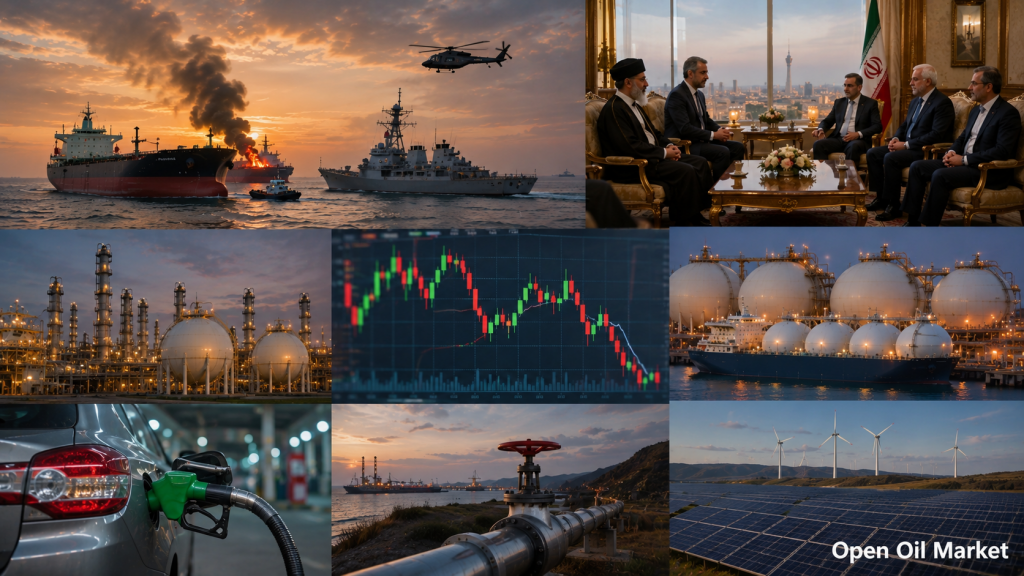
The Strait of Hormuz continues to be a strategic point for oil, gas, and LNG. Before the crisis, a significant portion of global hydrocarbon flows passed through this route, making even partial restrictions on tanker movements change the economics of supply for Europe, Asia, and the Middle East. The market has already adapted to the news backdrop, but has not removed the risk of a complete disruption.
- For the oil market, the Hormuz risk means a premium in Brent and WTI prices.
- For the gas market, increased competition for LNG between Europe and Asia.
- For petroleum products, pressure on margins, logistics, and insurance rates.
- For electricity, an increased role for gas and coal as backup generation sources.
This is why news in the oil and gas sector on July 16, 2026, focuses not only on oil prices but also on the physical availability of raw materials, refinery capacities, and the speed of trade flow recovery.
Refineries and Petroleum Products: Refining Becomes the Profit Center
The strongest signal for the energy market is currently coming from the refining segment. Global refinery margins remain high as crude oil becomes more accessible after a partial restoration of supplies, while the petroleum products market remains tense. Diesel, gasoline, aviation fuel, and LPG are trading at a premium due to restrictions on certain export destinations, maintenance work, attacks on infrastructure, and a lack of available capacities.
For fuel companies, this creates a mixed picture. On one hand, high crack spreads support the profitability of refiners. On the other hand, wholesale buyers of petroleum products face increased price volatility and supply disruption risks. Markets that depend on diesel and gasoline imports are particularly sensitive to this: Europe, parts of Asia, Latin America, and certain African countries.
Gas and LNG: Europe Battles for Molecules Again
The gas market enters mid-July with stiff competition for LNG. European storage is filling slower than required for a comfortable winter, and gas prices in Europe remain elevated. TTF and related European benchmarks reflect not only seasonal demand but also fears of LNG supply disruptions due to Middle Eastern geopolitics.
Asia also remains an active LNG buyer. The Japanese-Korean marker JKM is holding at levels that make competition between Europe and Northeast Asia particularly noticeable. For the global oil and gas market, this means LNG is becoming again not just a commodity, but a tool for energy security.
- Europe needs to accelerate gas injection into underground storage.
- Asia must maintain supply flexibility before peak demand seasons.
- LNG producers gain a strong negotiating position.
- Gas consumers face the risk of higher electricity costs and industrial expenses.
Electricity: Heat, Data Centers, and Gas Generation Shift Demand
The electricity sector is becoming one of the central themes of the global energy market. Summer heat is increasing demand for air conditioning, while the growth of data centers, artificial intelligence, electrification of transport, and industry is shaping a more stable long-term load on the networks. In the U.S., Europe, and Asia, discussions increasingly focus not only on electricity prices but also on the physical ability of networks to connect new large loads.
In this context, gas generation retains strategic significance. Despite the development of renewables, energy systems require controllable capacities that can quickly meet evening peaks and periods of weak wind generation. This supports demand for gas, turbines, energy storage, and electricity transmission infrastructure.
Renewables and Storage: Growth Continues, but the Market Demands Flexibility
The renewables sector remains a crucial area for the energy transition, but in 2026, investors are evaluating it more pragmatically. Solar and wind generation continue to decrease in cost and increase their share in the energy balance; however, without storage, network investments, and flexible demand, their influence on system reliability is limited.
For investors, the key takeaway is that renewables should no longer be viewed in isolation from infrastructure. Projects that integrate solar generation, wind, battery systems, gas backup power, and corporate PPAs into a single model become the most attractive. This approach is particularly rapidly evolving in the vicinity of data centers, industrial clusters, and energy-intensive production.
Coal: Demand Structurally Decreases, but Remains a Reserve for Energy Security
The coal market in mid-July shows a weakening compared to the previous month, but remains above last year’s levels. This reflects the dual role of coal in the global energy landscape. On one hand, long-term, it is being displaced by renewables, gas, and decarbonization policies. On the other hand, with high gas prices, LNG disruptions, and peak electricity demand, coal generation is again becoming a backup tool for energy systems.
For the raw material sector, this means continued demand for thermal coal in Asia, certain European markets, and countries with limited gas infrastructure. However, the investment profile of coal remains more risky: regulatory pressure, ESG factors, and capital costs restrict the long-term attractiveness of new projects.
What It Means for Investors and Energy Companies
For investors, the current configuration of the energy market appears as a blend of high short-term margin opportunities and growing systemic risks. Companies that currently hold strong positions are those that control multiple links in the chain: extraction, logistics, refining, trading in petroleum products, gas generation, or LNG infrastructure.
- Oil companies benefit from the sustained risk premium but depend on the political stability of export routes.
- Refineries receive support from high margins on petroleum products, especially diesel and gasoline.
- Gas companies profit from LNG and electricity demand.
- Energy holdings must invest in networks, storage, and controllable generation.
- Fuel companies face the need to manage inventories, logistics, and price risks.
What to Watch on July 16, 2026
The main indicators of the day for the oil, gas, and electricity markets will be the dynamics of Brent, WTI, TTF, JKM, crack spreads, levels of oil and petroleum product inventories in the U.S., rates of gas storage filling in Europe, export flows through the Strait of Hormuz, and refinery utilization. Additionally, investors should monitor coal prices, spot electricity prices in Europe and the U.S., as well as corporate statements from oil and gas companies regarding capital expenditures and the redistribution of investments among extraction, LNG, renewables, and electricity generation.
The baseline scenario for Thursday is the retention of volatility without an immediate price shock. However, the energy market remains vulnerable: if geopolitics strikes physical supplies again, oil, gas, petroleum products, and electricity could quickly enter a new phase of growth. Therefore, for investors, the focus should not be on betting on a single asset but rather on taking a diversified view across the entire energy chain—from raw materials and refineries to LNG, renewables, coal, and end demand for electricity.