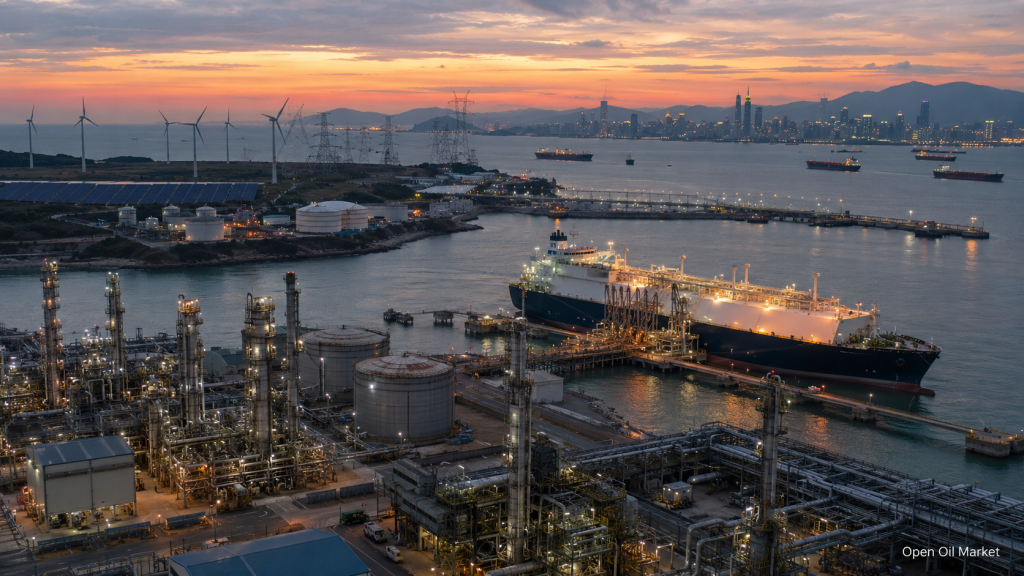
Global Energy Market on May 16, 2026 Remains Under Pressure from High Oil Prices, Growing Role of LNG, Tensions in Oil Products Market, and Rising Electricity Demand
Oil, gas and energy news for Saturday, May 16, 2026 paints a tense yet investment-rich picture for the global energy market. The main theme of the day is the persistence of a high geopolitical premium in oil and gas prices, limited capacity on key maritime routes, the growing importance of LNG, and the strengthening role of energy security in the strategies of states and companies.
For investors, energy market participants, fuel companies, oil companies, refinery operators and petroleum product suppliers, the current situation is a test of resilience. On one hand, high oil prices support the upstream sector, service companies and exporters. On the other hand, expensive energy commodities put pressure on industry, transport, aviation, petrochemicals and electricity consumers.
Oil: Market Again Trading Around Deficit Risk
The global oil market ends the week in a state of heightened nervousness. Brent and WTI remain above psychologically important levels, and traders are once again assessing not only the supply-demand balance but also the risk of supply disruptions through critical routes. The main factor remains the situation around the Middle East and restrictions in the Strait of Hormuz area, through which a significant portion of global oil and LNG trade passes under normal conditions.
For oil companies, this creates a dual effect. High prices improve cash flow from producing assets, but simultaneously increase political pressure on producers and heighten the risk of government intervention in the fuel market. Investors are increasingly watching three indicators:
- level of commercial inventories of crude oil and petroleum products;
- speed of production and export recovery in key regions;
- demand dynamics from China, India, Europe and the United States.
Even with signs of declining consumption, the physical market remains tight. This means oil may maintain high sensitivity in the coming days to any statements from politicians, shipping data, inventory statistics and news about refineries.
OPEC, Production and Market Balance: Supply Remains Vulnerable
For global oil and gas, the key question now is not only the level of demand but also the availability of actual supply. International forecasts point to a decline in global oil demand in 2026, but this does not remove the problem of deficit if production, exports and refining are physically constrained.
The market is receiving signals that some lost supply is being compensated by the Atlantic Basin, including the United States, Latin America and certain projects outside the Middle East. But quickly replacing lost barrels is difficult. Oil production requires infrastructure, drilling, logistics, insurance, tanker fleets and stable export routes.
For investors in oil companies and the service sector, this means the premium for asset reliability is increasing. Companies with the following characteristics become more attractive:
- low production costs;
- access to export infrastructure;
- diversified supply geography;
- strong balance sheet and sustainable free cash flow.
Gas and LNG: Global Market Restructuring Faster Than Expected
The gas market is increasingly splitting into two worlds: the domestic US market with relatively low prices and the international LNG market where a high premium for deliveries persists. The United States strengthens its position as the largest supplier of liquefied natural gas, and new LNG projects are becoming strategic assets for buyers in Europe and Asia.
Against this backdrop, the decision to launch construction of the major Commonwealth LNG project in Louisiana reinforces a long-term trend: the global gas market is moving away from a regional pipeline model toward flexible maritime trade. For Europe, this is a matter of replacing former gas sources; for Asia, it is about energy security and competition for cargoes during peak demand periods.
Oil and gas companies are also adjusting their strategies. The priority is shifting toward LNG, trading, long-term contracts, terminals, freight and regasification infrastructure. For investors, this means the gas market is becoming no less important than the oil market, especially in the segments of transportation, storage and international trade.
Refineries and Petroleum Products: Refining Margins Remain in Focus
The refinery and petroleum products sector remains one of the most sensitive segments of the global energy market. Limited feedstock availability, logistical disruptions and high demand for diesel, gasoline and jet fuel support refining margins. However, the situation is uneven: some refineries benefit from high crack spreads, while others face expensive crude oil, supply disruptions and regulatory pressure.
The dynamics of middle distillates are particularly important. Diesel remains a critical fuel for freight transport, industry, agriculture and part of the power sector. A diesel shortage quickly translates into inflation, higher logistics costs and final prices for businesses.
A separate trend is the growing role of biofuels and renewable diesel. In the United States, new biofuel blending mandates have supported producers and improved the economics of several refining companies. However, this segment remains dependent on feedstock costs, including soybean oil, as well as policy, tax incentives and prices for conventional diesel.
Electricity: Demand Rising Due to Industry, Data Centers and Electrification
The global electricity sector is entering a new investment cycle. Rising electricity consumption is linked not only to population growth but also to data centers, artificial intelligence, electric vehicles, industrial automation and localization of production. For energy companies, this means increased load on grids, generation and balancing capacity.
The United States, Canada, Europe, Asia and the Middle East are increasingly investing in grids, substations, energy storage and flexible generation. Canada has already outlined a large-scale strategy to increase electricity grid capacity by 2050. This approach reflects a global trend: energy security now includes not only oil and gas but also the resilience of electricity grid infrastructure.
For investors in the power sector, the most promising areas remain:
- modernization of grids and interregional connections;
- gas-fired generation as backup for power systems;
- nuclear energy as stable baseload capacity;
- energy storage and digital load management;
- projects for data centers and energy-intensive industries.
Renewables and Storage: Energy Transition Becomes More Pragmatic
Renewable energy continues to grow, but the market increasingly views renewables not as a separate ideological sector. Solar and wind generation are now evaluated together with storage, grids, balancing capacity and power purchase agreements. The main challenge is not just to build more solar and wind farms but to ensure predictable electricity supply at the right hours.
In Europe, interest is rapidly growing in projects where renewables are built together with batteries from the start. This reduces the risk of negative prices during oversupply hours and allows electricity to be sold at higher prices during deficit periods. For investors, this changes the valuation model: not only installed capacity matters but also the project's ability to manage its generation profile.
Renewables remain a critical direction for the global energy transition, but in 2026 the market increasingly demands commercial viability, grid integration and real contribution to the energy balance from such projects.
Coal: Asia Temporarily Strengthens the Role of Traditional Generation
Despite the growth of renewables, coal retains an important role in global energy, especially in Asia. Amid expensive LNG and supply risks, Japan, South Korea and several Southeast Asian countries are increasing the use of coal-fired generation to protect their power systems from disruptions and price shocks.
This does not negate the long-term trend toward decarbonization but shows that energy security during crisis periods often outweighs climate rhetoric. Coal remains a backup resource for countries where gas is too expensive, nuclear generation is limited, and renewables cannot fully cover peak load.
For coal companies, short-term conditions may be favorable, but long-term risks persist: emission regulations, cost of capital, bank pressure and competition from renewables and storage.
What This Means for Investors and Energy Companies
By May 16, 2026, the global energy market looks like a market of high volatility and high strategic importance. Investors are again assessing energy assets not only through the lens of ESG and dividends but also through companies' ability to ensure physical deliveries of oil, gas, electricity and petroleum products under crisis conditions.
Key takeaways for market participants:
- oil remains an asset with a high geopolitical premium;
- LNG becomes one of the main tools of energy security;
- refineries and petroleum products may sustain elevated margins amid fuel shortages;
- electricity sector receives a new impetus from data centers, industry and electrification;
- renewables become more investment-attractive when combined with storage and grid infrastructure;
- coal temporarily strengthens its role in Asia as a backup generation source.
Near-Term Outlook: Market Will Watch Oil, LNG and Inventories
In the coming days, the attention of oil, gas and energy market participants will focus on three areas: shipping dynamics through key routes, data on crude and product inventories, and LNG prices in Europe and Asia. Any signs of supply recovery could lower the geopolitical premium, but for now the physical market remains tight.
For fuel companies, oil companies, refinery operators, power producers and investors, the main conclusion remains the same: the 2026 energy market has once again become a market of infrastructure, logistics and security of supply. Winners are not only those who produce oil or gas but also those who control refining, storage, transportation, power grids, LNG terminals and flexible generation.