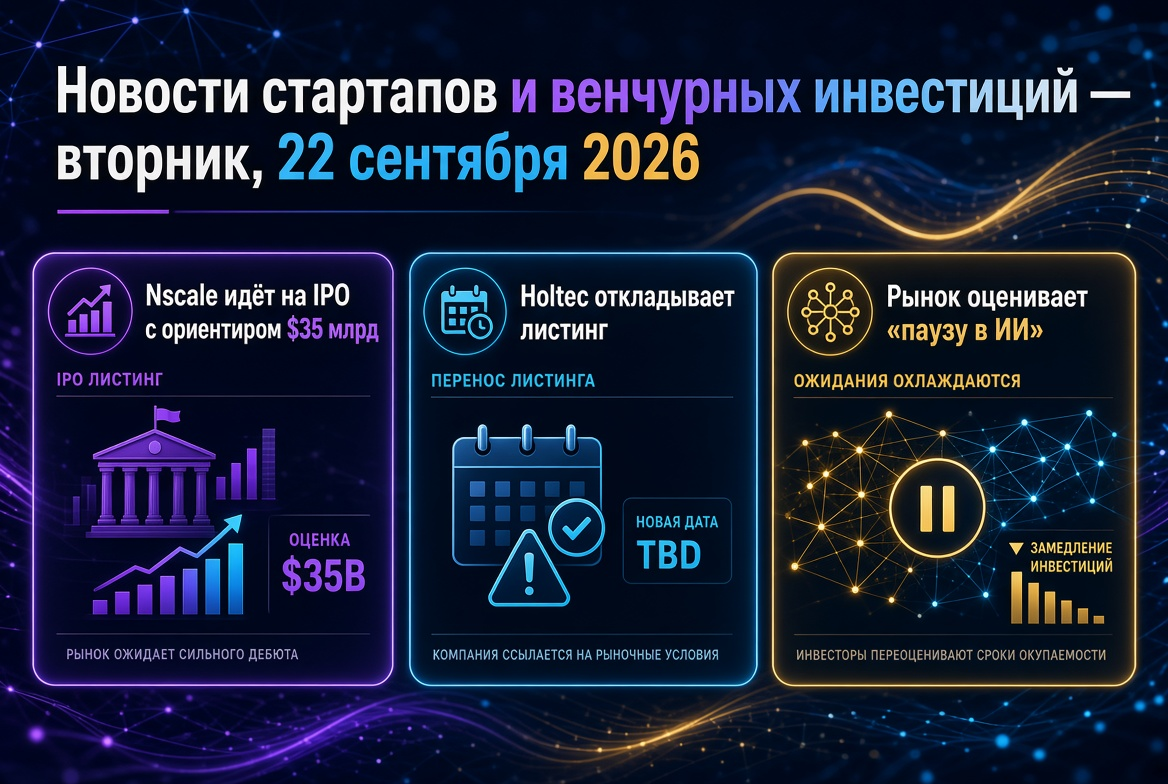
Latest Startup and Venture Capital News for April 14, 2026: Growth in AI Infrastructure, Defense Tech, Fintech, and IPO Preparations
The global startup and venture capital market enters Tuesday, April 14, 2026, amidst a heightened concentration of capital and simultaneously increasing selectivity. While money is available in the market, it is increasingly flowing not into "all things tech," but rather into narrow segments where real demand, scalable infrastructure, and a clear path to liquidity can be observed. AI startups, chip technologies, networking infrastructure, defense technologies, and fintech platforms that reduce costs in global transactions are taking center stage.
For venture capitalists and funds, this signals a new market configuration. It's not just about a startup's revenue growth anymore, but rather its position within the new tech stack: who controls computations, who owns data access, who is building AI infrastructure, and who can be the fastest to go public or secure a strategic sale. These themes are shaping the agenda of global venture capital today.
The Venture Market Kicked Off 2026 with Record Scale but Capital is Concentrating among the Few
The first quarter of 2026 has proven historic for global venture capital. The volume of global startup financing has surged to record levels, with the lion's share of capital directed toward major late-stage deals. This is an important signal for the market: venture investments have accelerated again, but the growth is uneven. Investors are more willing to pay high valuations for clear leaders than to spread capital widely.
- Capital concentration is increasing. Several colossal AI deals have constituted a significant portion of the quarterly volume.
- The U.S. remains a focal point. The North American market continues to dominate late-stage funding and technological growth stages.
- Early-stage funding is alive, but has tightened. While there is ample seed and Series A funding, investors are significantly raising their quality requirements regarding team, market, and product velocity.
For the funds, this means a straightforward reality: the startup market remains liquid primarily for those companies that have already proven their ability to become infrastructure for the next technological cycle.
AI Startups are No Longer Just About Models—Now Capital is Going into Infrastructure
The most critical theme on April 14 is the shift from abstract interest in artificial intelligence towards concrete AI infrastructure. Venture investments are increasingly directed toward companies building the computational, networking, and semiconductor foundation for the new AI market.
Where Money is Concentrating Today
- Chip architectures and alternatives to traditional suppliers;
- Network solutions for AI clusters and data centers;
- Computational infrastructure for scaling inference and training;
- Intermediary stack between models and corporate deployment.
The SiFive deal highlights this pivot vividly. The company raised $400 million, betting on the server CPU market based on RISC-V. Simultaneously, Aria Networks secured $125 million for the development of AI networking infrastructure. In other words, the market is now financing not only those who write models but also those who sell “bricks and pipes” for the AI economy.
For investors, this is more vital than hype. Infrastructure-based AI startups fit better into longer investment cycles, provide clearer strategic value, and more frequently catch the interest of major tech corporations.
Physical AI and the Industrial Stack are Evolving into a Separate Investment Class
Another notable line is the rising interest in physical AI. This is no longer just software solutions but companies at the intersection of artificial intelligence, robotics, industry, transport, energy, and automation. The new $1.3 billion Eclipse fund, focused on this segment, exemplifies how venture capital is trying to establish a foothold in the real economy, rather than only in cloud services.
Why is this particularly significant now:
- Corporations want to see direct economic effects from AI, not just experiments;
- Industrial markets provide long contracts and more predictable revenues;
- Automation, autonomous systems, and "smart" manufacturing are better protected from price erosion than many SaaS models.
As a result, startups working in industrial AI, robotics, semiconductor design, and the automation stack are gaining more strategic weight in fund portfolios. This direction is particularly appealing to investors looking for not just quick valuation growth, but also long-term platform value.
Defense Tech has Fully Entered the Mainstream of Venture Capital
Defense technologies are currently one of the fastest-growing segments of the global startup market. Recent funding for Shield AI at $2 billion, with a valuation of $12.7 billion, and AEVEX’s IPO preparations aimed at $2.35 billion indicate that defense tech is moving out of its niche and becoming a full-fledged growth class for major funds.
The investment thesis here is built around several factors:
- Acceleration in military budgets and modernization of armaments;
- Demand for autonomous systems, drones, and software-defined platforms;
- Public market readiness to pay for companies related to the drone economy and national security stack.
For venture investors, this is no longer exotic but one of the few segments that combines a large addressable market with political support and high barriers to entry. Amid geopolitical turbulence, defense tech is increasingly appearing as an institutionalized direction of venture investments.
Asia is Gaining Momentum: China is Once Again Shaping a Significant Portion of the Global Agenda
If in 2024–2025 many funds were cautiously monitoring the Chinese startup market, by spring 2026, the situation has changed. Asia has recorded its best quarter for startup funding in over three years, and China is once again becoming a focal point for capital.
Three signals are particularly important:
- Increased fundraising for VC funds themselves. In China, the volume of new capital for venture funds approached record levels within the first two months of the year.
- Strong AI funding rounds. ShengShu attracted approximately 2 billion yuan for its AGI developments.
- The return of the IPO theme. StepFun is restructuring its corporate structure in preparation for a possible listing in Hong Kong, signaling renewed interest in exits through Asian exchanges.
For global funds, this means that the Asian startup market can no longer be viewed solely as a source of risk. It is gradually re-emerging as a source of growth, particularly in AI, semiconductors, and applied enterprise technologies.
Fintech Remains Selective, but Capital is Flowing into Payment Infrastructure and Cross-Border Payments
Fintech is not the main beneficiary of the current boom; however, it is far from weak. Capital is increasingly flowing into infrastructure solutions related to the movement of money, rather than another round of consumer applications. OpenFX’s $94 million round illustrates how venture investments are shifting towards platforms that reduce the cost and time of international transfers.
Particular interest is directed toward startups operating at the intersection of:
- Stablecoin rails and enterprise payments;
- B2B cross-border settlement;
- Financial infrastructure for payroll, neobanks, and treasury;
- Regulatory-resilient scaling models.
An added nuance is Europe. London is strengthening its position as the world’s largest fintech hub, and the European market’s financing volume has approached that of the American market. This makes European fintech startups a more crucial part of global deal flow, especially for funds seeking growth outside the overheated U.S. AI valuations.
The IPO Window is Cracking Open, but the Exit Market Remains Selective
One of the key questions for any fund is not how to enter a deal but how to exit it. Here, the market is sending moderately positive signals. In the U.S. on April 13, several issuers launched roadshows, and the private markets are ramping up preparations for new public offerings. This does not indicate a complete opening of the IPO window but suggests that the market is gradually acclimatizing to a new normal.
The most important markers are:
- Investors are once again willing to discuss listings for tech and biotech companies;
- Defense and infrastructure startups have a higher likelihood of exiting;
- The M&A market remains an important liquidity channel and often appears more realistic than a classic IPO.
Even the largest private AI companies are already thinking in terms of the public market. This is evident in their IPO preparations, new discipline in corporate governance, and attempts to test future demand. For funds, this means that in 2026, the quality of exit strategies becomes a central factor in evaluating startups.
What This Means for Venture Investors and Funds on Tuesday, April 14
Investors should not only focus on the major headlines in the upcoming session and weeks but also on the architecture of the market. It is not just “AI companies” that win, but those building the layer without which AI cannot scale.
- Priority #1: AI infrastructure, semiconductors, networking, physical AI.
- Priority #2: Defense tech as a structural long-term bet.
- Priority #3: Fintech infrastructure and cross-border rails.
- Priority #4: Asia, particularly China and Hong Kong, as a source of new deal flow and potential exits.
The key takeaway is simple: the startup market in 2026 has not become broader, but it has become more expensive and professional. Venture investments are heading to where there is infrastructure value, high product complexity, and a clear path to scaling. For funds, this is not a market for passive participation but rather for precise selection of themes and platforms.
Conclusion: The main theme of the day is not just AI growth, but the transition of capital into the infrastructural layer of the new technological economy. It is around this layer that valuations, deals, future IPOs, and the best opportunities for global venture capital are currently forming.