Latest Startup and Venture Investment News as of December 2, 2025: Key Rounds, M&A Transactions, AI, FinTech, Biotech, and Climate Tech Trends. Global Analytics for Investors and Funds.
At the end of 2025, the global venture market is showing robust growth. By the end of the third quarter, total investments exceeded $97 billion (up +38% from last year), reaching the highest level since 2021. Venture deals are returning to significant sizes: investors are once again willing to fund bold projects, particularly in the field of artificial intelligence. Simultaneously, the IPO market is revitalizing: startups are actively going public, returning capital to the ecosystem. Investments are diversifying across sectors—from fintech and biotech to climate and space technologies.
- The return of mega-funds and large investors.
- Record investments in AI and a new wave of unicorns.
- Revival of the IPO market and exit prospects.
- Diversification of sectors (fintech, biotech, climate, defense, etc.).
- Increased M&A activity and consolidation.
- Global expansion: venture growth in Asia, the Middle East, and Africa.
- Renewed interest in crypto and blockchain startups.
- Local trends: Russia and the CIS amidst global trends.
The Return of Mega-Funds and Large Players
After a period of caution, major investors are returning to the technology market with new capital volumes. SoftBank announced the launch of its Vision Fund III, amounting to approximately $40 billion for AI and robotics projects. Similarly, venture firm Andreessen Horowitz is forming a fund of about $10 billion (focusing on growth companies and AI infrastructure). Sequoia Capital is preparing its early-stage funds totaling nearly $750 million for seed and Series A startups. Gulf sovereign funds (Mubadala, PIF, etc.) are pouring billions into promising projects, while the largest technology corporations are expanding their venture divisions.
- SoftBank (Vision Fund III) — approx. $40 billion for AI and robotics;
- Andreessen Horowitz — $10 billion fund (growth investments and AI infrastructure);
- Sequoia Capital — ~$750 million for Series A + $200 million for seed funds;
- Gulf sovereign funds — multi-billion investments in technology;
- Corporations (Google, NVIDIA, Samsung) — actively increasing their venture portfolios.
Record Investments in Artificial Intelligence and a New Wave of Unicorns
The artificial intelligence sector continues to set the tone, attracting unprecedented funding rounds. AI startups are regularly raising hundreds of millions in investments. For instance, American company Anysphere (the Cursor platform) secured $2.3 billion in a single round, with its valuation exceeding $29 billion. Lila Sciences (developing "scientific superintelligence" for research) announced it raised $350 million to develop AI systems. Additionally, significant rounds have been reported for Sesame, Hippocratic AI, OpenEvidence, and other companies.
Some of the largest deals include:
- Anysphere (Cursor) — $2.3 billion (Series C);
- Lila Sciences — $350 million (Series A);
- Sesame (voice AI) — $250 million (Series B);
- Hippocratic AI — $126 million (Series C);
- OpenEvidence — $200 million (Series C).
Such investments are driving valuations of leading AI startups to record heights and giving rise to a new wave of unicorn companies.
Revival of the IPO Market and Exit Prospects
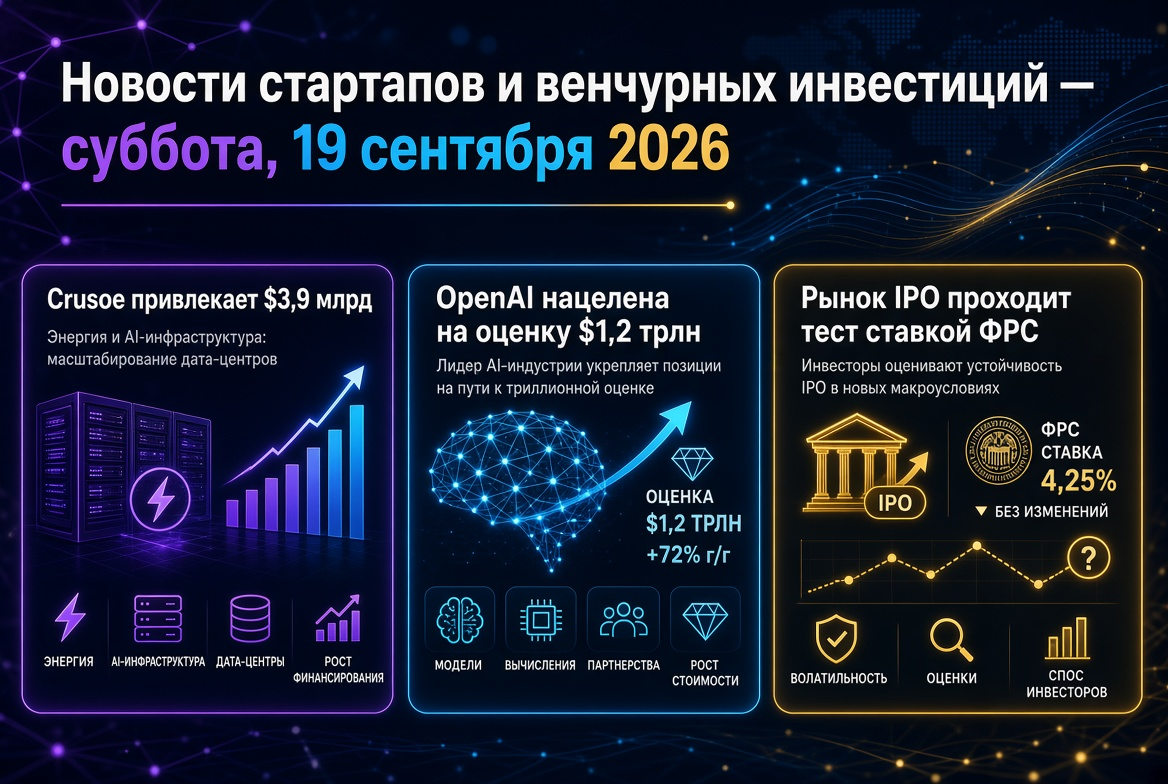
After a quiet period, the tech IPO market is gradually reviving. In 2025, several major companies successfully conducted initial public offerings. For example, the stablecoin issuer Circle launched shares with a market valuation of around $7 billion, while cryptocurrency exchange Bullish raised $1.1 billion during its IPO. In addition, cryptocurrency exchange Gemini (the Winklevoss brothers' project) went public, raising $425 million, demonstrating investor interest in fintech and blockchain. According to insiders, OpenAI is considering an IPO as early as 2026 with a potential valuation of up to $1 trillion.
Diversification of Sectors: FinTech, Biotech, Climate, Defense, and More
Investors are gradually broadening their focus: alongside AI, interest in financial, biotech, and environmental startups is rising. A revival is being observed in the following sectors:
- FinTech (digital banks, payment solutions, BNPL, crypto payments);
- Biotech and HealthTech (biomedicine, genomics, AI platforms for research);
- Climate technologies and clean energy (green-tech, renewable sources);
- SpaceTech (space startups, satellite communications, scientific missions);
- Defense technologies (AI systems for security, autonomous drones, cybersecurity).
For instance, the defense sector attracted record volumes: total investments in defense tech exceeded $7.7 billion by the end of the year. The leader in the US was Anduril with a round of $2.5 billion, while in Europe, defense startup Helsing raised $694 million for weaponry software. At the same time, AI platforms for drug development and genetic research are attracting investor attention in biotechnology.
Consolidation and M&A Transactions
M&A activity is increasing in the venture market. Funds and startups are merging to strengthen their positions. For example, two American funds—CerraCap Ventures and Impact Venture Capital—merged into a single platform, CerraCap Impact (CIVC), creating a global network of corporate support for startups. Additionally, technology companies are increasingly acquiring one another. In the first half of 2025, the number of "startup acquires startup" deals increased by about 18% compared to the previous year. Notable transactions in the industry include OpenAI acquiring the startup Io (AI-powered smart home devices) for $6.5 billion. This allows companies to adopt new technologies more swiftly and creates conditions for major investor exits.
Global Expansion: Asia, the Middle East, and Africa
Venture capital is increasingly flowing into new regions. In Asia, the market is growing rapidly: Chinese robotics startups are raising rounds in the billions of yuan (for example, Robot Era raised around ¥1 billion, approx. $140 million). Significant deals are being recorded in Southeast Asia and India: the Thai company Roojai raised $60 million (digital insurance), while Indian SquareYards secured $35 million (real estate, valuation around $900 million). Startups focused on deep tech in Singapore and the Philippines have raised tens of millions of dollars.
In the Middle East, notable investment events are also occurring. Saudi fintech Erad secured a $125 million credit line, and the electronics restoration platform Revibe raised $17 million. Saudi startup Mnzil (housing for workers) received $11.7 million Series A from Founders Fund. Regional infrastructure projects secured funding as well: Zinit (Dubai) raised $8 million, Strataphy (KSA) received $6 million, and Buildroid AI raised $2 million. These examples demonstrate that investors are financing not only consumer services but also infrastructure solutions (housing, energy, logistics, etc.).
Renewed Interest in Crypto Startups
The blockchain sector, after a prolonged downturn, is once again attracting investor attention. Cryptocurrencies are demonstrating growth: Bitcoin has surpassed the $100,000 mark, and the approval of an ETF on Ethereum is expected in the US. This has sparked venture interest: Web3, DeFi, and fintech-blockchain companies are receiving new rounds at high valuations. Successful IPOs of crypto companies (Circle, Bullish, Gemini) have restored confidence in the industry. Experts believe that the influx of funds into crypto projects will continue, although startups will operate under close regulatory scrutiny.
A Local Perspective: Russia and the CIS
The Russian startup market remains small and conservative. According to ComNews, in the first nine months of 2025, technology companies in Russia raised approximately $125 million (an increase of +30% from last year). The primary sectors of investment are IndustrialTech, Healthcare, and FinTech. AI startups accounted for a significant share of investments (over $60 million, 32 deals). In the CIS (Kazakhstan, Uzbekistan, Belarus), early rounds of $1–5 million are prevalent, with participation from governmental funds. Government institutions are attempting to offset the outflow: for example, "RUSNANO" plans to invest around 2.3 billion rubles into domestic startups by the end of 2025. However, major foreign investors are still largely absent in the region.