Main Highlights as of July 29, 2026: Key Figures Shaping the Agenda
Below are the key indicators that frame the current market discussion:
- $510 billion — global venture investments in the first half of 2026; Q1 contributed $305 billion, and Q2 added another $205 billion across more than 5,000 companies.
- 43% — share of two companies, OpenAI and Anthropic, in the global venture funding volume for the half-year ($217 billion combined).
- Over 70% — share of AI startups in global venture investments during the second quarter, compared to about 50% a year earlier.
- $412.7 billion — venture investments in the U.S. for the half-year, of which $355.9 billion (86%) were allocated to AI companies.
- $251 billion — raised in 86 U.S. IPOs since the beginning of the year, more than five times the total of 2025 ($47.4 billion).
- $113 billion — volume of acquisitions of startups priced at over $1 billion in the second quarter, a record in the history of observations.
- 5.09 billion rubles — volume of the Russian venture market for the half-year, down 40% year-on-year with a twofold decrease in the number of deals.
Half-Year Record: Why $510 Billion Does Not Mean "The Market Has Returned"
The record amount of venture financing was not achieved through the expansion of the funnel, but through a few gigantic rounds. The number of deals in the first half of the year has practically not increased, and in Asian markets, the number of transactions has even reached a multi-year minimum amid record amounts. In other words, the average check has risen significantly, while access to capital has narrowed.
Late-stage financing in the second quarter increased by about 141% year-on-year. This represents a fundamental shift in the behavior of venture funds: capital is flowing not into expanding a portfolio of new names, but into recapitalizing proven leaders. For fund managers, this means a more predictable but less asymmetric return profile; for LPs, it signals an increase in correlation between funds of different strategies.
Capital Concentration: The Main Risk on the Agenda
The situation where two companies absorb 43% of global venture capital for the half-year has no historical analogues. Additionally, there is a geographical imbalance: about 88% of all investments in AI startups are concentrated in companies headquartered in the U.S. At the same time, the U.S. share in the total volume for the second quarter has decreased from 83% to 66-67% — capital is both concentrating across sectors and internationalizing geographically.
This poses three practical questions for investment committees:
- How diversified is the fund’s portfolio if the majority of sector returns are defined by a few private companies?
- How should we evaluate "second-tier" AI startups if valuation benchmarks are set by rounds of unprecedented scale?
- What will happen to sector multipliers if even one of the leaders disappoints the public market?
End-of-July Deals: Where Was the Money Really Flowing?
The last decade of July provided a revealing snapshot of venture funds' priorities. The most noteworthy funding rounds are:
- Etched — $300 million, Series C, inference chips, led by Sequoia.
- CuspAI — $450 million, Series B, AI for new materials development (Kleiner Perkins, NEA).
- Meshy — around $400 million, Series B, 3D content generation.
- Glow — $180 million, Series A, cybersecurity (Sequoia, Cyberstarts).
- Cathedral — $160 million, defense cyber-AI (Andreessen Horowitz, Sequoia).
- Humanoid — $152 million, Series A at a valuation of $1.35 billion; the first European "unicorn" in humanoid robotics.
- Neo — $100 million from "stealth," application security in the era of AI agents.
Earlier in July, the market witnessed even larger transactions: $1.8 billion for defense company Helsing, $1 billion for SambaNova Systems, $800 million for Together AI, $700 million for medical tech platform Neko, €411 million for nuclear project Proxima Fusion. The overall conclusion is that venture capital is funding not so much applications but the "operating system" of the new economy — computation, energy, security, and robotic manufacturing processes.
Physical AI, Defense, and Deep Tech: A New Map of Priorities
Three themes are shaping the investment mood for the second half of 2026. The first is physical AI: models connected with hardware, from construction robots to industrial perception. The second is defense and sovereign technologies, where European startups are, for the first time in a decade, competing with American ones in terms of check sizes. The third is energy for data centers: nuclear, geothermal, and grid projects are being funded as an infrastructure rather than a venture asset class.
Notably, cybersecurity has become a derivative of the widespread use of AI agents: investors are financing companies addressing problems created by generative models themselves. This is a resilient "second-order" pattern, and it will remain a source of deals at least until the end of the year.
IPO Window 2026: Open, But Not for Everyone
The initial public offering market is experiencing its strongest comeback since 2021. By the end of July, there were 86 IPOs in the U.S. with a total volume of $251 billion; global proceeds for the half-year reached $178 billion (+205% year-on-year) across 524 deals. Technology placements saw an average gain of 44.5% on the first day of trading, and the combined valuation of companies in the IPO pipeline exceeded $2.1 trillion.
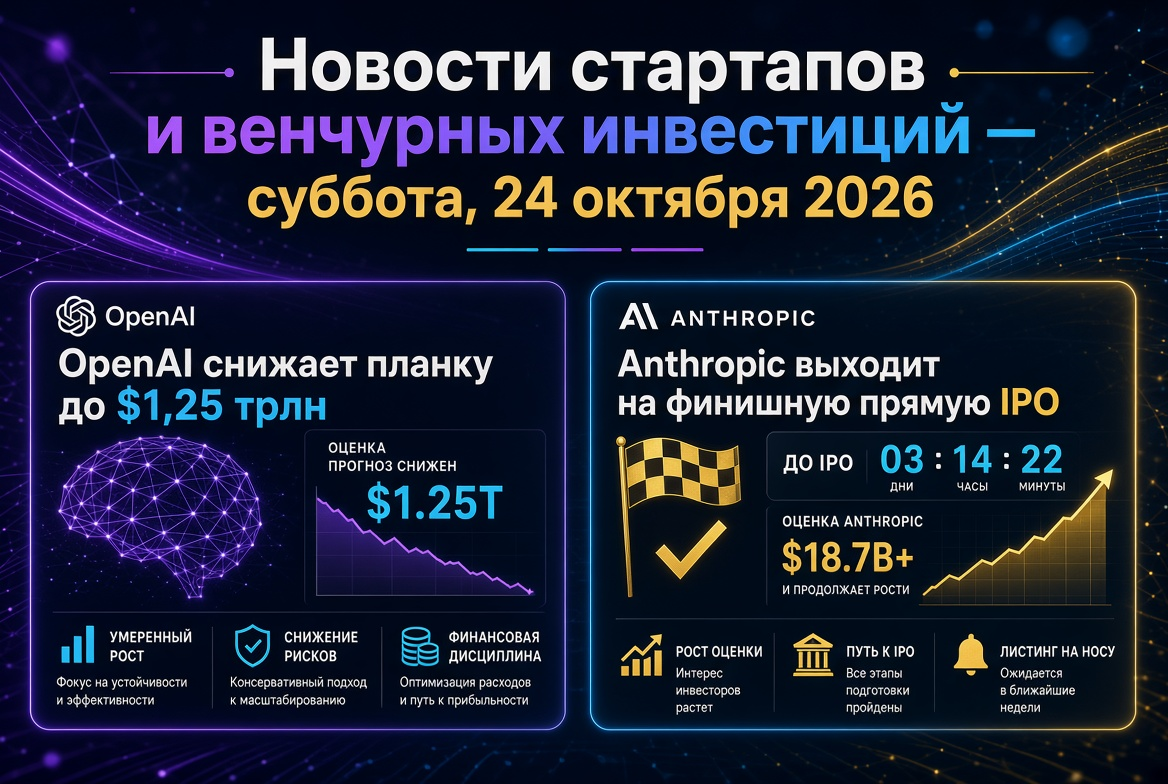
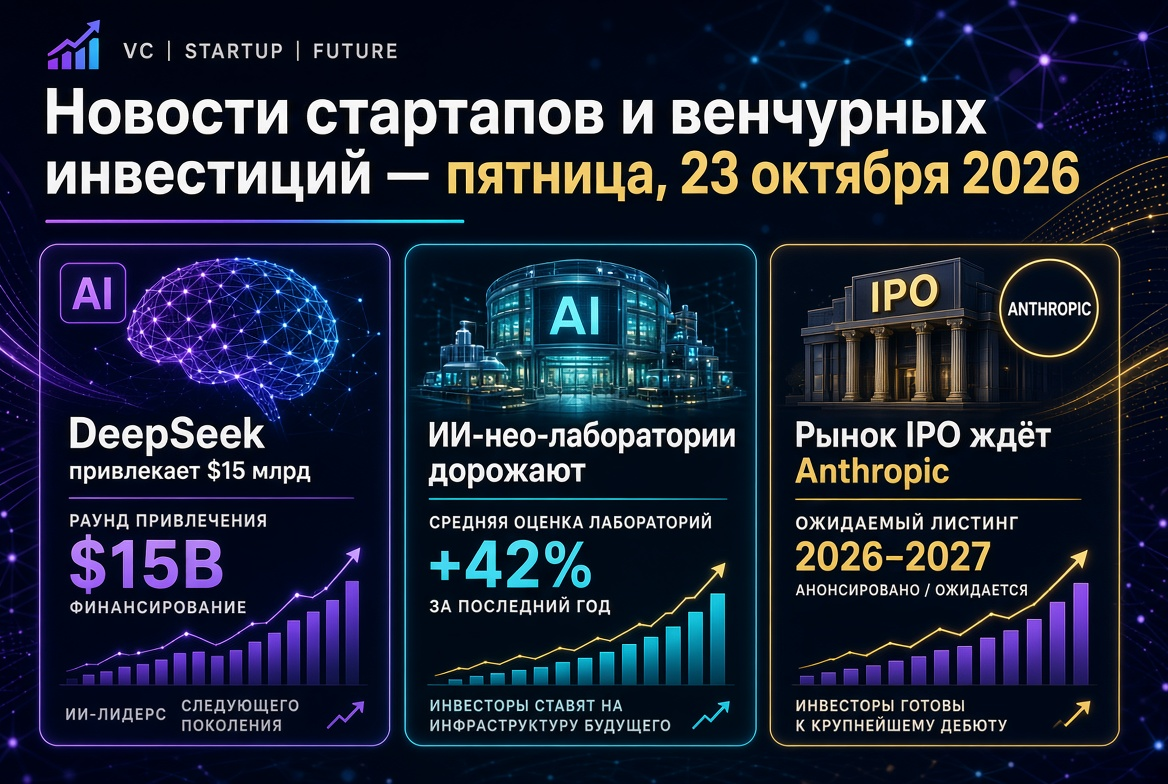
However, the structure of this record is as concentrated as the venture market. The SpaceX offering of $85.7 billion at a valuation of $1.75 trillion accounted for about one-third of all funds raised this year. Anthropic filed on June 1 after a round of $65 billion, and OpenAI confidentially filed on June 8 at a private valuation of $852 billion. Strava is preparing for a listing at a valuation of around $2.2 billion. Simultaneously, Databricks has publicly opted out of listing in 2026 in favor of 2027, discussing a private round at a valuation of $165-175 billion compared to $134 billion half a year earlier. Canva and Cohere are still viewed by the market as candidates for 2027.
M&A and Exits: The Best Quarter in Five Years
For the first time since 2021, the dynamics of exits have caught up with the dynamics of financing. In the second quarter, 32 companies went public with valuations over $1 billion, and another 24 were acquired for prices starting at $1 billion, totaling $113 billion — a record in the history of observations. For venture funds, this means unlocking DPI: distributions to LPs have finally started returning to levels that allow for a full cycle of re-signing new funds.
Nevertheless, the quality of exits remains uneven. Large strategic acquisitions are focused on AI infrastructure, semiconductors, and biotech, while traditional mid-sized SaaS exits still come with a discount compared to 2021 rounds.
Fundraising and Dry Powder: Capital Exists, But Access is Limited
On a global scale, private markets hold about $3.9 trillion in unallocated capital, of which about $600 billion is directly attributable to venture funds. However, the share of successfully closed funds has fallen to about 57% compared to 94% in 2020 — LPs have become noticeably more selective and prefer established platforms to new managers.
The practical consequence for the market is that the gap between "top-quartile" and other funds continues to widen, and emerging managers are increasingly entering deals via syndicates, SPVs, and co-investments with large platforms.
Russia and the CIS: The Market in Strict Selection Mode
The Russian venture market is moving in counterphase to the global one. In the first half of 2026, the volume of venture investments amounted to 5.09 billion rubles — 40% less than the previous year. There were 50 deals, half the number from the first half of 2025, with an average check of 113.2 million rubles. The largest volume of investments was allocated to artificial intelligence and machine learning — the industry focus aligns with global trends, but the scale does not.
Industry analysts compare current figures with levels from 2009-2011. The logic of financing has structurally changed: with high key interest rates, the deposit and debt markets compete with venture returns, so investors require startups to have proven revenue, positive unit economics, and a clear path to profitability, rather than just "promising ideas." The main sources of capital remain corporate venture, industry funds, and club syndicates.
Conclusions for Venture Investors and Funds
The agenda as of July 29, 2026, boils down to four theses:
- Record ≠ Broad Market. The aggregated $510 billion masks a narrowing funnel: capital is available to category leaders, not the average startup.
- Concentration is a standalone risk. Portfolios whose returns rely on a few AI leaders require stress-testing for scenarios where one of them disappoints at debut.
- The exit window is open, but selectively. Companies valued at $2–5 billion, with stable revenue and proximity to profitability, have a real chance to leverage the current IPO cycle.
- Infrastructure bet wins over applied. Computation, energy, security, and physical AI provide a more secure position than applications built on top of others' models.
The market has entered a phase where an excess of capital coincides with limited access to it. For venture funds and institutional investors, this means a return to fundamental discipline: quality selection, valuation discipline, and prudent liquidity planning — regardless of how impressive the headline figures for the half-year may appear.