Startup and Venture Capital News Highlights as of July 15, 2026: AI Infrastructure, Semiconductor Startups, Defense Tech, Biotech, Generative AI, IPOs, and Major Venture Market Deals
The global startup and venture capital market is approaching mid-July 15, 2026, in a state of high selectivity: capital is available, but it is concentrating in companies with access to computing infrastructure, defense technologies, biotech, semiconductors, and applied artificial intelligence. For venture investors and funds, the key question is no longer whether there is demand for AI startups, but which business models can withstand rising computing costs, competition for talent, and pressure from future funding rounds.
The main theme of the day is the shift in the venture market from the classic race for user growth to the fight for infrastructure control. Startups providing access to chips, models, data, defense systems, and biological platforms are commanding premium valuations. Other companies are required to prove their efficiency, profitability, and ability to swiftly generate revenue.
AI Infrastructure Becomes the New Hub of the Venture Economy
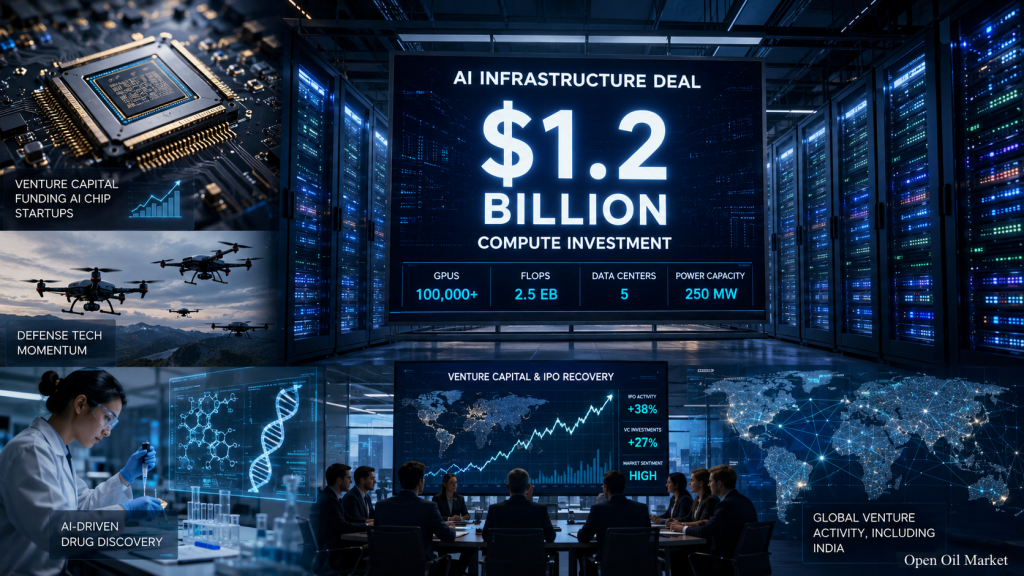
The most notable signal for the market is the major deal between Reflection AI and Nebius for access to computing power worth over $1 billion. For venture funds, this serves as an important indicator: in the artificial intelligence sector, competitive advantage is increasingly defined not only by the quality of the model or team but also by long-term access to GPU infrastructure.
AI startups can no longer build their strategy solely around the idea of creating "the best algorithm." The following factors now come to the forefront:
- the cost of training and inferencing models;
- contracts with cloud and infrastructure providers;
- access to Nvidia chips and specialized accelerators;
- the ability to monetize open-source models;
- the sustainability of unit economics amidst rising computing costs.
For venture investments, this means a widening gap between leaders and the rest of the market. Startups that can secure computing resources in advance gain a strategic advantage when attracting subsequent funding rounds.
Semiconductor Startups Returning to Investors' Focus
Another important trend is the funding of TYLSemi, a startup focused on component architecture for custom AI chips. The company secured $43 million at an early stage, indicating that the venture market is once again prepared to invest in complex hardware sectors tied to artificial intelligence and reducing dependency on closed semiconductor solutions.
For funds, this is particularly significant for three reasons:
- AI requires specialized hardware. General-purpose chips no longer meet the entire demand for performance and energy efficiency.
- Large corporations seek customization. Big Tech, cloud platforms, and industrial clients are on the lookout for their own architectures.
- Open standards are becoming an investment theme. Startups that reduce market dependency on closed suppliers can receive a strategic premium.
Semiconductor startups remain capital-intensive, but by 2026, they are increasingly viewed not as niche deep tech projects but as the infrastructure foundation of the new AI economy.
Defense Tech Emerges as a Leading Venture Sector
Venture capital investments in defense tech continue to grow. This week, the market was drawn to two deals: the European company Helsing raised $1.8 billion at a valuation of $18 billion, while the American startup Singularity emerged from stealth mode with an $80 million Series A round and a valuation of around $400 million.
Defense tech is no longer perceived as a peripheral issue for a limited circle of investors. Geopolitical instability, the increasing role of drones, the necessity for cost-effective air defense systems, and the development of autonomous platforms are generating a market where startups can compete with traditional defense contractors.
Key areas for venture funds include:
- drones and anti-drone systems;
- AI for battlefield data analysis;
- autonomous maritime and aerial platforms;
- affordable alternatives to expensive air defense systems;
- software for defense infrastructure.
For the global startup market, this signals the emergence of a new category of mega-rounds: previously, such valuations were characteristic of fintech and consumer tech; now they apply to defense AI and autonomous systems.
Biotech and AI Drug Discovery Maintain Premium Valuations
The biotech segment remains one of the most attractive for venture investors. Chai Discovery secured $400 million, raising its valuation to several billion dollars. This signals to the market that AI-driven drug discovery remains among the most promising directions, despite the long drug development cycles and regulatory risks.
Investors are viewing such companies not as traditional biotech startups but as platform businesses. If the model genuinely speeds up the development of molecules, antibodies, and therapeutic candidates, the company's potential value could rise faster than that of conventional lab projects.
The main investment intrigue in the sector is whether AI biotech can prove clinical effectiveness, not just technological elegance. Until then, funds will closely evaluate partnerships with pharmaceutical companies, pipeline quality, and start-ups' ability to convert algorithms into commercial products.
Generative Video Becomes a New Mega-Round Trend
AI-generated video is moving out of the experimental phase and developing into a full-fledged venture market. PixVerse raised $439 million in an extension of its Series C round, highlighting the demand for generative content, world models, and tools for video production automation.
For funds, generative video is appealing not only as a consumer product. Potential markets include advertising, e-commerce, cinema, training, gaming engines, and corporate communications. However, the sector remains competitive: the cost of computing is high, legal issues surrounding content are unresolved, and user loyalty can be unstable.
Venture investors will be seeking in this segment not just visually appealing demos but signs of sustainable monetization: subscriptions, corporate contracts, API access, integrations with marketing platforms, and reduced costs in generating individual videos.
India Strengthens Its Position on the Global Venture Map
The Indian startup market remains in focus for global funds. Elevation Capital has launched a new $500 million fund focused on early-stage AI startups. This confirms the broader trend: India is increasingly seen not only as a consumer market but also as a base for creating global AI products.
For venture funds, India is attractive due to the combination of several factors:
- a large domestic market;
- a strong engineering base;
- relative cost-effectiveness of development;
- growing demand for AI in fintech, education, healthcare, and B2B services;
- the potential to build global SaaS companies from a local ecosystem.
In 2026, competition for the best Indian AI startups may intensify: international funds are increasingly seeking early-stage deals while valuations remain lower than in the U.S.
IPO Market Regaining Liquidity Channel
An important factor for the venture market is the resurgence of interest in IPOs. The U.S. primary offering market is nearing record volumes, and new deals in the segments of data centers, AI infrastructure, biotech, and technology platforms are improving exit expectations for funds.
For venture investors, this is critical: after a period of frozen liquidity, funds need capital returns. If the IPO window remains open, late-stage startups will have more opportunities for exits, and limited partners will have more grounds to increase allocations to venture strategies again.
However, the market remains sensitive to the quality of issuers. Investors will demand clear revenue, predictable margins, moderate cash burn, and proven market positioning. Startups with high valuations but weak economics may face discounts during public offerings.
What Venture Investors and Funds Should Consider
Startup and venture investment news as of July 15, 2026, indicates that the market is not cooling down, but it is becoming harsher. Money is flowing into companies that control key nodes of the technology chain — computing, chips, defense systems, biological models, and AI content.
For venture funds, key takeaways include:
- AI infrastructure is more important than interfaces. Startups with access to compute, data, and specialized hardware gain an edge.
- Defense tech is becoming an institutional theme. The sector is already attracting capital from the largest funds and financial investors.
- Biotech requires patience. Valuations are rising, but real validation will happen through clinical outcomes and partnerships with pharma.
- India is emerging as a global hub for AI startups. Early deals in the region could become a source of high returns.
- The IPO window is once again significant. Liquidity is returning, but the public market will be selective regarding asset quality.
The main investment idea of the day: the venture market of 2026 is transitioning from the era of cheap growth to the era of strategic infrastructure. The winners will not just be fast startups, but companies that control critical resources of the new economy — computing, security, biological data, semiconductors, and exit pathways to the public market.