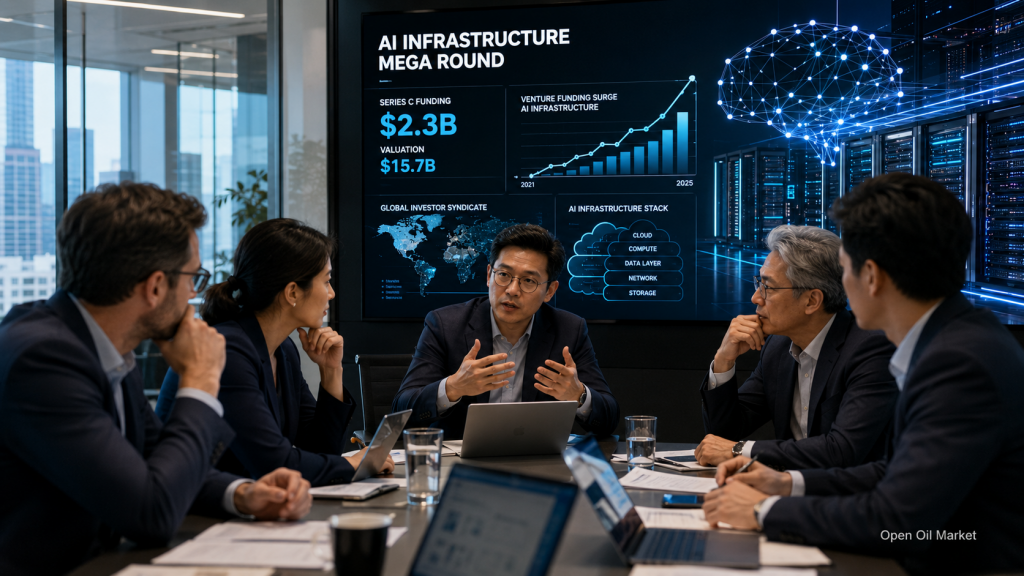
Startup and Venture Capital News for Thursday, June 25, 2026: Growth of AI Infrastructure, Mega Valuation for Baseten, Deals in Deep Tech, Healthtech, Cybersecurity, and New Benchmarks for Venture Funds
The global startup and venture capital market enters Thursday, June 25, 2026, with a clear capital shift towards artificial intelligence, infrastructure platforms, deep tech, healthtech, and cybersecurity. For venture investors and funds, this is no longer just another cycle of interest in AI startups; it is a structural market reshaping where funds are concentrating around companies capable of reducing computing costs, accelerating AI integration into business processes, and creating the technological foundation for the next generation of the digital economy.
The main theme of the day is significant rounds in AI infrastructure and the rise in valuations of companies catering not only to consumer applications but also to corporate demand for inference, automation, security, medical services, and industrial solutions. Venture capital is once again actively seeking scalable business models; however, funds are becoming more demanding regarding revenue, margins, customer quality, and the startup's ability to demonstrate technological superiority.
AI Infrastructure Remains the Main Magnet for Venture Capital
A key market signal is the funding round for Baseten, which has raised the valuation of the AI infrastructure company to approximately $13 billion. The startup operates in the inference infrastructure segment, assisting companies in launching, optimizing, and scaling AI models at lower costs. For investors, this serves as an important benchmark: capital is increasingly flowing not only to developers of large models but also to the layer of "production deployment" of AI.
Venture funds see clearer economics in such projects compared to AI applications. Corporate clients are looking not just to experiment with artificial intelligence, but to reduce query costs, control data, and achieve predictable performance. Therefore, AI infrastructure is becoming one of the most competitive areas for growth funds.
- Demand is shifting from demo AI products to operational infrastructure.
- Investors are assessing not only the technology but also the unit economics of computing.
- Interest in open-source models and hybrid corporate architectures is growing.
Mega Valuations Are Back, But the Market Has Become More Selective
Despite the large deals, the venture market in 2026 cannot be described as overheated. Mega valuations are primarily awarded to startups positioned at the center of long-term technological shifts: AI infrastructure, data centers, physical world modeling, cybersecurity, chips, and corporate automation. For other companies, capital attraction conditions remain stricter.
Funds demand from founders not only revenue growth but also demonstrable market positioning. Important criteria include customer retention, customer acquisition cost, the depth of the technological barrier, and the potential for IPO or strategic sale. This means that venture investments are becoming less broad-based but more concentrated.
Healthtech Emerges as a Key Area in Europe
One notable event for the European market was a substantial investment in the French healthtech startup Alan. The company is raising capital amid a growing interest in digital medicine, corporate insurance, personalized services, and AI tools for healthcare. For Europe, this deal is significant not only for its size but also as an industry signal: venture funds are ready to finance not only pure AI companies but also regulated business models with sustainable revenue.
Healthtech is becoming an attractive area for global funds for several reasons:
- High demand for digitizing medical and insurance services;
- Protective barriers due to regulation and market complexity;
- The possibility of combining AI assistants, telemedicine, and B2B products;
- Long client lifecycle and high data value.
India and the Global Early-Stage AI Rounds Are Gaining Momentum
There is noticeable activity around AI startups from India and the international ecosystem at early stages. Hang Ten Systems raised $32 million in seed funding led by Mayfield, while the marketing AI platform JustAI secured over $17 million in a Series A round with participation from Base10, Y Combinator, and Peak XV Partners.
For venture investors, this demonstrates that the early-stage market has not stopped but has shifted its focus. Funds are more willing to finance teams with a strong technical reputation, clear corporate application, and the ability to quickly enter the global market. AI solutions for marketing, sales, customer support, analytics, and internal business processes are particularly in demand.
Deep Tech and "Physical World Models" Become a New Investment Theme
The startup Odyssey, which is working on AI systems for modeling the physical world, has become emblematic of a new wave of deep tech. Such projects attract venture funds because they intersect artificial intelligence, robotics, autonomous systems, simulations, industrial design, and defense technologies.
Investors are increasingly viewing world models as the next major technological layer following language models. If large language models changed the way we work with text, code, and knowledge, physical world models could impact robotics, autonomous systems, manufacturing, logistics, gaming, design, and engineering simulations.
Cybersecurity and Defense Technologies Strengthen Their Positions
Amid the rise of AI tools, demand for cybersecurity is also increasing. The Israeli AI startup Dream has secured a large funding round, reaching a valuation of around $3 billion. For the market, this is an important indicator: funds continue to actively support companies working on digital infrastructure protection, automated threat detection, and security for government and corporate systems.
Cybersecurity remains one of the most resilient segments of the venture market. Even with a decline in risk appetite, companies cannot drastically cut spending on data protection, cloud services, industrial systems, and AI infrastructure. This makes the sector attractive for late-stage funds, strategic investors, and corporate buyers.
AI Chips and Design Automation Become a Separate Market
The growing interest in startups that simplify the design of specialized chips merits separate attention. Architect Labs raised seed funding to develop AI tools capable of speeding up and reducing the cost of creating custom semiconductors. This segment is crucial for the entire AI chain as the cost of computing continues to be a major growth constraint.
For venture investors, the area of AI chips and semiconductor software appears particularly promising. If a startup can shorten the design cycle, reduce development costs, and provide companies access to specialized hardware architecture, it can occupy an important position among cloud providers, chip manufacturers, and corporate customers.
IPOs and M&A: Investors Are Once Again Eyeing Exits
The IPO and M&A market remains a key factor for venture funds. After a period of limited liquidity, investors are closely monitoring public offerings of tech companies, strategic acquisitions, and major deals in the AI sector. For funds, this is a matter of not only profitability but also returning capital to limited partners.
Multiple scenarios are intensifying on the horizon:
- Major AI companies will prepare for IPOs as demand for tech assets remains high;
- Corporations will continue to acquire startups in the chip, cybersecurity, and AI infrastructure sectors;
- Growth funds will compete with the public market for the best pre-IPO assets;
- Competition for local tech champions will intensify in Europe and Asia.
What Matters to Venture Investors and Funds
For venture investors, the main takeaway for June 25, 2026, is that the startup market is once again active, but capital is being distributed extremely unevenly. Winning companies are those in critically important layers of the new technological economy: AI infrastructure, computing, cybersecurity, healthtech, deep tech, industrial AI, and corporate automation.
Funds should focus on several practical factors:
- Valuations in AI infrastructure are rising faster than in most other segments;
- Early AI rounds remain accessible, but competition for strong teams is increasing;
- Regulated industries, including healthcare and finance, are becoming more attractive due to sustainable revenue;
- M&A may become the primary exit channel for deep tech and cybersecurity startups;
- The global geography of venture investments is expanding, but the US still concentrates a significant portion of capital.
Thus, the news of startups and venture investments for Thursday, June 25, 2026, indicates a transition of the market to a more mature phase. Investors are no longer buying an abstract idea of artificial intelligence — they are seeking infrastructure, revenue, technological barriers, and a clear path to liquidity. For venture funds, this means the need to act faster on quality deals while rigorously evaluating the economics, team, and strategic value of each startup.