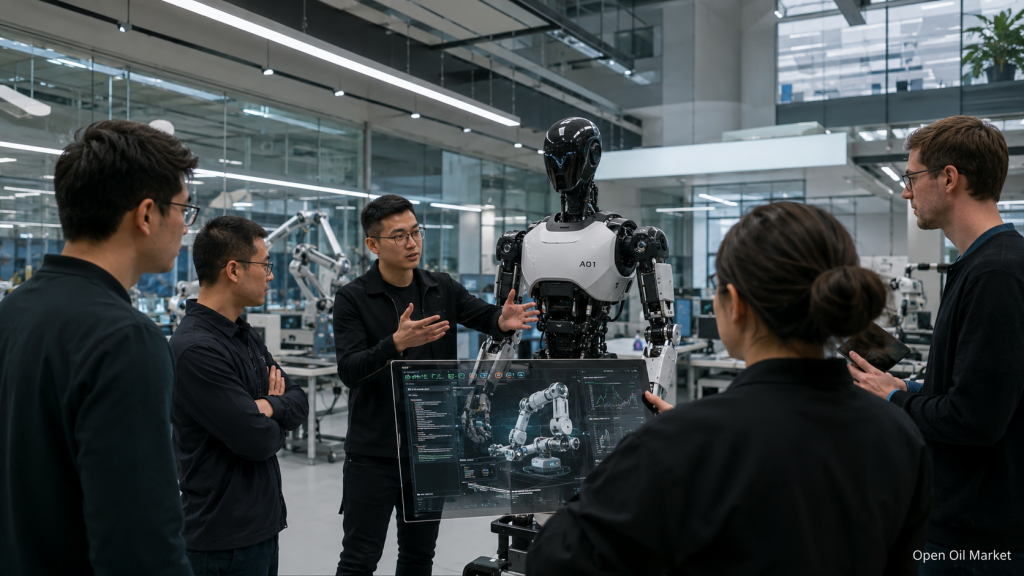
Global Startup and Venture Investment Market: Focus on Investors, AI Startups, Data Centers, Logistics, Travel-Tech, and Deep-Tech on May 29, 2026
On Friday, May 29, 2026, news surrounding startups and venture investments is once again focusing on artificial intelligence, the infrastructure for AI products, and substantial late-stage funding rounds. This is an important signal for venture investors and funds: the startup market is not just regaining its appetite for risk but is increasingly distinguishing companies into two distinct groups. The first group comprises startups with proven revenue, corporate demand, and a robust technological infrastructure. The second group includes projects that are facing growing challenges in attracting capital without clear economics, differentiation, and a pathway to the global market.
The primary theme of the day is a renewed interest in AI-coding, inference infrastructure, multi-model platforms, and services that help companies implement artificial intelligence in real business processes. Notably, venture investments are flowing not only into AI startups. Amid the mega-rounds in AI, there are visible transactions in e-commerce logistics, travel-tech, sleep-tech, and deep-tech, indicating a more complex structure within the global startup market.
Cognition: AI-Coding Emerges as a Top Venture Bet in 2026
A significant market signal comes from Cognition, the developer of the autonomous AI engineer Devin, which secured over $1 billion at a pre-funding valuation of approximately $25 billion. This is not just another deal in the artificial intelligence sector for venture funds; it confirms that AI-coding has become a distinct investment category.
The crucial question for investors is whether an independent AI startup can compete with large model platforms, cloud providers, and tech giants. In the case of Cognition, the market bets that corporate clients will be purchasing not just access to a model but a complete digital employee capable of handling tasks related to coding, testing, and support.
- For venture investors, this confirms the demand for AI products with a clear business function;
- For late-stage funds, it signals that mega-valuations are returning, but only for category leaders;
- For startups, it emphasizes the need to focus on revenue, corporate adoption, and measurable client outcomes.
OpenRouter: AI-Model Access Infrastructure Becomes a Separate Market
OpenRouter highlights another important theme: companies do not want to depend on a single AI model. The startup raised $113 million in a Series B round, bringing its valuation to approximately $1.3 billion. For the global startup market, this is indicative of venture capital increasingly flowing into the infrastructure that sits between developers, corporate clients, and model providers.
OpenRouter functions as a single gateway to hundreds of models, allowing developers and companies to choose the optimal tool for specific tasks. This alters the investment logic in the AI startup sector. While the primary battle in 2023-2024 focused on creating foundational models, by 2026, value is increasingly shifting toward orchestration, routing, cost control, and enhancing inference quality.
For venture funds, this means the emergence of a new layer in the market: not just "who creates the model," but also "who manages the use of models in business."
Groq and Nvidia: Inference Becomes a Strategic Asset
Another significant development in venture investments is Groq's efforts to raise up to $650 million following a large deal with Nvidia. The company is increasingly shifting its focus from hardware to AI-inference, meaning the rapid and efficient deployment of already trained models in real user scenarios.
This is fundamentally important for the market. While training models remains capital-intensive, the next stage of artificial intelligence monetization is linked to billions of requests, corporate agents, coding, analytics, searching, customer support, and industrial tasks. As the volume of inference increases, there is a rising demand for specialized chips, computation optimization, and new business models surrounding AI infrastructure.
- AI infrastructure becomes as crucial as the models themselves.
- Deals with major tech players can replace the classic path to IPO.
- Venture investors are increasingly assessing startups based on their strategic value to major platforms.
Stord: Logistics and Commerce-Tech Make a Comeback in Fund Focus
Amid the dominance of artificial intelligence, the deal concerning Stord stands out. The e-commerce logistics startup raised $250 million at a valuation of approximately $3 billion. This is an important example that venture investments are not limited to AI startups. Funds continue to seek companies that address significant infrastructure challenges in retail, supply chains, and fulfillment.
Stord is building an alternative to traditional logistics models for brands looking to compete on delivery speed while maintaining control over customer relationships. The additional interest revolves around introducing AI interfaces into operational software, indicating that AI is becoming a technological layer within logistics, commerce-tech, and B2B services.
WeRoad: Consumer Startups Seek Growth in the Offline Economy
Italian travel-tech startup WeRoad raised $58 million in a Series C round with participation from Airbnb and is preparing for expansion into the U.S. This is an interesting signal for venture investors: despite the market's focus on artificial intelligence, the consumer sector is not disappearing but changing its format.
WeRoad is betting on group travels and real social connections. In an environment where digital platforms are overloaded with content, part of the demand has shifted towards what is termed the IRL (In Real Life) economy—services that help people meet, travel, participate in events, and build communities beyond screens.
For funds, this means that promising consumer startups in 2026 must demonstrate not only audience growth but also a compelling behavioral hypothesis: why users will return, pay, and recommend the service to others.
SOND and Sleep-Tech: Health, Data, and Personalization Become Investment Themes
Sleep-tech startup SOND has emerged from stealth mode with $7 million in funding and a product in the form of smart sleep headphones. At first glance, this seems like a niche deal, but within the venture market, it reflects a broader trend: investors are continuing to seek points of growth at the intersection of healthtech, wearables, data, and personalized AI.
The health market is becoming increasingly tech-driven. Passive tracking is no longer enough for users. The next stage involves devices and services that collect physiological data, interpret it in real-time, and offer personalized interventions. For venture funds, such startups are appealing when three factors are present: a strong team, defendable technology, and a recurring consumption model.
Deep-Tech and Early Stages: Capital is Shifting to Complex Technologies
Alongside megara rounds in the U.S., activity in deep-tech remains robust. New funds and regional investment initiatives are increasingly focusing on artificial intelligence, space technologies, defense solutions, climate sciences, and industrial automation. This creates a more favorable environment for startups in early stages but simultaneously raises the bar for technical expertise.
Venture investments in deep-tech differ significantly from traditional SaaS approaches. The development cycle is longer, capital demands are higher, and hypothesis validation is more complex. However, when successful, such companies can create deeper technological moats and strategic value for governments, corporations, and industrial players.
What Matters for Venture Investors and Funds
The key takeaway for May 29, 2026, is that the venture market is once again ready to pay high valuations, but only for companies that demonstrate scale, revenue, technological uniqueness, and strategic significance. Mere positioning within artificial intelligence is no longer sufficient.
- AI-coding is becoming one of the most expensive categories in venture capital.
- AI-infrastructure is attracting capital as the foundational layer of the future digital economy.
- Inference is evolving into a market with its own investment logic.
- Consumer and travel-tech retain potential if linked to strong user behavior.
- Healthtech and wearables benefit from the combination of data, personalization, and AI.
The Startup Market is Becoming More Selective Yet Remains Active
News on startups and venture investments as of Friday, May 29, 2026, reveals a market with a high concentration of capital. Money is flowing where there is scalable infrastructure, corporate demand, and the chance to secure a strategic position within the new technological chain. AI startups continue to dominate the agenda, but venture funds are not turning away from other sectors if they see robust economics and global potential.
For investors, the primary question in the coming months will not be whether interest in artificial intelligence will persist but rather which startups can transform technological hype into sustainable revenue, profitability, and long-term competitive advantage. These companies will define the venture market's agenda in the latter half of 2026.