Investors continue to increase their stakes in artificial intelligence, but the focus is shifting from applications to "hard" infrastructure: energy, specialized chips, data centers, and cybersecurity. Simultaneously, the volatility of recent IPOs is prompting funds to reassess their exit strategies in favor of M&A and secondary deals. Below are the key events and trends shaping the venture market agenda for Wednesday, August 5, 2026.
Major Deal: Nvidia Invests $5 Billion in Safe Superintelligence
Central to recent developments is the strategic partnership between Nvidia and Safe Superintelligence (SSI)—the lab founded by Ilia Sutskever, co-founder of OpenAI. According to sources familiar with the deal, the chipmaker's investment amounts to approximately $5 billion—one of Nvidia's largest bets during the AI boom.
The deal's details are impressive even against the backdrop of a heated market:
- SSI will receive priority access to the Vera Rubin computational platform—the latest Nvidia architecture;
- the startup's computing power is expected to grow tenfold within the next 12 months;
- SSI's total funding has reached around $7 billion with a valuation of approximately $32 billion;
- the company still lacks any commercial product and publicly states that it does not plan to release interim models until it achieves its main goal.
This deal underscores a new market logic: the largest tech corporations are willing to pay billions not for revenue, but for access to cutting-edge research and talent. For the venture funds that previously invested in SSI—including Andreessen Horowitz, Sequoia, Lightspeed, and Greenoaks—the partnership with Nvidia has become a powerful validation of their positions.
Record-Breaking Half-Year: $510 Billion and Unprecedented Capital Concentration
Statistics for the first half of 2026 have rewritten all historical records. The global amount of venture capital investments reached $510 billion—about 36% higher than the previous record set in the second half of 2021. The first quarter alone brought in $305 billion, marking the largest quarter in the industry's history; the second quarter added another $205 billion, distributed among more than five thousand startups.
However, behind these impressive figures lies a troubling market structure for allocators:
- around 43% of the total capital for the half-year went to just two companies—OpenAI and Anthropic;
- nearly 80% of global funding for startups across seed to late stages went to American firms—a stark contrast to the pre-AI era when the U.S. share rarely exceeded half;
- in the AI segment, the concentration is even higher: about 88% of AI investments, or roughly $319 billion, went to companies based in the U.S.;
- the five largest managers gathered over 73% of all venture commitments, while the top 15 firms accounted for nearly 89%.
Analysts warn that the venture asset class increasingly resembles public indices, where a narrow group of mega-capitalizations dictates returns. For institutional investors, this signifies a risk of hidden exposure duplication when investing in several large funds concurrently.
IPO Market: A Record Year with a Bitter Aftertaste
The IPO market in 2026 is formally experiencing a renaissance: the U.S. has already seen 44 IPOs from venture-backed companies—compared to 50 for all of last year. The climax was SpaceX's historic debut in June with a valuation of around $1.77 trillion, followed by the IPOs of Cerebras, Quantinuum, X-Energy, and HawkEye 360.
However, the post-debut dynamics have dampened enthusiasm. SpaceX's shares fell approximately 30% below the offering price within six weeks, and shares of Cerebras dropped by as much as 35%. The repercussions were swift:
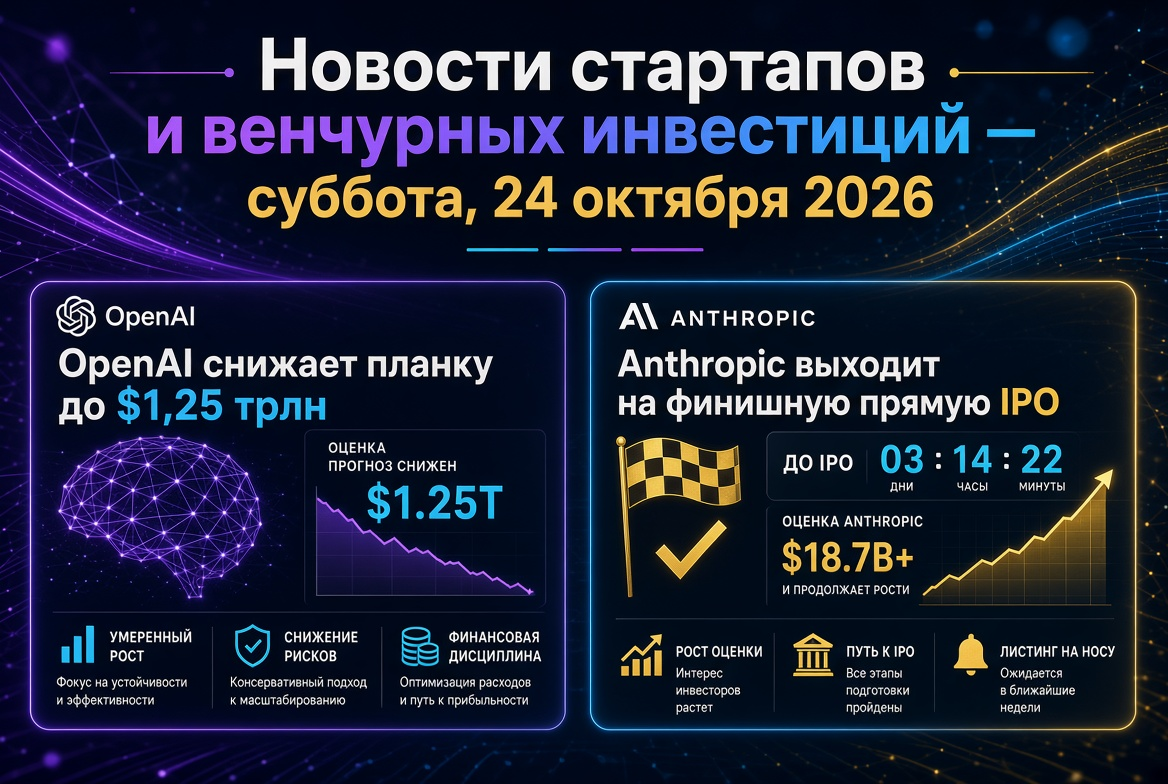
- OpenAI has postponed its public offering plans to 2027;
- Databricks completely excluded itself from the listing queue—the company's head described 2026 as a "terrible year for going public" due to a crowded calendar of mega-offerings;
- Late-stage investors are increasingly utilizing secondary deals and structured liquidity instead of waiting for an IPO.
An interesting countertrend is being set by Robinhood: the broker is taking a second venture fund of up to $200 million public, offering retail investors access to early-stage private companies through a listed structure. The offering is scheduled for mid-August—a sign that the democratization of the venture asset class continues regardless of sentiment in the traditional IPO segment.
Where the Money Is Going: AI Infrastructure Instead of Applications
Recent funding rounds demonstrate a clear capital shift toward the physical infrastructure of the AI economy. Investors are financing the "bottlenecks" of the boom—energy, computation, and security:
- Valar Atomics raised $1 billion in Series B funding at a valuation of $6 billion for the serial production of modular nuclear reactors for data centers;
- Commonwealth Fusion Systems secured $1 billion for the construction of an industrial-scale fusion power plant, bringing its total funding to $4 billion;
- Antora Energy closed a Series C round of $550 million for thermal energy storage for data centers;
- K2 Space raised $500 million for the production of powerful satellites;
- the British developer of photonic chips for AI inference OLIX raised approximately $312 million at a valuation of $3.3 billion;
- Horizon3.ai secured $250 million for autonomous cybersecurity testing tools.
The logic of investors is clear: while the outcome of competition among AI applications remains uncertain, suppliers of "shovels and picks"—energy, computation, and security—stand to gain in any scenario.
Consolidation and M&A: Strategists Reshape the Landscape
Amidst the narrowing IPO window, mergers and acquisitions are becoming the primary channel for liquidity. The first half of the year has already brought notable deals: Qualcomm acquired AI chip developer Modular for approximately $4 billion, Salesforce acquired the customer AI solutions provider Fin, and the purchase of Cursor has gone down in history as the largest acquisition of a venture company.
Corporate venture divisions are also changing their tactics: instead of maintaining a broad portfolio of small bets, they are focusing on a smaller number of significant investments in AI startups, viewing them as a way to gain priority access to computational power and technologies. For early-stage funds, this broadens the map of potential buyers for portfolio companies.
Discipline Amidst Abundance: How Funds Manage Their "Gunpowder"
Despite record volumes of available capital, the discussion of easy money is off the table. Managers describe the current market as selective: the next rounds are awarded to teams with clean metrics, clear unit economics, and a coherent exit strategy. Valuations are rising rapidly only among category leaders—primarily in AI and late stages—while the rest of the market faces a stringent resilience test.
It is also worth noting that the record exit environment does not benefit small and new venture firms: institutional money continues to flow to the largest industry brands, complicating fundraising for first- and second-fund managers.
Russia and the CIS: Cautious Recovery on a Low Base
The Russian venture market is moving according to its own logic. By the end of 2025, its volume was approximately $159 million across 102 deals, although the average check increased by two-thirds—to $1.7 million. Forecasts for 2026 anticipate growth of 10–15% with a gradual recovery to a level of around 17 billion rubles.
Key drivers include private and state funds, while the activity of business angels is hindered by high key rates and competition from bonds. Among notable initiatives is the launch of the country's first specialized fund for AI-agent-based projects, along with a busy calendar of industry events: by mid-August, Moscow will host the anniversary forum "Venture Landscape," gathering key players in the local ecosystem.
Looking Ahead: What This Means for Investors
The venture market enters the second half of 2026 with a unique combination of factors: unlimited private capital, record concentration, a cooling public window, and the growing role of M&A. For funds and allocators, three practical takeaways emerge from this scenario. First, diversifying beyond consensus mega-deals becomes a source of alpha—competition for quality assets is significantly lower in less efficient market segments. Second, liquidity strategies require reassessment: the secondary market and sales to strategists are displacing IPOs as the baseline exit scenario. Third, a bet on AI infrastructure—energy, chips, cybersecurity—appears to be the most resilient to potential valuation corrections in the applications segment. The market remains generous, but it rewards discipline rather than appetite for risk in itself.