Current Startup and Venture Investment News as of April 12, 2026, Including AI Mega-Rounds, Growth in Infrastructure Technologies, and Key Trends in the Global Venture Market
The global startup and venture investment market is entering the second quarter of 2026 in a notably stronger position compared to a year ago. At first glance, the market appears to be a story of returning risk appetite: large funding rounds are again measured in hundreds of millions and billions of dollars, AI infrastructure is attracting capital almost without pause, and late-stage investments are gaining fresh momentum. However, beneath this growth lies another critical trend: the venture market is becoming significantly more concentrated, disciplined, and demanding in terms of asset quality.
For venture investors and funds, this signifies a shift in focus. It is no longer sufficient to merely have a presence in sectors like AI, fintech, or deeptech. Understanding where capital is systematically accumulating, which startups are becoming infrastructure players, where exit windows are genuinely opening, and where valuations are rising faster than fundamental metrics is more crucial than ever. Below are the key themes shaping the startup and venture investment market as of April 12, 2026.
The Main Market Driver: Not Just AI, But Infrastructure for AI
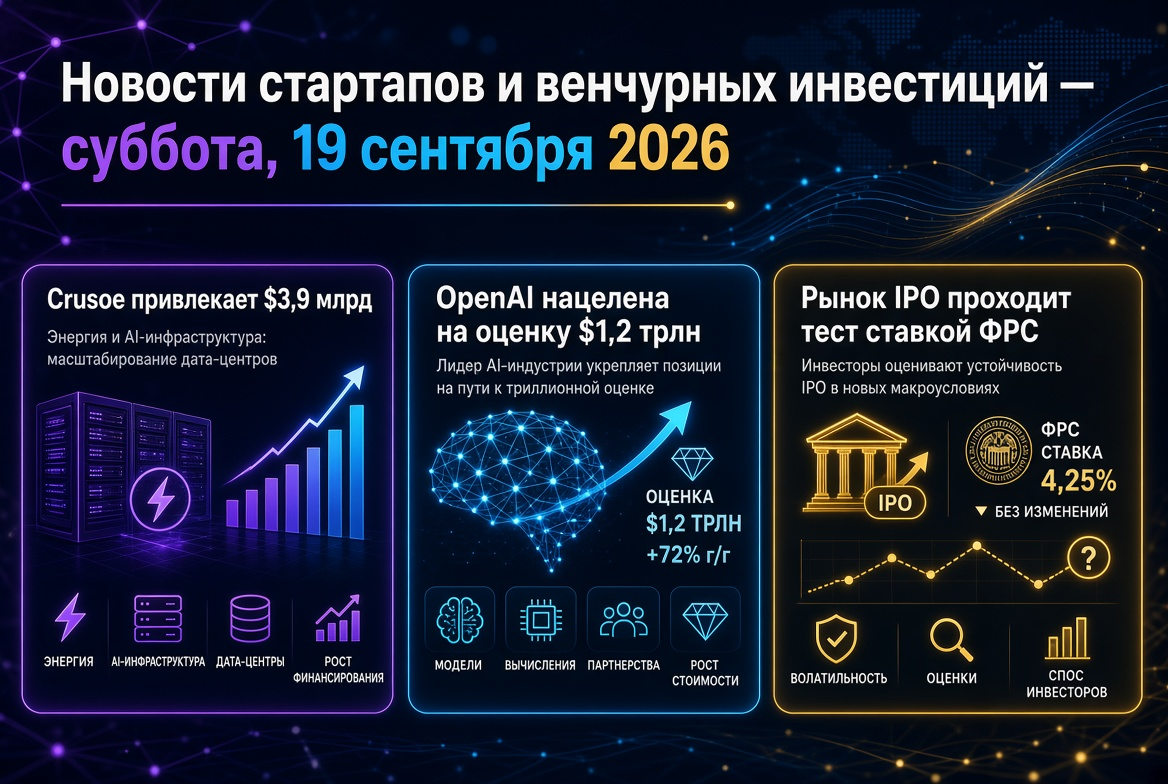
While investors actively funded applied AI companies in 2024-2025, the focus is now shifting even more towards infrastructure. This pertains to computing, chips, models, energy, load management, and software architecture—the critical factors without which scaling AI becomes prohibitively expensive and slow.
Consequently, the largest market deals increasingly occur around segments that can be termed the "shovels and picks" of the new technology cycle. Venture funds and strategic investors are more inclined to finance startups that can become a critical link in the AI supply chain than those with narrow application functions. There is growing interest in semiconductors, systems software, GPU clusters, data center optimization, and the infrastructure for deploying models in industrial applications.
- The highest demand remains in AI infrastructure, semiconductors, compute orchestration, and enterprise AI stack.
- Funds are increasingly favoring platform assets over point AI applications.
- Valuations in infrastructure segments are growing faster than in traditional SaaS.
Large Rounds Confirm: The Market Is Again Paying a Premium for Technological Core
In recent days, several noteworthy deals have boosted market sentiment. One of the most indicative events was the substantial round for SiFive—developers of RISC-V architectures and solutions. Attracting hundreds of millions of dollars with the involvement of high-profile investors indicates that capital is once again willing to pay a premium for assets at the intersection of AI, data centers, and chip design.
Concurrently, there is a growing influx of funds into next-generation AI companies in Asia. This is significant not just as news but also as a signal of geographic expansion of the venture cycle. Whereas the global startup market was previously seen as predominantly an American story, it is now evident that China and other Asian ecosystems are also increasing their roles in the race for capital, talent, and computing power.
For venture investors, this means that the startup and venture investment market is again evaluating not only revenue growth but also the depth of technological moats, control over intellectual property, and a company's ability to become a standard in its category.
Record Q1 Does Not Signal Broad Market Recovery
Preliminary data for the first quarter of 2026 looks impressive: global venture funding has sharply increased, and the headline figures create a sense of a full market turnaround. However, funds must avoid falling into the illusion of widespread normalization.
In practice, a two-speed market is forming. On one hand, there is a small group of startups that are securing gigantic rounds and can choose their investors. On the other hand, a broad cohort of companies, particularly outside of AI, continues to face more stringent terms, lower multiples, and protracted fundraising processes.
- Late-stage investments are attracting significantly more capital than the broader early-stage market.
- AI companies receive valuation premiums even with comparable growth metrics.
- Non-AI segments more frequently face demands for efficiency and burn rate reduction.
- Funds are becoming more selective in follow-on investments.
This is why the current growth of the venture market cannot be interpreted as a return to an era of "money for everyone." This growth benefits the best assets rather than the entire ecosystem.
Europe Strengthens, but Gaps Between Leaders and Others Are Already Visible Within the Region
The European venture market in 2026 appears to be more resilient than many expected. Interest in deeptech, AI, defense tech, climate tech, and enterprise software remains strong across the continent. Another factor is the development of venture debt, which is increasingly used as a tool to extend runway without immediate equity dilution.
However, within Europe, a noticeable gap is forming. Companies operating in AI and adjacent infrastructure continue to attract capital on favorable terms, while other startups must be more flexible: reducing valuation expectations, agreeing to stricter liquidation preferences, and more strongly demonstrating paths to profitability.
This creates an interesting opportunity for global funds. Europe remains a source of quality engineering teams and applied B2B startups, but the market requires much more precise selection. A mere bet on the region no longer works—investments must be targeted towards the right vertical within the region.
Fintech Is Making a Comeback, but Without Previous Euphoria
After a challenging period, fintech is once again starting to increase in capital raised. However, this growth is not occurring through a large expansion in the number of deals but rather through larger checks for fewer companies. In other words, fintech has regained investment interest, but it is now a much more mature and selective market.
The most attractive segments appear to be those where fintech intersects with AI, back-office process automation, risk management, B2B payments, and tax infrastructure. This is especially important for funds targeting a global audience: such business models are easier to scale internationally and better meet the demands of corporate clients.
- Fintech is no longer marketed simply as a growth story focused on user base expansion.
- Investors demand clear product economics and sustainable monetization.
- The winners are not the loudest brands but the companies integrated into real financial processes.
China and Asia Are Strengthening Their Own Venture Contours
One of the most significant themes in April is the strengthening of the Asian venture contour. In China, governmental and quasi-governmental mechanisms for supporting technology companies have sharply intensified. This primarily concerns sectors deemed strategic: AI, robotics, semiconductors, quantum tech, and industrial software.
Such a shift is changing the global architecture of the startup and venture investment market. For international investors, this means that Asian ecosystems will increasingly develop not as peripheral growth markets but as independent centers for forming technological leaders. As a result, competition for deeptech assets and AI companies will intensify not only among funds but also between geopolitical capital blocs.
This also raises the importance of due diligence regarding regulatory risks, export restrictions, and compatibility with international exit strategies.
IPO Window Is Slightly Open, but the Exit Market Remains Selective
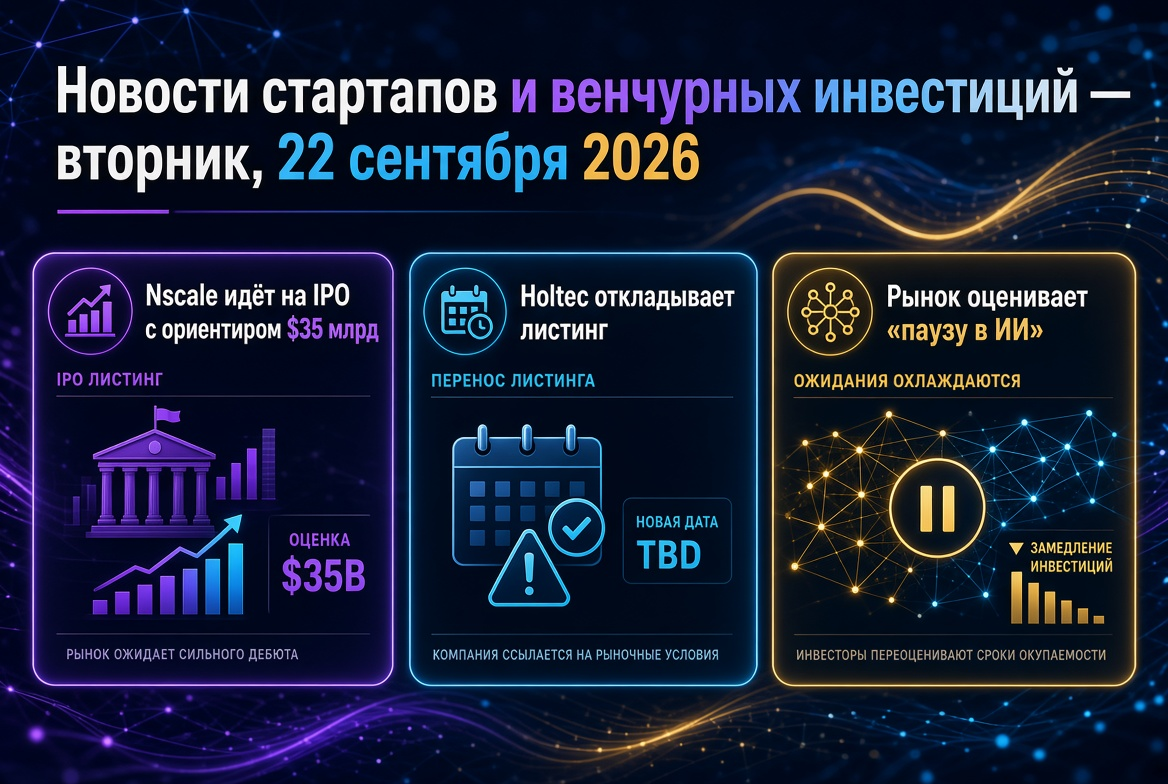
One of the main hopes for the venture market in 2026 remains the restoration of exit opportunities. Currently, the picture is uneven. On one hand, investors are clearly ready to discuss large public offerings and are closely monitoring pre-IPO stories. On the other hand, the IPO window remains sensitive to interest rate volatility, geopolitics, and issuer quality.
This means that in the coming months, only large, recognizable, and strategically important companies are likely to go public. For most startups, the more realistic exit path remains M&A. This is why the growth of corporate activity and large acquisitions is currently just as important as potential IPOs.
For venture funds, the takeaway is clear: exit planning should involve multiple scenarios simultaneously. Relying solely on the hope for an IPO as the only exit route in the current cycle appears too risky.
What This Means for Venture Investors and Funds Right Now
The current market favors those who can combine discipline and speed. There is more money in the system, but the competition for the best assets has intensified. The most attractive startups are securing capital more rapidly, while the average market continues to face pressure.
Against this backdrop, the logic of fund operations is changing:
- The focus is shifting towards AI infrastructure, deeptech, cyber, energy-for-compute, and B2B fintech.
- The significance of secondary deals and structured rounds continues to grow.
- The quality of the syndicate is becoming almost as important as the size of the check.
- The ability to assess exit optionality is turning into a key competitive advantage.
The main theme as of April 12, 2026, is not just the growth of the startup and venture investment market. It is a transition to a new phase where capital is again active, but operates much more rationally. The winners will be the startups with strong technology, sustainable product architecture, and a clear place in the new AI economy. And the winners among funds will be those who can differentiate temporary hype from long-term platform value.