Global Startup and Venture Capital News for March 10, 2026, Including Mega Rounds, AI Development, Fintech Growth, and Key Venture Market Deals
The main characteristic of the current cycle is capital concentration. According to Crunchbase, February 2026 was a record month for global venture funding ($189 billion), with the bulk coming from several mega rounds in the AI segment. At the level of "everyday" deals, activity remains consistent, but investors are increasingly demanding evidence of demand and operational discipline.
- United Kingdom and Europe: accelerated deals surrounding AI infrastructure, industrial tech, and deep tech (energy, manufacturing, materials).
- USA: rising interest in defense tech and B2B automation based on agentic AI.
- Asia: fintech and payments are once again moving towards public markets (listings, pre-IPO preparations).
Main Topic: Nscale and the AI Compute Premium
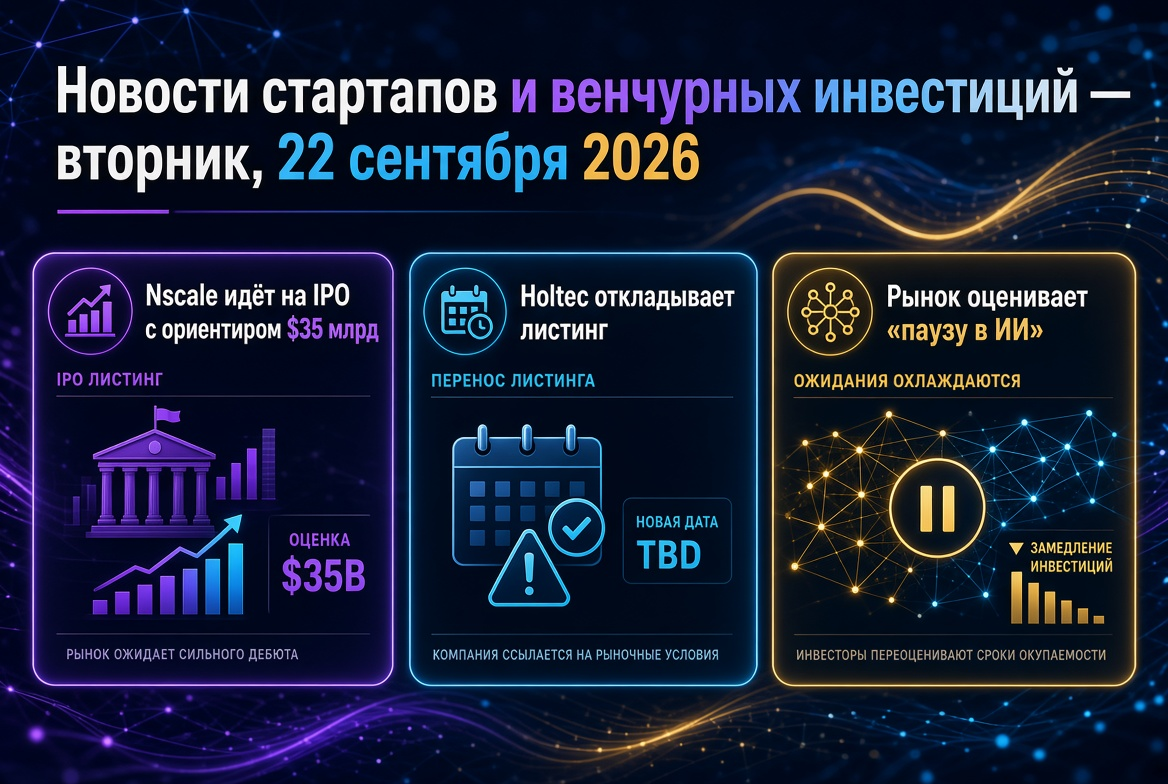
The headline feature is the British computing provider for AI, Nscale: the company announced it raised $2 billion in a Series C round, valuing it at around $14.6 billion. The investor composition emphasizes the “infrastructure premium”: the market is ready to finance not only models and applications but also the “shovels” — data centers, GPU fleets, and software stacks for large-scale AI compute.
The deal is significant for two additional reasons. First, in the face of increasing competition for GPU power, the position of providers capable of rapidly deploying new capacities and contracting with large clients is strengthened. Second, a public trajectory is forming around the company: discussions of preparing for an IPO are circulating in the market, enhancing the value of early access and the secondary market of shares for funds.
Defense Tech and Space: Security as an Investment Megatrend
In the U.S., venture capital investors continue to be drawn to Anduril: the company is reportedly discussing a round of approximately $4 billion, nearly doubling its valuation compared to last year. This case underscores a shift: defense developments, autonomous systems, and sensor platforms are becoming a mainstream focus for large funds.
In aerospace and space technologies, a “second wave” of capital is evident. Spanish PLD Space closed a major round to enhance launch capabilities, while American Vast secured funding to develop private orbital stations. In Europe, the industrial layer is also strengthening: British Isembard raised $50 million in a Series A round to scale its production network for clients in defense and aerospace.
Agentic AI and B2B SaaS: Process Automation Becomes a Product
Agentic AI is shifting from experimentation to “industrial” implementations. A notable example is Lyzr AI: the company, which is working on infrastructure for corporate AI agents, announced it raised $14.5 million and increased its valuation to $250 million in a Series A+ round. For venture funds, this signals that the market is willing to pay for platforms that manage workflows and integrations rather than simply “generating text.”
At the SMB market level, the Mega round ($11.5 million Series A) is intriguing: the startup promotes the idea of an “AI growth team” that replaces agencies, disparate tools, and manual campaign management. In the legal tech segment, ILS raised $3 million, offering automation for post-close processes for private funds — a domain where errors are costly, and budgets are often safeguarded even in a “risk-off” phase.
Fintech and Payments: IPO Preparations and New Rails
The fintech agenda is once again linked to public markets. In Japan, PayPay is preparing for an IPO in the U.S. and aiming for a valuation of up to $13.4 billion. In India, PhonePe reportedly aims for a listing with an estimated valuation of around $9–10.5 billion and a placement volume of up to $1.05 billion. For venture investors, this provides an important framework: the IPO window in the fintech vertical opens selectively — where a company is embedded in the national payment ecosystem and can articulate its path to profitability.
On the local Indian market, Moneyview stands out: the fintech company has filed documents for an IPO amounting to around ₹1,500 crore, confirming that exits through public markets are becoming more feasible not only for “unicorns” but also for profitable niche players.
A separate line includes stablecoins as payment infrastructure. Payment company KAST announced a Series A round of $80 million at a valuation of approximately $600 million and plans for international expansion. In 2026, such deals are increasingly perceived as bets on cross-border payments and the compliance layer, rather than purely “crypto beta.”
Funds and the LP Market: Selective Fundraising and Demand for Liquidity
Fundraising for venture funds remains uneven: LP capital flows to brands with discipline and industry specialization. Oak HC/FT raised nearly $2 billion for a new fund focused on AI applications in healthcare and fintech. Battery Ventures closed a fund of $3.25 billion for global tech deals, while Canadian Novacap completed its Tech Fund VII collection of nearly $3.8 billion — a sign that demand for “tech buyout/growth buyout” platforms persists even in challenging macro conditions.
Amid discussions of venture capital returns relative to public markets, investors’ demand for a more predictable “liquidity toolkit” is growing: M&A, secondary share sales, deal structuring, and selective IPOs. This influences the terms of financing rounds, preferences, and holding periods for assets.
Europe and Deep Tech: Marketplaces, Climate Tech, and Infrastructure Software
European deals demonstrate a breadth of verticals. Lithuanian B2B marketplace Saltz raised €20 million in a Series A round for expansion across Europe and the development of cross-border trading infrastructure in food supply. In the United Kingdom, Shellworks secured $15 million in a Series A round to scale alternatives to plastic packaging and penetrate markets in the EU and the USA — an example of how climate tech and materials rekindle investors’ interest when there is a clear production roadmap.
In Germany, Telura raised €4 million in a pre-seed round for its electric impulse drilling technology for geothermal energy, while Peeriot announced late-seed funding in a seven-figure amount for a market launch in 2026 in the edge/IoT software segment. In the United Kingdom, Augur secured $15 million in seed funding to develop AI analytics for physical spaces — an indicator that investments in infrastructure and public safety are becoming part of standard venture portfolio strategies.