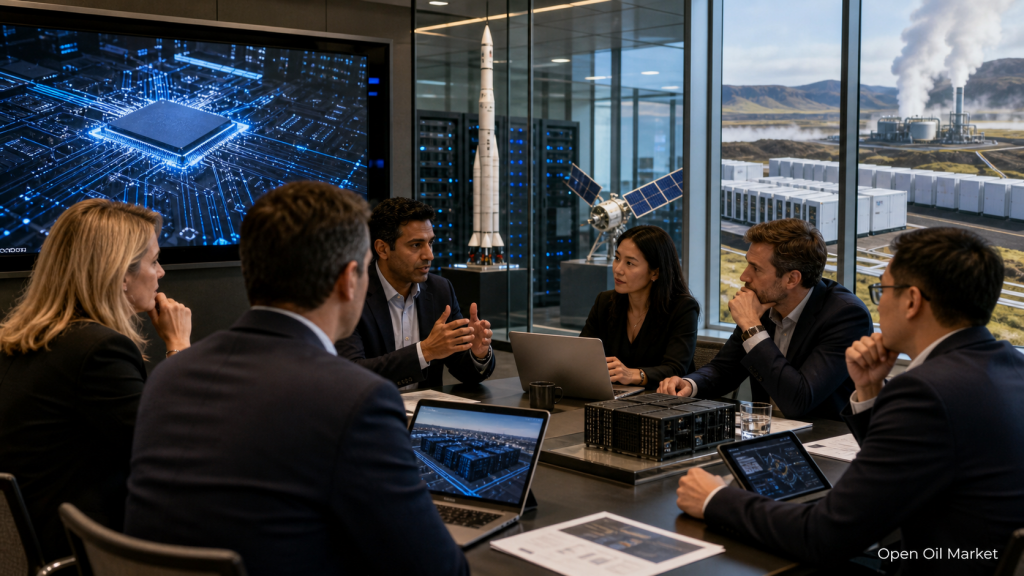
Venture Investors Discuss AI Infrastructure Startups, Deeptech, Energy Technologies, and IPOs on the Global Market - May 5, 2026
The global venture market enters May 2026 in a state of sharp capital concentration. Startups are once again securing large rounds of funding, but investors are acting with much more selectivity than during the broad tech boom. The main focus of venture funds is not just on rapid user base growth but on the infrastructure technologies that can support the new artificial intelligence economy: chips, data centers, energy systems, corporate process automation, defense deeptech, and specialized AI platforms.
For venture investors and funds, a key feature of the current agenda is that the market has stopped evaluating startups solely based on promises of future scale. The spotlight is now on revenue, capital intensity, access to corporate clients, business model sustainability, and the likelihood of exits through IPO or strategic deals. News from startups and venture investments on Tuesday, May 5, 2026, indicates that capital is still prepared to pay a premium for growth, but only where technology becomes a critical part of the global infrastructure.
Today's Main Trend: AI Infrastructure Becomes the New Core of the Venture Market
Artificial intelligence remains the leading focus of venture investments; however, the structure of demand is changing. In the past, the market concentrated on chatbots, generative applications, and consumer AI services. Now, investors are increasingly financing the "lower floors" of the tech economy: chips, computing platforms, energy-efficient architectures, corporate AI agents, and infrastructure for scaling up models.
This transformation is understandable. Major companies are no longer asking whether they need artificial intelligence. The main question is how to implement AI safely, economically, and with controlled computational costs. Consequently, venture capital is shifting towards segments where startups address real market bottlenecks:
- shortage of high-performance chips and accelerators;
- rising costs of model inference and training;
- energy consumption of data centers;
- automation of customer service and corporate processes;
- cybersecurity and AI agent management;
- infrastructure for industrial, defense, and financial applications of AI.
For funds, this means a shift in deal selection logic. The most "loud" startups are not in the spotlight; instead, companies with a technological barrier, corporate revenue, and the ability to be part of critical infrastructure are prioritized.
Record Q1 2026: Capital Exists but is Unevenly Distributed
The first quarter of 2026 has proven to be one of the strongest periods for the global venture market. Investment volume in startups sharply increased, with a significant portion of capital directed towards AI-related companies. However, this growth does not signify an evenly distributed recovery across the whole market. On the contrary, venture investments are becoming more concentrated: the largest rounds go to a limited number of leaders capable of demonstrating scale, technological uniqueness, and strategic importance.
The concentration is particularly noticeable in late stages. Major funds, sovereign investors, corporate venture arms, and strategic players prefer to invest in companies that can already show revenue, partnerships, institutional demand, or preparation for a public market exit. This creates a new norm: the venture market is growing, but early-stage startups are finding it more difficult to compete for capital attention without clear technological differentiation.
IPOs Resurgence: Cerebras and Fervo Test Public Market Appetite
One of the most important themes for venture investors is the revival of the IPO market. After a prolonged period of caution, public investors are once again beginning to consider rapidly growing tech companies, especially those tied to AI infrastructure, energy, and industrial transformation.
AI chipmaker Cerebras has become a key indicator of this trend. The company aims to go public with a high valuation, positioning itself as a specialized alternative to dominant computing infrastructure providers. For the venture market, such a deal is significant not only as a potential exit but also as a test of public demand for AI infrastructure.
Another representative example is Fervo Energy, a developer of advanced geothermal systems. Interest in the company is driven by the fact that the growth of artificial intelligence boosts demand not only for chips and data centers but also for stable electricity. For venture funds, this signals that energy startups capable of providing a base load for the digital economy could become a distinct category of investment demand.
Defense Deeptech Steps Out of Niche Segment
Defense technologies and space security are becoming one of the fastest-growing areas of venture investment. A large round for True Anomaly confirmed that funds are increasingly viewing aerospace, defense tech, and dual-use technologies as a fully-fledged asset class rather than a narrow governmental niche.
The reasons behind this trend are evident. Geopolitical tensions, rising demand for satellite infrastructure, autonomous systems, orbital monitoring, and secure communications create a market where government and corporate clients are willing to pay for technological advantage. For startups, this opens access to long-term contracts, and for venture investors, it leads to companies with high barriers to entry and potentially large exits.
Corporate AI: From Experiments to Business Process Implementation
The corporate AI segment is becoming increasingly mature. Startups like Netomi, Avoca, Hightouch, and Rogo demonstrate that investors are seeking not abstract AI solutions but products embedded in specific business functions: customer service, financial analytics, marketing, sales, data management, and workflow automation.
For funds, three criteria become crucial:
- Measurable Economic Impact. The startup must reduce costs, enhance conversion, or accelerate employee productivity.
- Integration into Existing Corporate Infrastructure. The easier the implementation, the higher the chances of scaling.
- Risk Management. Companies require reliability, cybersecurity, transparency, and compliance with regulatory demands.
This is why venture investments in AI services are increasingly directed towards vertical solutions, where artificial intelligence does not serve as a standalone "showcase," but as a working tool within business.
Europe: SaaS, Climate Technologies, and Capital for Energy Storage
The European startup market is also showing signs of revival, but its structure differs from that of the U.S. In Europe, the role of vertical SaaS, climate technologies, industrial automation, and energy infrastructure is more pronounced. The Smartness round in Italy shows that investors are ready to finance B2B platforms if they solve practical industry problems and can scale beyond local markets.
Notably, CMBlu Energy has raised capital for the development of long-term energy storage based on non-lithium solutions. This segment becomes particularly significant with the growth of data centers, renewable energy, and demands for grid resilience. For venture funds, climate technologies are again becoming not only an ESG direction but also an infrastructure bet on the new industrial economy.
India and Emerging Markets: A Bet on AI Compute and Local Tech Chains
Interest in startups addressing artificial intelligence infrastructure challenges is increasing in emerging markets. Indian startup Tsavorite secured funding to develop an AI compute platform focused on energy-efficient computing, edge scenarios, corporate systems, and data centers. For global investors, this is an important signal: competition in AI infrastructure will not only occur between the U.S. and China but also through new tech hubs in India, Southeast Asia, Europe, and the Middle East.
Such deals highlight the growing demand for local computing architectures, independent supply chains, and specialized solutions for the corporate market. This creates opportunities for venture investors to discover undervalued companies outside traditional Silicon Valley centers.
New Funds and Corporate Capital: BMW i Ventures Strengthens Focus on Physical AI
Corporate venture funds are becoming increasingly active participants in the market. The launch of a new $300 million fund by BMW i Ventures reflects industrial players' interest in agentic AI, physical AI, manufacturing software, new materials, supply chains, and industrial automation.
This is an important landmark for the venture market. Capital is increasingly directed towards areas where artificial intelligence intersects with the physical economy: automotive, logistics, robotics, production, and energy. For startups, this means heightened prospects for strategic partnerships, pilot projects, and subsequent M&A deals.
What Venture Investors and Funds Should Monitor
The agenda for May 5, 2026, shows that the global startup market is not in a simple recovery phase, but rather undergoing structural restructuring. Money is returning, but it is being allocated more stringently. Investors are ready to fund large rounds but require a clear answer to the question: what critical problem is the company solving, and why is it poised to become a category leader?
Key Areas for Monitoring
- AI Infrastructure: chips, inference, computing platforms, data centers, and energy efficiency.
- Corporate AI: automation of customer service, marketing, financial analytics, and internal processes.
- Defense Deeptech: space, autonomous systems, cybersecurity, and dual-use solutions.
- Energy Startups: geothermal energy, energy storage, resilient networks, and powering data centers.
- IPO Candidates: companies able to open exit windows for late-stage funds.
- Emerging Markets: India, Europe, the Middle East, and Southeast Asia as new centers of tech capital.
The Venture Market is Becoming More Mature and Infrastructure-Oriented
News from startups and venture investments on Tuesday, May 5, 2026, confirms that the global venture market maintains a high-risk appetite, but this risk is becoming more rational. Investors are seeking not just rapid growth but technological platforms capable of becoming the foundation for a new economy driven by artificial intelligence, industrial automation, energy resilience, and digital security.
For venture funds, the main takeaway is the necessity of looking deeper than user metrics and high valuations. The most promising deals are formed where a startup combines technological advantage, corporate demand, infrastructural significance, and a potential path to liquidity. Such companies will determine the next cycle of venture investments in 2026.