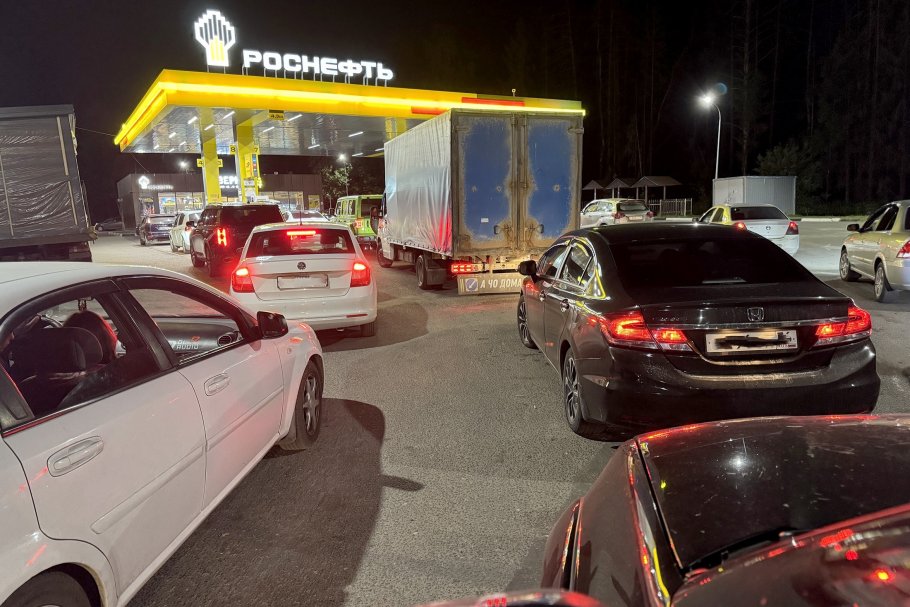
Last week, there was a sharp acceleration in fuel prices at gas stations in the capital. The price of AI-95 gasoline increased by 0.3% over seven days, while diesel rose by 0.6%. According to the Moscow Fuel Association (MTA), the average price of AI-95 at Moscow gas stations reached 71.17 rubles per liter, with diesel fuel (DT) at 77.93 rubles per liter.
Data from Rosstat nationwide will only be available on the evening of May 27, but they typically align closely with the dynamics reported by MTA. Furthermore, there are over 2,400 gas stations operating in Moscow and the region, accounting for 8.4% of all gas stations in Russia. Prices vary by region, but their dynamics are generally similar across the country, with the exception of cases of local shortages. Since the end of April, the weekly price increase for gasoline in Russia has not exceeded 0.1%.
The acceleration in price hikes occurred against reports of mass drone attacks on oil refineries (NPZ) in the European part of Russia. Notably, while in April the attacked facilities primarily catered to export markets, since early May, the focus has shifted to those supplying the domestic market (Moscow and the region, Central Russia, Northwestern and Southern regions, Volga region, and Ural). According to Reuters, production has been halted or reduced at five of the largest fuel suppliers in Russia. However, this is unlikely to be the primary reason for the surge in prices. Rather, unplanned repairs at NPZs provided a convenient excuse for price increases, exacerbated by existing internal issues within oil refining.
This is illustrated by the unexpected rise in diesel prices. There is no significant diesel deficit in the country; production is nearly double the domestic demand. Yet, DT emerged as the leader in price increases last week. If Rosstat's data aligns with MTA's statistics, the rate of diesel price increases will surpass the average inflation in the country.
Moreover, the Ministry of Energy consistently emphasizes that the domestic market is well-stocked with gasoline, diesel, and aviation fuel, and the logistical infrastructure is functioning robustly, placing fuel reserves at sufficient levels.
As noted by Dmitry Gusev, Deputy Chairman of the Supervisory Board of the "Reliable Partner" Association and a member of the Expert Council of the "Gas Stations of Russia" contest, the price hike is not directly linked to attacks on NPZs; rather, it is a reaction to price restraints on fuel exchange rates and gas station prices. However, to prevent price increases, mere administrative measures are insufficient; a surplus of supply is required. Unfortunately, we lack economic incentives to boost oil refining volumes.
Specifically regarding gasoline, production capacities only exceed the internal market needs by 10-15%. The volume of exchange sales for AI-95 gasoline dropped by 27.5% from early April to May 26 compared to the same period last year. The exchange is one of the primary sources for gas stations to procure fuel. A decrease in supply results in rising prices.
Both gasoline and diesel production in Russia exceeds domestic consumption.
According to Dmitry Prokofyev, Director of External Communications at NEFT Research, the increase in prices for premium gasoline and DT is attributed to a combination of three overlapping factors. NPZs have faced a wave of unplanned repairs. Consequently, crude oil processing in May fell below planned expectations. Less fuel is physically produced.
Additionally, discrepancies in regulations for gasoline and diesel have impacted the market, according to Prokofyev. Since April 2026, the government has imposed a complete ban on gasoline exports. Simultaneously, oil companies are mandated to curb retail price increases at gas stations in 2026 in line with inflation levels, effectively closing off a primary channel for cost compensation. Diesel exports have not been banned, creating fundamentally different incentives: gasoline producers are confined to the domestic market with limited margins, while DT retains access to export opportunities. As global prices began to rise (due to the crisis in the Hormuz Strait), producers received incentives to redirect diesel flows for export, adding pressure on internal prices. The third factor is seasonal; May is the peak sowing season, leading to a traditional surge in diesel demand from agricultural producers.
The rise in diesel prices is not a coincidence but a logical consequence of the market configuration, where reduced domestic supply coexists with sustained seasonal demand alongside export alternatives, believes the expert.
Furthermore, the informational backdrop plays a role, asserts Sergey Tereshkin, CEO of Open Oil Market. The market reacts not only to the actual balance of supply and demand but also to expectations that fuel availability may decline. The real picture is likely to only become clear in June when the situation regarding fuel shipments from the largest NPZs is clarified. Additionally, traditionally, regulatory specifics come into play: exchange prices for AI-95 are not considered when disbursing subsidies from the budget to oil companies, increasing the risks of accelerated price growth specifically in this market segment—even under stable fuel production conditions.
Furthermore, in Prokofyev’s view, oil companies—under conditions of limited AI-95 supply—might prioritize deliveries to their own distribution structures. This directly increases the vulnerability of independent gas stations that operate "from tanker to tanker".
The risk of shortages of specific fuel types in Central Russia and Moscow is currently not systemic but structural, concentrating around specific fuel types and certain distribution channels. It is primarily linked to logistical disruptions and the market vulnerability of independent gas stations, not due to an actual absence of fuel, according to the expert.
Source: RG.RU
What are you looking for: