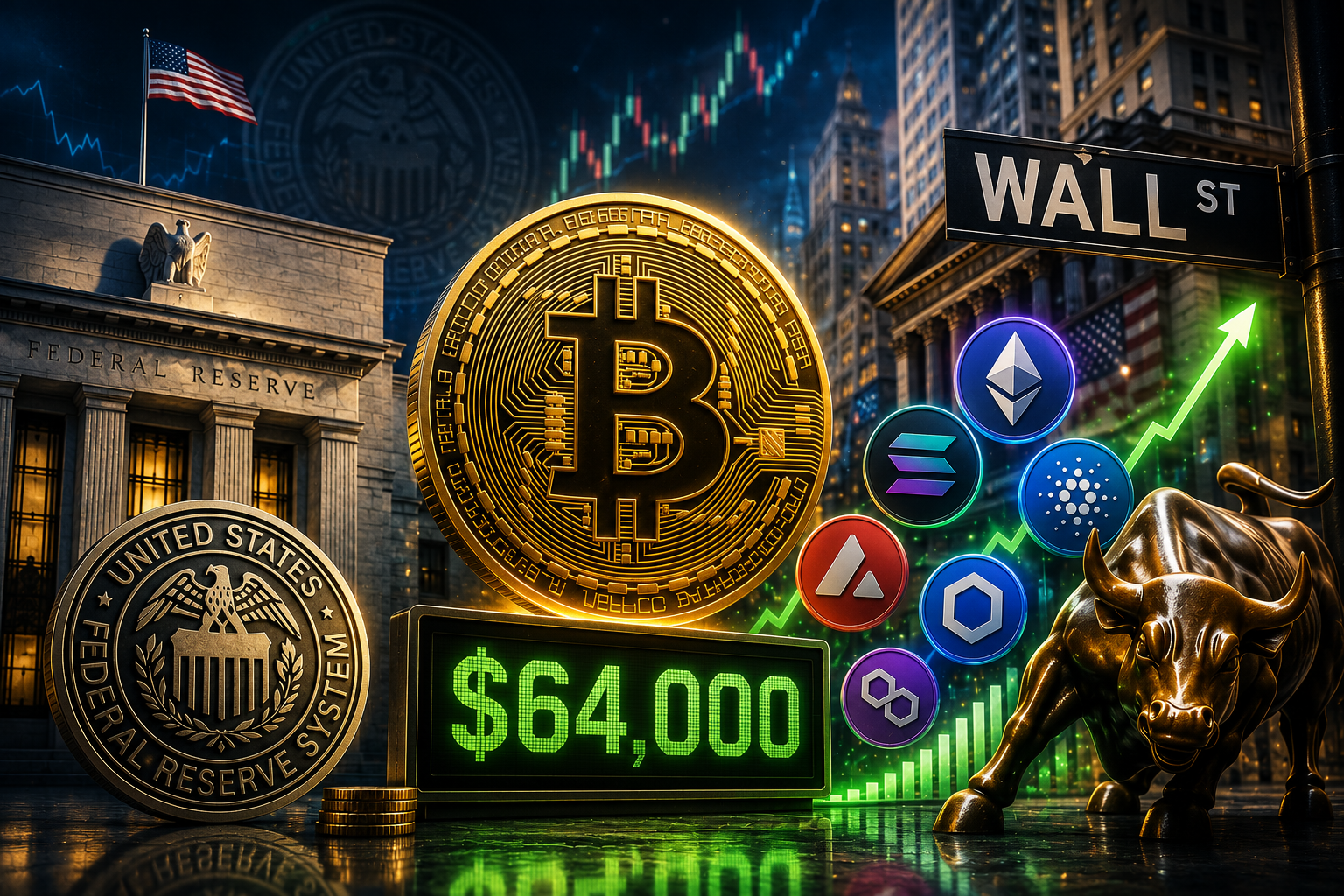
Cryptocurrency News, Thursday, July 30, 2026: Market Awaits Fed Verdict, Bitcoin Holds $64,000, Wall Street Delves into Altcoins
The cryptocurrency market greets Thursday, July 30, 2026, in a state of tense equilibrium. The total capitalization of digital assets hovers near $2.28 trillion, with a daily trading volume of about $62 billion, and the fear and greed index remains at 29 points — within the "fear" zone. Investors worldwide are focusing on two key factors: the results of the July meeting of the Federal Reserve System of the United States and the accelerating institutionalization of the market, symbolized by the launch of exchange-traded products by Morgan Stanley on Ethereum and Solana.
Key Events of the Day: In Brief
- Bitcoin trades in the range of $63,000–64,500, maintaining key support after pulling back from weekly highs.
- The Fed concludes its two-day meeting: the market is pricing in a steady rate in the range of 3.50–3.75%, but is attentively watching the regulator's rhetoric.
- Morgan Stanley launched exchange-traded products on Ethereum and Solana with a record low fee of 0.14% on NYSE Arca.
- Strategy has refrained from purchasing Bitcoin for the fifth consecutive week, increasing its dollar reserve to $3.75 billion.
- Losses from hacks of crypto projects reached $1 billion in the first half of 2026 — a historical low.
- The industry awaits advancements on the CLARITY Act in the U.S. Senate amid the formation of a strategic crypto reserve.
Macroeconomic Background: All Eyes on the Fed
The decision by the Federal Open Market Committee (FOMC) remains the main driver of the week for all risk assets, including cryptocurrencies. The consensus forecast suggests holding the base rate at 3.50–3.75%, however, for traders, the accompanying rhetoric is far more critical: any hint at further monetary easing could reignite risk appetite, while stringent language may enhance pressure on prices.
In anticipation of the regulator's decision, the market displayed classic "risk-off" behavior: trading volumes declined, with liquidations totaling approximately $95.7 million within 24 hours, and large players adopted a wait-and-see approach. Additionally, the instability in Asian equity markets, which experienced one of the worst declines of the year, added to the market's nervousness.
Bitcoin: Defending the $63,000 Threshold
The leading cryptocurrency trades close to $63,800–64,000 with a market capitalization of approximately $1.27–1.28 trillion and dominance of 56.3%. After bouncing back from a local low around $62,800, Bitcoin gained about 1% over the day; however, it remains roughly 49% below its historical maximum of $126,080. The technical picture indicates a battle for key support: maintaining it could pave the way for recovery, while a breach downwards would intensify selling pressure.
Notably, the behavior of corporate holders has been telling. Strategy, the largest corporate holder of Bitcoin with a portfolio of 843,775 BTC, has refrained from purchases for the fifth consecutive week, concurrently increasing its dollar reserve to $3.75 billion. The pause taken by the largest buyer in recent years is perceived by the market as a signal of caution, although the company maintains all accumulated positions.
Ethereum: Institutional Demand vs. Technical Resistance
Ethereum trades around $1,900–1,920, gaining over 2% for the day and outperforming Bitcoin in short-term dynamics. ETH's share in the total market capitalization stands at about 10.2%. The fundamental outlook remains strong: over 2.5 million ETH — roughly 2% of the circulating supply — are awaiting entry into staking, forming a queue of validators lasting about 44 days with virtually zero demand for withdrawals.
Grayscale provides additional momentum: the company plans to transition to regular cash payouts for staking rewards to holders of its Ethereum fund starting in early August, making the product more attractive to conservative institutional investors.
Wall Street Delve into Altcoins: Morgan Stanley's Move
A key structural event of the week was the debut of Morgan Stanley's exchange-traded products on Ethereum and Solana on the NYSE Arca. The 0.14% fee is the lowest in the market for similar instruments, and the launch followed the success of the bank's Bitcoin fund, whose assets exceeded $381 million. For global investors, this represents a continuation of the trend: leading financial houses in the U.S. are no longer limited to Bitcoin and are systematically expanding the range of regulated crypto products.
Top 10 Cryptocurrencies: Power Dynamics as of July 30
The hierarchy of the largest digital assets by market capitalization looks as follows:
- Bitcoin (BTC) — around $63,800; an undeniable leader with a dominance of 56.3% and a market capitalization of about $1.27 trillion.
- Ethereum (ETH) — around $1,900–1,920; the main beneficiary of institutional demand for staking.
- Tether (USDT) — the largest stablecoin, a base liquidity instrument linked to the U.S. dollar.
- XRP — around $1.08–1.11; the asset is consolidating above the psychological mark of $1 against the backdrop of improving regulatory prospects for Ripple and testing payments on XRP Ledger by the central bank of Singapore.
- BNB — a token of the Binance ecosystem; the segment has increased by more than 6% over the month, thanks to user inflows and institutional interest.
- Solana (SOL) — around $73–74; the network is preparing for a significant consensus update, Alpenglow, and is conducting a community call on July 30.
- USD Coin (USDC) — the second most important regulated stablecoin, in demand for corporate settlements.
- TRON (TRX) — the network maintains its lead in stablecoin transfer volumes with steady blockchain loads.
- Dogecoin (DOGE) — around $0.07; the largest meme coin stays in the top ten with a market capitalization of about $11–12 billion.
- Cardano (ADA) — around $0.16; the asset remains under pressure, although the community points to undervaluation relative to fundamental metrics.
Regulation: CLARITY Act and the U.S. Strategic Reserve
The regulatory agenda in Washington remains one of the main long-term catalysts. The industry is pressing the U.S. Senate to bring the CLARITY Act to a vote, which aims to establish a clear division of powers between the SEC and the CFTC. Two factors provide a positive backdrop:
- A joint statement from the SEC and CFTC declaring that 16 major digital assets are not securities;
- Confirmation from the White House of plans to establish an official strategic cryptocurrency reserve.
For global investors, this reduces legal uncertainty — historically the main barrier to conservative capital entry.
Security and Infrastructure: Alarming Signals
A report from cybersecurity analysts recorded 212 incidents of crypto project hacks in the first half of 2026, with a total damage of about $1 billion and average losses of $5.4 million per attack. The largest losses were incurred by the Ethereum and Solana ecosystems. Concurrently, the market is witnessing a consolidation of infrastructure: exchanges BitMEX and BitMart announced closures, which analysts describe as the end of an era for the early crypto industry. Among trending developments is a shift in mining companies: Core Scientific accelerates its transition from Bitcoin mining to AI data centers in partnership with AMD.
Forecast: What Investors Should Watch For
The upcoming sessions will determine the market direction for August. Key benchmarks include:
- The reaction to the Fed's final statement and the regulator's press conference;
- The ability of Bitcoin to hold the $62,800–63,000 zone — losing this level will intensify the correction scenario;
- For Ethereum — consolidation above $1,900 with targets of $1,940 and $1,980;
- For XRP — defending the psychological level of $1;
- Dynamics of inflows into Morgan Stanley's new exchange-traded products as an indicator of institutional appetite.
The combination of cautious sentiment, strong institutional flows, and progress in regulation creates a contradictory yet potentially constructive picture: the market is awaiting a trigger, and the Fed's decision may become one.
This material is for informational purposes only and should not be considered an investment recommendation.