Economic Events and Corporate Reports: Thursday, July 30, 2026 — US GDP, Bank of England Rate Decision, Reports from Apple, Amazon, Samsung, and Ozon
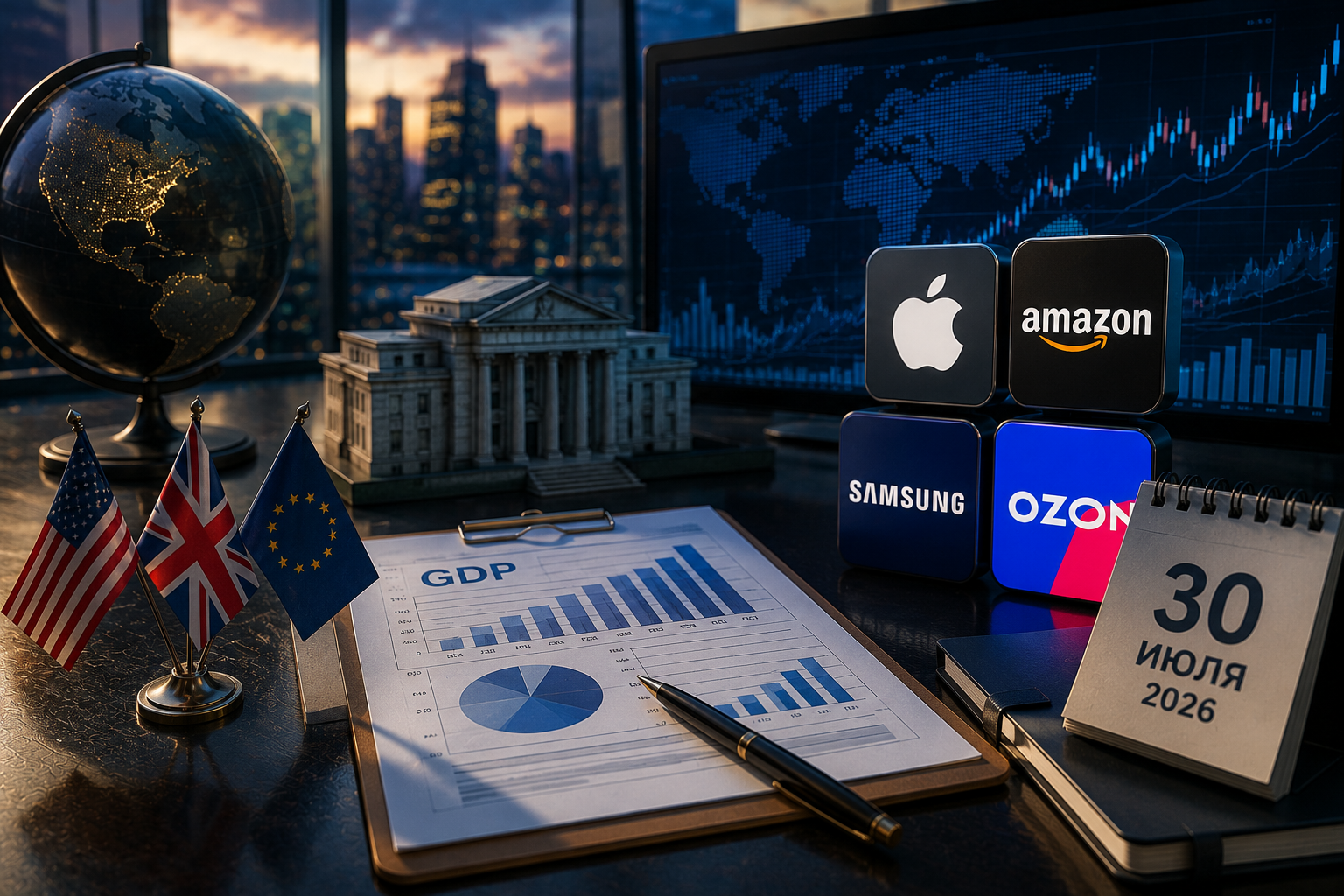
Thursday, July 30, 2026, will be one of the most eventful days of the summer season on global financial markets. Investors will be greeted with a blend of key macroeconomic statistics and peak corporate reports: in the US, the preliminary estimate of GDP for the second quarter is released along with PCE inflation data, the Bank of England announces its interest rate decision, and after the close of US trading, Apple and Amazon report — the final note of the week for the "big tech quartet." Additional intrigue is added by the full results from Samsung Electronics, reports from Shell, Sanofi, and Mastercard, as well as a block of publications from Russian issuers led by Ozon. This all occurs on the heels of the Federal Reserve's meeting, making the trading session particularly volatile for the S&P 500, Euro Stoxx 50, Nikkei 225, and MOEX indices.
Macroeconomic Background: Markets After the FOMC Meeting
The economic calendar for Thursday opens with global markets processing the outcomes of the two-day FOMC meeting held on July 28–29. The American regulator's decision on the key rate and the Fed's rhetoric will set the tone for the entire session: this will influence US Treasury yields, the dollar exchange rate, and risk appetite in emerging markets. The technology sector is additionally pressured by discussions surrounding capital expenditures on artificial intelligence, as investors recalibrate the balance between AI investments and free cash flow for megacorporations, especially after Alphabet raised its spending guidance for 2026.
US GDP for Q2 and PCE Inflation
The main macro event of the day is the first (preliminary) estimate of US GDP for the second quarter of 2026. The consensus forecast suggests an acceleration of annual growth rates for the American economy compared to earlier in the year, when the economy grew at a moderate pace due to weak investments. Simultaneously, the Bureau of Economic Analysis will release June data on personal income and spending in the US, including the PCE price index—a key inflation benchmark for the Fed. A slowdown in monthly core inflation is expected, which is critical for the trajectory of monetary policy in the second half of the year.
On the same day, weekly jobless claims data will be released in the US. Investors should closely monitor three parameters:
- GDP growth rates relative to the consensus—a significant deviation could sharply shift rate expectations;
- Dynamics of the core PCE index—a key indicator of the resilience of the disinflationary trend;
- The state of the labor market—an increase in jobless claims will bolster arguments for policy easing.
Bank of England Rate Decision
In London, the focus will be on the Bank of England's meeting. The regulator will announce its rate decision, publish the voting protocol, and update economic forecasts in its quarterly monetary policy report, followed by remarks from Bank Governor Andrew Bailey. For the British pound and the FTSE 100 index, the critical factor will be not just the decision itself but also the distribution of votes within the committee and signals regarding the pace of further easing amid cooling in the British economy.
Eurozone, Japan, and Asia Statistics
The European session will begin with a preliminary estimate of the Eurozone's GDP for the second quarter and unemployment data for June. These figures will determine sentiment in the Euro Stoxx 50 and the euro exchange rate ahead of Friday's inflation publication in the currency bloc. Late in the evening Moscow time, attention will shift to Asia: Japan will release a block of statistics—inflation in Tokyo, unemployment rate, retail sales, and industrial production. This data comes just before the Bank of Japan's decision, which the market expects will keep rates at 1.00%. For the Nikkei 225 and the USD/JPY pair, this publication package will serve as a key benchmark for the week's close.
US Corporate Reports: Apple, Amazon, and Mastercard
The earnings season in the US is reaching its climax. Before the market opens, Mastercard will present its second-quarter results: analysts expect earnings of around $4.77 per share on revenue of approximately $9.1 billion—growing at double-digit rates year on year. The payment giant's report typically serves as a barometer for global consumer spending.
After the market closes, the week's main events unfold:
- Apple — third-quarter financial report. The consensus anticipates revenue of about $109–110 billion and earnings of approximately $1.89 per share. The significance of this release is heightened as it marks Tim Cook's final report in his capacity as CEO before passing the baton to John Ternus.
- Amazon — second-quarter results with expected earnings of around $1.85 per share. The focus will be on growth rates in the AWS cloud segment and, crucially, guidance on capital expenditures for AI infrastructure.
On the same day, Coinbase Global, Norwegian Cruise Line, and Yum! Brands will also report their earnings, thereby expanding the outlook on the crypto market, tourism, and the consumer sector.
European Reports: Shell and Sanofi
In Europe, the day will begin with heavyweights from the Euro Stoxx 50 and FTSE 100. Oil and gas giant Shell will present its second-quarter results before the market opens: the market will evaluate cash flow, share buyback volumes, and comments on the oil market’s outlook. French pharmaceutical corporation Sanofi will host an online presentation of its quarterly results for investors—focusing on the sales dynamics of key drugs and progress in its research portfolio.
Asia: Full Report from Samsung Electronics
Samsung Electronics will publish its complete financial report for the second quarter on July 30, breaking down results by divisions. Preliminary data has already indicated record operating profit of approximately 89.4 trillion won—nearly 19 times higher than last year's figure—driven by a surge in DRAM and NAND memory prices due to booming data centers. The breakdown of its chip business will send important signals to the entire global semiconductor sector.
Russian Market: Ozon, DOM.RF, RusHydro, and Energy Sectors
Thursday is also rich in corporate events on the Moscow Exchange:
- Ozon (OZON) — financial results for the second quarter of 2026 (preliminary date); key metrics include GMV turnover, profitability, and fintech dynamics;
- DOM.RF (DOMRF) — IFRS report for the first half of the year, analyst call, and a session with top management;
- RusHydro (HYDR) — RAS report for six months;
- EL5-Energy (ELFV) — IFRS report for the half-year;
- TGC-1 (TGKA) — RAS results for six months;
- T-Technologies (T) — shareholders' meeting concerning dividends for the first quarter of 2026 at a rate of 4.6 rubles per share.
For the MOEX index, the combination of Ozon's report and dividend decisions will be the main domestic driver of the day, while external factors will be shaped by oil price movements and results from the US publications.
What Investors Should Focus on July 30, 2026
The conclusion of the day for investors will revolve around several key decision points. Firstly, the combination of "US GDP + PCE inflation" on the day following the FOMC meeting has the potential to reshape rate expectations and set the direction for the dollar, gold, and bonds through the end of summer. Secondly, reports from Apple and Amazon wrap up the week of major cases for the "big four": the market will evaluate not just profits but also plans for capital expenditures on AI—this parameter currently defines investor sentiment in the tech sector. Thirdly, the Bank of England's decision and Eurozone statistics will influence European indices, while Samsung’s comprehensive report will dictate sentiment in semiconductors. Finally, in the Russian market, Ozon and dividend events will take center stage. The day promises heightened volatility; thus, cautious investors may wisely wait for key data publications before increasing positions, while active traders should take preemptive measures to limit risks in tech stocks.