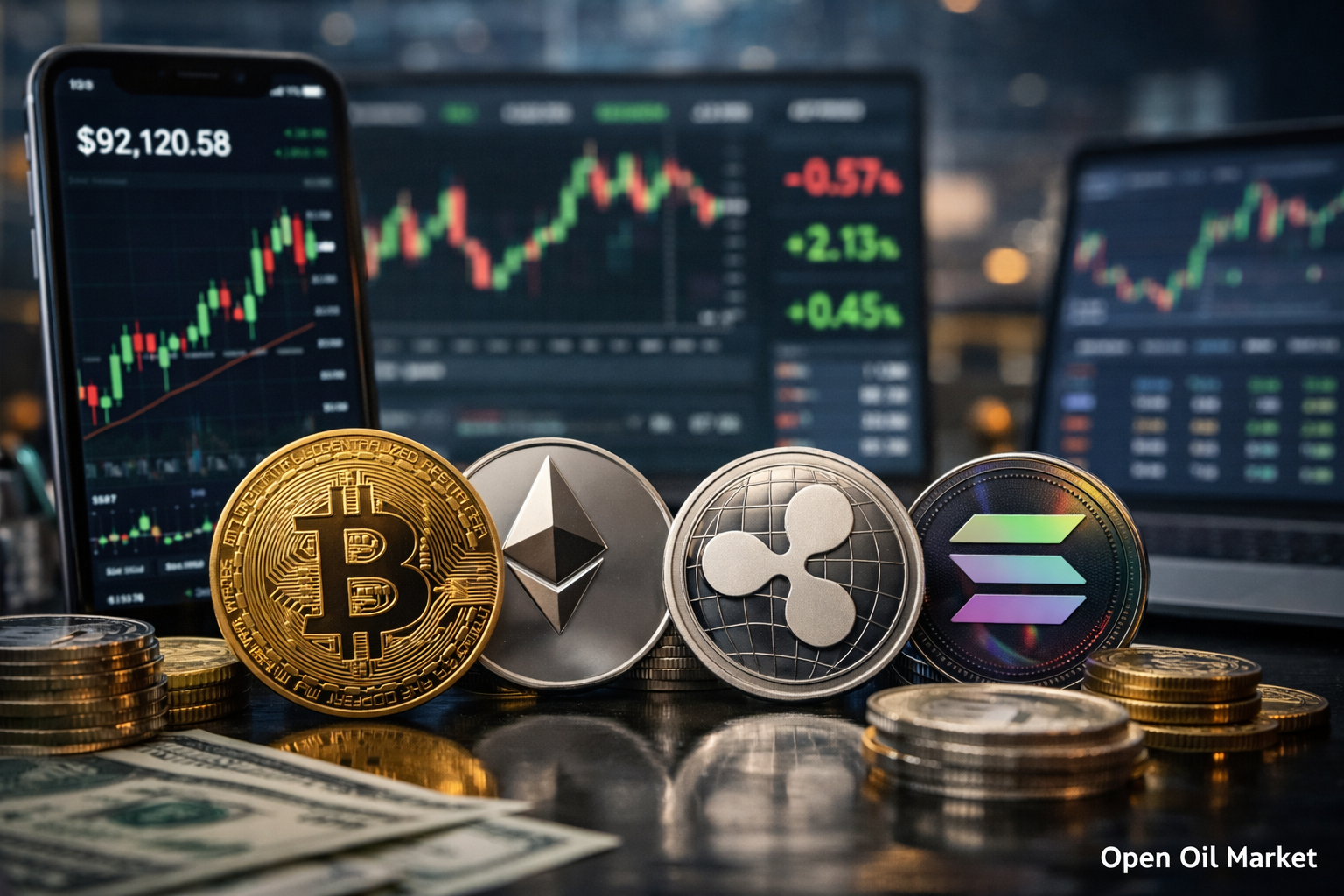
Latest Cryptocurrency News for Tuesday, January 13, 2026: Bitcoin, Altcoins, DeFi and NFT Market, Institutional Investment, and Overview of the Top 10 Most Popular Cryptocurrencies Worldwide.
Market Overview
- The total market capitalization of the global cryptocurrency market is estimated at approximately $3.2 trillion, remaining close to weekend levels. The daily trading volume has not changed significantly, reflecting a consolidation phase following the volatility of the first week of the year.
- Bitcoin (BTC) is holding steady around $92,000, slightly above the important psychological level of $90,000. Bitcoin's market capitalization is approximately $1.8 trillion, sustaining its dominance at around ~58% of the overall cryptocurrency market capitalization.
- Ethereum (ETH) is trading in the range of $3,200–3,300, showing moderate growth following Bitcoin. ETH's market capitalization exceeds $380 billion (about 12% of the market), confirming its status as the second most significant cryptocurrency.
- Major altcoins are mostly exhibiting slight price changes within the range of +1–3% over the past 24 hours. Coins in the top-10, such as Solana, XRP, Cardano, and others, are trading close to the previous day's levels. This signals a continued stabilization of the market following a tumultuous start to the year.
Bitcoin: Consolidation After Growth
At the beginning of the new week, Bitcoin continues to consolidate in the range of $90,000–92,000. Following the volatile start of the year, the leading cryptocurrency is trying to stay above $90,000. On January 5, BTC spiked close to $95,000 (approximately $94,800, the local maximum of recent months), but then a correction followed, and on January 8, the price briefly dipped below $90,000. Currently, Bitcoin has regained most of the dip, returning to around ~$92,000, which is roughly 3–4% above the levels at the beginning of the year. The current quotes are still about a quarter below the all-time high (~$124,000, reached in mid-2025); however, investors note the resilience of BTC at the attained highs.
Analysts point out that the range of $90,000–95,000 has become a new psychologically significant zone for Bitcoin. Sellers are actively taking profits during attempts to rise above these levels, while buyers are supporting prices during retracements below $90,000. Macroeconomic uncertainty (for example, the upcoming release of inflation data in the US) is currently restraining sharp price movements; however, fundamental factors for BTC remain positive. Many still perceive Bitcoin as "digital gold" and a safe-haven asset. Recent geopolitical tensions have only heightened interest in BTC as a "safe haven": against the backdrop of international uncertainty, investors have sought refuge in Bitcoin. Additionally, rumors have surfaced about substantial BTC reserves held by some states (and the potential withdrawal of a portion of coins from circulation), adding bullish expectations to the market.
Ethereum Maintains its Number Two Position
Ethereum (ETH), the second-largest cryptocurrency by market capitalization, is moving in line with the overall market dynamics. As of January 13, Ether is trading around $3,250 per coin, having slightly strengthened over recent days. In the first half of January, ETH already reached ~$3,300 – a peak since the fall of last year. On a weekly basis, Ether has gained about 5–6%, confidently maintaining its status as the largest altcoin. Although the current price is significantly lower than its all-time high (~$5,000), Ethereum demonstrates stability and attracts investors with its technological potential.
Ethereum's market capitalization is currently around $380 billion (approximately 12% of the total market capitalization), firmly securing its second position in the industry. Interest in the smart contract platform remains high. In 2025, the first spot ETFs on Ethereum were launched, which provided institutional investors with convenient access to ETH and led to record inflows of capital into related funds. Major players view Ethereum as the foundational infrastructure for a whole layer of the industry – from decentralized finance (DeFi) to non-fungible tokens (NFTs) and other Web3 applications. Ongoing technical development of the network (scheduled protocol upgrades, layer 2 scaling solutions) combined with institutional support allows for the projection of Ethereum's strong positions and potential growth in value in the medium term.
Altcoins: Leaders in Growth and Correction
The altcoin market is showing mixed dynamics at the beginning of the week. The total market capitalization of all alternative cryptocurrencies (excluding Bitcoin) remains around ~$1.35 trillion. This is below the summer peaks of 2025 (~$1.7 trillion) but still reflects sustained investor interest in digital assets beyond BTC. Many leading altcoins, after a tumultuous rally in the first half of 2025, experienced a significant correction in the fall and are now attempting to find a new equilibrium at higher levels.
Among the largest altcoins, Ripple (XRP) stands out. The token of the Ripple payment network confidently holds above $2.00 following an impressive surge of about 25% in the early days of January. The main drivers of XRP's growth were the legal clarity of the token's status (Ripple's victory over the SEC in court in 2025) and the launch of the first ETFs on XRP. The market capitalization of XRP is estimated at around $110 billion, bringing it back into the top three market leaders. Institutional interest in XRP has noticeably increased due to the emergence of opportunities to invest in the asset through regulated funds, reinforcing the long-term positive sentiment among market participants.
Another notable player is Binance Coin (BNB), the native token of the largest cryptocurrency exchange, Binance. Despite the regulatory challenges surrounding Binance last year, BNB is trading around $500 (market cap of approximately $80 billion) and remains in the top 5 cryptocurrencies. The current price is below the all-time high (~$750); however, the coin demonstrates resilience due to its broad utility. BNB is actively used for paying fees on the exchange, participating in token sales, and operating decentralized applications on the Binance Smart Chain (in DeFi protocols, games, etc.). This utility value allows the token to retain demand even under regulatory pressure.
There is also high activity among platform tokens of smart contracts. Solana (SOL) exceeded the $150 mark per coin at the beginning of January for the first time since 2022. The news about the launch of the first spot ETF on Solana in the US at the end of 2025 spurred the growth of this cryptocurrency, increasing investment flows. Solana's market capitalization has now reached ~$60 billion. The revival of the ecosystem of projects based on Solana – from DeFi applications to NFT marketplaces – supports optimism among investors regarding the further prospects of SOL.
Cardano (ADA), another major platform, is attracting analyst attention with plans to launch an ETF based on its token. At the end of last year, the investment firm Grayscale filed for approval to create an ADA-linked ETF in the US, which sparked a surge of interest in this cryptocurrency. Currently, Cardano is trading around $0.70 (market cap of approximately $23 billion) after a pullback from recent local highs. The key psychological level of $1.00 has not yet been surpassed, but ADA remains one of the most promising platforms in terms of technological development. The project team follows a research-oriented approach, and the active community of supporters continues to believe in Cardano's long-term growth.
It is also worth noting the segment of so-called meme cryptocurrencies. In the first week of January, there was a surge in demand for high-risk "meme coins" among retail traders. For example, Dogecoin and Shiba Inu rose by about 15-20% over the past 7 days, lifting the total capitalization of niche meme tokens above $45 billion. This phenomenon indicates the persistence of risk appetite in certain corners of the market, despite the overall cautious sentiment among investors. However, such rallies in illiquid assets tend to be of a short-term nature. By the end of the past weekend, the growth of meme coins began to slow. Experts warn that such volatile assets can quickly reverse, so participation in them should be approached with particular caution.
DeFi and NFT: Developing Industry Segments
The decentralized finance (DeFi) sector continues to develop and integrates more deeply with the traditional financial system. Major DeFi platforms are already comparable in turnover to centralized exchanges: for instance, the emerging exchange Hyperliquid is processing hundreds of billions in trading volumes and competing with giants like Binance in derivatives. Increasingly, institutional and professional traders are getting involved in DeFi, although regulators are paying increased attention to this sector. In the coming years, increased legal clarity on issues such as KYC procedures and tokenholder rights is expected as DeFi becomes a more influential part of the financial market. Despite possible regulatory hurdles, the growth trajectory of decentralized finance remains upward – this sector has already “earned a seat at the table” of major capital and, judging by trends, will only gain weight.
Meanwhile, the non-fungible token (NFT) market is undergoing a maturation phase after explosive growth and subsequent cooling. The boom of 2021-2022 has yielded to a more restrained period: many major brands that experimented with NFTs have reevaluated their strategies and reduced activity in the digital collectibles sphere. Nevertheless, the NFT ecosystem continues to thrive and find new applications that extend beyond art and collecting. Virtual items in the form of NFTs are actively used in blockchain games and metaverses, loyalty and membership programs are being implemented on the basis of NFTs, and use cases for tokens for digital identity and community management are emerging. Although the massive hype surrounding NFTs has subsided, active communities of collectors and enthusiasts remain, and a potential new upswing in the crypto market could rekindle interest in the most well-known NFT collections. Overall, the NFT segment is transitioning from hype to more practical and utilitarian applications, indicating its gradual maturation.
Institutional Investment and ETF Launches
- High Institutional Involvement: Major financial organizations continue to increase their presence in the cryptocurrency market. In 2025, US regulators approved the first spot ETFs for Bitcoin and Ethereum, opening doors for investments from banks, hedge funds, and even pension funds. By early 2026, institutional investors collectively hold record volumes of crypto assets, viewing them as a promising class for portfolio diversification.
- New ETFs and Applications: At the end of 2025, exchange-traded funds for some altcoins – primarily for XRP and Solana – entered the market, marking a significant milestone for the industry. At the beginning of 2026, the range of crypto-ETFs continues to expand: financial giant Morgan Stanley has officially submitted an application to the SEC to launch spot funds for Bitcoin and Solana. This is the first instance where one of Wall Street's largest banks has directly initiated the launch of a crypto fund, and this step is viewed as a signal of growing trust in digital assets.
- Inflow and Outflow of Capital: Following the launch of new ETFs for Bitcoin and Ethereum in the early days of January, the respective funds attracted billions of dollars. However, against the backdrop of recent price corrections, short-term outflows of funds have also been recorded: from January 7-8, approximately $0.5 billion was withdrawn from US Bitcoin funds, and about $0.16 billion from Ethereum funds. Experts estimate that these outflows are associated with profit-taking after the rally of late 2025 and do not indicate a loss of trust. Overall capital inflow in recent weeks still exceeds outflows, and major players are not strategically reducing their positions.
- Companies Accepting Cryptocurrencies: Besides financial institutions, cryptocurrencies are increasingly penetrating the corporate sector. For example, in January, Bank of America officially recommended that clients include Bitcoin up to 4% in their investment portfolios, effectively acknowledging its significance as an asset. Another notable step was taken by retail giant Walmart, which announced the initiation of cryptocurrency payments (BTC and ETH) through its OnePay Cash app. This move allows over 150 million Walmart customers to pay with digital currencies for goods and services, marking an important step towards the mainstream acceptance of crypto assets.
Regulation and Global Trends
- Easing Positions in Major Economies: Globally, work continues on establishing uniform rules for dealing with cryptocurrencies. In the US, following significant legal precedents in 2025 (including the Ripple vs. SEC case), calls for clear legislation in the sphere of digital assets have intensified. Lawmakers and regulators are developing new norms that will allow legal investment in crypto assets without fears regarding the uncertainty of their status. In 2026, discussions are expected to take place in the US Congress regarding a federal law on stablecoins and digital assets – which may lay the groundwork for further industry growth in the country.
- Europe Implements MiCA Regulations: The comprehensive regulatory framework MiCA (Markets in Crypto-Assets) is coming into effect in the European Union, aiming to standardize approaches to cryptocurrencies across all EU countries. The new rules enhance market transparency and establish unified requirements for crypto companies while giving institutional investors more confidence. It is expected that uniform rules in Europe will attract new crypto startups and capital to the region as legal clarity becomes a competitive advantage.
- Asian Markets Opening Up: In Asia, there is ongoing movement towards the crypto industry. Authorities in South Korea have stated their intention to allow trading of spot Bitcoin ETFs on national exchanges by 2026, while simultaneously tightening requirements for stablecoins (mandatory 100% backing of issued stablecoins with real assets is being introduced). Financial hubs in the region, such as Hong Kong and Singapore, are implementing licensing for crypto exchanges and services, aiming to become hubs for global crypto investments. These steps indicate a general trend: despite differences in approaches, the largest economies of the world are increasingly integrating cryptocurrencies into their financial and legal systems.
Market Sentiments and Prospects
Following the rapid growth in the first half of 2025 and the subsequent sharp decline in the fall, sentiments in the cryptocurrency market at the beginning of 2026 remain cautious. The "fear and greed" index for cryptocurrencies has remained in the fear zone since mid-December; as of January 8, it stood at around 28 points out of 100, reflecting prevailing investor concerns. Prolonged stays of the index at low values are often viewed as a sign of market oversold conditions — previously, similar levels frequently preceded upward reversals, as the most nervous participants have already exited positions. However, the continued dominance of "fear" means that confidence following the recent crash has not yet fully recovered.
Volatility in the crypto market remains elevated. Sharp price movements in the early days of January led to a wave of margin position liquidations. For instance, in just one day, January 8 saw over $450 million worth of positions forcibly closed, with the majority of this amount attributed to long (buying) positions. The rapid decline in quotes forced around 120,000 traders to close positions at a loss. This episode reminds participants of the risks associated with using high leverage: excessively optimistic bets on continued growth can lead to the "squeezing" of long positions and an escalation of the downturn. Such instances have occurred in the history of the cryptocurrency market (for example, in October 2025, one-day liquidations reached a record $19 billion), underscoring the need for caution.
Experts advise investors to remain patient and carefully manage risks. As long as no new fundamental growth drivers (such as a noticeable improvement in the macroeconomic situation or breakthrough technological updates) emerge on the horizon, any surges of optimism may rapidly turn into profit-taking. The divergence of sentiments in the market — from a generally cautious "fear" to local bursts of enthusiasm over individual tokens — indicates a transitional phase. Many analysts believe that the current price consolidation may continue for several weeks.
Nevertheless, long-term investors remain optimistic: the fundamental growth factors of the industry (expanding acceptance of blockchain technology, institutional interest, gradual improvement of regulation) have not disappeared. In the absence of new shocks, the market has chances to gradually regain upward momentum in the second half of 2026. In any case, market participants are advised to closely monitor economic data and news — as these will largely determine the trajectory of the cryptocurrency market in the near future.
Top 10 Most Popular Cryptocurrencies
- Bitcoin (BTC) — the first and largest cryptocurrency. BTC is trading around $92,000 after recent fluctuations, with its market capitalization approximately $1.8 trillion (≈58% of the entire market). Bitcoin is perceived by investors as "digital gold" and a fundamental asset for many investment strategies in the crypto industry.
- Ethereum (ETH) — the leading altcoin and the platform for smart contracts. ETH is holding around $3,300, significantly lower than historical highs, yet it confidently retains the second position in market cap (~$390 billion, ≈12% of the market). Ethereum serves as the backbone of the DeFi and NFT ecosystems, continuing to attract developers and investors.
- Tether (USDT) — the largest stablecoin pegged to the US dollar at a ratio of 1:1. USDT is widely used by traders for transactions and capital storage between trades. Its market cap stands at around $170 billion; thanks to full reserve backing, the coin consistently maintains a price of $1.00, acting as a sort of “safe haven” in a volatile market.
- Ripple (XRP) — the token of the Ripple payment network for cross-border transactions. XRP is currently trading around $2.00, with a market cap of about $110 billion. Legal clarity surrounding XRP's status in the US following the 2025 court ruling and the launch of an ETF for this token has bolstered investor confidence. XRP has managed to reclaim its place among market leaders, remaining appealing for quick payments and the tokenization of various assets.
- Binance Coin (BNB) — the coin of the largest cryptocurrency exchange, Binance, and the native token of the BNB Chain network. BNB is priced around $500 (market cap of ~ $80 billion). Despite the regulatory challenges surrounding Binance, the token remains in the top 5 due to its wide range of applications: BNB is used to pay fees on the exchange, participate in token sales, and operate decentralized applications within the Binance ecosystem.
- Solana (SOL) — a high-performance blockchain platform for decentralized applications (dApps). SOL is trading around $150 per coin (market cap ~ $60 billion), having regained a significant portion of the downturn from the autumn of 2025. Interest in Solana is supported by the launch of the first ETF on this asset and the revival of projects based on it, returning the platform to its position as one of the technological leaders in the industry.
- USD Coin (USDC) — the second-largest stablecoin backed by reserves in US dollars (issued by Circle). USDC consistently maintains a $1.00 price thanks to regular audits of its reserves, with a market cap of about $60 billion. The coin is actively used both by institutional investors and in DeFi protocols, providing transparency and a high level of trust in the stablecoin segment.
- Cardano (ADA) — a blockchain platform with a research-oriented approach to development. ADA is currently priced around $0.70 (market cap ~ $23 billion) after a pullback from recent highs. Cardano is attracting attention for its planned ETF launch and ongoing technical improvements of its network. The project's community believes in the long-term growth of ADA, and its focus on scientific underpinnings of solutions distinguishes this platform favorably among competitors.
- TRON (TRX) — a platform for smart contracts and decentralized entertainment, particularly popular in Asia. TRX is trading around $0.25 (market cap ~ $22 billion). TRON remains in the top 10 partly due to its wide use of its network for issuing stablecoins (a significant portion of USDT operates specifically on the TRON blockchain) and because of its active Asian user base.
- Dogecoin (DOGE) — the most well-known “meme cryptocurrency,” originally created as a joke. DOGE is holding around $0.14 (market cap ~ $21 billion), supported by an active community and occasional celebrity attention. Although Dogecoin's volatility remains high, this coin still ranks among the top ten, demonstrating a surprising resilience of investor interest in high-risk assets.