The Global Cryptocurrency Market on June 15, 2026: Bitcoin, Ethereum, ETFs, USDT, USDC, and Asset Tokenization
As of Monday, June 15, 2026, the global cryptocurrency market is cautiously recovering following a volatile week. Bitcoin continues to be the primary indicator of risk appetite, Ethereum is attempting to stabilize after facing pressure from institutional flows, while stablecoins and tokenized assets are becoming increasingly integral to the financial infrastructure. For investors, the key question of the day is not only the direction of Bitcoin's price but also how the structure of the cryptocurrency market is evolving: capital is being increasingly allocated among spot ETFs, derivatives, DeFi, stablecoins, tokenized treasury bonds, and infrastructure projects.
The Overall Picture of the Crypto Market: Recovery Without a Clear Trend
Cryptocurrency news as of June 15, 2026, is shaped by a moderate improvement in sentiment, but it is too early to speak of a full trend reversal. The market capitalization of digital assets remains around $2.2 trillion, and Bitcoin is trading near a significant level of around $64,000. This signals not so much a strong bullish market as an effort to stabilize after a period of sell-offs.
Investors are globally assessing several factors:
- The dynamics of capital inflows and outflows in cryptocurrency ETFs;
- The demand for Bitcoin as a protective digital asset;
- The weakness or recovery of Ethereum and major altcoins;
- The role of stablecoins USDT and USDC in settlements and liquidity storage;
- The growing interest in the tokenization of traditional financial assets;
- The competition of cryptocurrencies with AI stocks, tech IPOs, and commodity assets.
The main feature of the current market is the absence of a single powerful driver. The cryptocurrency market remains liquid, global, and technologically significant, but capital has become more selective. Investors increasingly prefer not only to buy cryptocurrencies but also to analyze the network's quality, the resilience of business models, regulatory prospects, and institutional demand.
Bitcoin: Key Support Zone and a Test of Investor Confidence
Bitcoin firmly remains the benchmark for the entire digital asset market. Following a decline from previous highs, BTC is trying to hold onto an essential technical and psychological zone. For institutional investors, this is a moment of verification: if Bitcoin can maintain its position above current levels and show capital inflows through ETFs, the market stands a chance for a more sustainable recovery.
However, pressure persists. Some capital is shifting to more dynamic stories — artificial intelligence, tech stocks, anticipated IPOs, and tokenized real assets. This diminishes speculative demand for Bitcoin, especially among investors who view BTC not as a long-term store of value but as a high-risk growth instrument.
It is important for investors to monitor not only Bitcoin's price but also three indicators:
- Trading volumes in the spot market;
- The dynamics of cryptocurrency ETFs;
- The behavior of long-term holders and corporate buyers.
Ethereum: An Infrastructure Asset Under Competitive Pressure
Ethereum remains the second most significant cryptocurrency and a key platform for smart contracts, DeFi, tokenization, and Web3 infrastructure. However, as of mid-June 2026, ETH appears weaker than Bitcoin in terms of investment momentum. The market is waiting for confirmation that the Ethereum ecosystem can not only maintain technological leadership but also attract new institutional capital.
The main investment narrative surrounding Ethereum is not its short-term price but its role in the tokenization of real assets. Banks, exchanges, asset managers, and payment infrastructures are increasingly exploring blockchain as the foundation for settlements, issuing tokenized bonds, funds, and digital instruments. If this trend accelerates, Ethereum might again become one of the main beneficiaries of the institutional shift towards digital financial markets.
Top 10 Most Popular Cryptocurrencies in Investor Focus
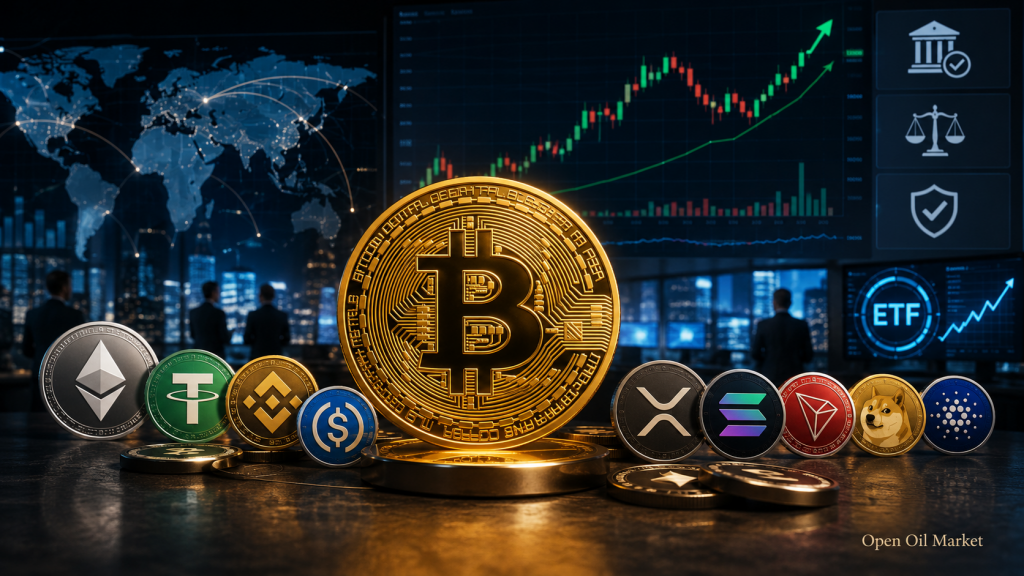
On Monday, June 15, 2026, the global investment focus remains on ten of the most popular cryptocurrencies and digital assets, notable for their high liquidity, wide recognition, and significant role in market infrastructure.
1. Bitcoin (BTC)
The leading digital asset and primary indicator of market sentiment. Bitcoin remains a foundational tool for institutional investors, ETFs, and long-term strategies.
2. Ethereum (ETH)
A key platform for smart contracts, DeFi, NFTs, tokenization, and corporate blockchain solutions. Ethereum continues to be an infrastructure bet on the development of digital finance.
3. Tether (USDT)
The largest stablecoin and one of the main tools for transactions in the global cryptocurrency market. USDT is crucial for liquidity, particularly in Asia, Latin America, and emerging markets.
4. BNB (BNB)
The token of the Binance ecosystem and BNB Chain. Its dynamics are closely linked to trading activity, the development of exchange infrastructure, and demand for applications within the ecosystem.
5. USDC (USDC)
A stablecoin with strong institutional positioning. USDC is important for regulated settlements, corporate clients, and the integration of the cryptocurrency market with traditional finance.
6. XRP (XRP)
An asset related to cross-border payments and banking infrastructure. XRP remains a focal point for investors due to its association with international settlements and potential involvement in institutional tokenization.
7. Solana (SOL)
One of the most notable networks for fast and inexpensive transactions. Solana retains interest from DeFi, NFTs, memecoins, payment applications, and developers of high-load blockchain services.
8. TRON (TRX)
A network actively used for stablecoin transfers and inexpensive transactions. TRON is especially significant for markets where users leverage cryptocurrencies for quick international settlements.
9. Dogecoin (DOGE)
The most well-known memecoin, remaining a highly liquid speculative asset. DOGE is sensitive to market sentiment, retail demand, and social media activity.
10. Cardano (ADA)
A blockchain project with a focus on formal development, scalability, and long-term ecosystem sustainability. ADA remains on investors' radar despite high competition among smart contract platforms.
ETFs and Derivatives: The Institutional Market Becomes More Complex
Cryptocurrency ETFs remain one of the main channels for the inflow and outflow of institutional capital. Following initial enthusiasm, investors have become more discerning, evaluating liquidity, fees, product structure, and the ability of ETFs to withstand periods of market stress.
Derivatives, including perpetual futures and regulated instruments on digital assets, are attracting particular attention in June 2026. For professional market participants, this is an important signal: cryptocurrencies are gradually transforming from a speculative segment into a full-fledged asset class with its own infrastructure for hedging, arbitrage, and risk management.
However, the growth of derivatives also increases systemic risks. High leverage, sharp liquidations, and liquidity concentration on major venues can amplify volatility in Bitcoin, Ethereum, Solana, XRP, and other popular cryptocurrencies.
Stablecoins and Tokenization: The Main Long-Term Trend
Stablecoins are becoming one of the most important themes for the global cryptocurrency market. USDT and USDC are already used not only by traders but also by companies, payment services, fintech platforms, and users in countries with limited access to dollar liquidity.
For investors, it is particularly significant that stablecoins are changing the structure of financial infrastructure. They accelerate settlements, reduce transaction costs, and create a foundation for round-the-clock capital movement. At the same time, the most attractive investment opportunity may not lie in the stablecoin itself but in the infrastructure surrounding it: wallets, custodial services, compliance platforms, payment gateways, and blockchain analytics.
Concurrently, the tokenization of real assets is accelerating. Tokenized treasury bonds, money market funds, equities, and settlement instruments are becoming a bridge between traditional finance and the cryptocurrency industry. This enhances the role of blockchain as a technological layer for global capital markets.
Global Geographic Focus: The USA, Europe, and Asia
The global cryptocurrency market in June 2026 is developing unevenly. The USA remains a key center for regulation, ETFs, institutional capital, and judicial-legislative decisions. Europe focuses on regulatory frameworks, investor protection, and oversight of stablecoins. Asia maintains a high role in trading activity, retail demand, exchange infrastructure, and practical use of digital assets.
For global investors, this means that cryptocurrency news can no longer be assessed solely through the price of Bitcoin. Regional differences are important:
- In the USA — regulation, ETFs, institutional products, and tokenization;
- In Europe — rules for stablecoins, custodians, and digital financial services;
- In Asia — liquidity, exchange activity, payment scenarios, and retail usage of cryptocurrencies;
- In emerging markets — demand for dollar stablecoins and fast cross-border transfers.
What is Important for Investors on June 15, 2026
Monday, June 15, 2026, may serve as a crucial day for assessing the resilience of the current recovery in the crypto market. If Bitcoin maintains its key zone and the market sees improved flows into ETFs, sentiment could turn more constructive. Conversely, if demand remains weak, investors will continue to reduce risk in altcoins and shift into stablecoins, cash, or more familiar stories beyond the crypto market.
Investors should pay attention to the following factors:
- Bitcoin: Maintenance of the current zone and market response to any attempts at growth.
- Ethereum: Dynamics of institutional demand and news on asset tokenization.
- ETFs: Inflows and outflows of capital as indicators of large investors' confidence.
- Stablecoins: Growth in the role of USDT and USDC in global settlements.
- Solana, XRP, and BNB: The status of major altcoins and demand for infrastructure blockchain ecosystems.
- Regulation: Decisions by the USA, Europe, and Asia regarding digital assets, ETFs, derivatives, and stablecoins.
- Macro Factor: Competition of cryptocurrencies with AI stocks, tech IPOs, commodity assets, and traditional defensive instruments.
The core takeaway for investors remains cautious: the cryptocurrency market retains long-term potential but requires discipline, diversification, and risk management in the short term. The most resilient themes appear to be Bitcoin as the foundational digital asset, Ethereum as the infrastructure for tokenization, stablecoins as the settlement layer, and blockchain infrastructure as the domain where a new market for digital finance is being formed.