International G7 Summit and Global Markets Amid Economic Events and Corporate Reports on June 15, 2026
Monday, June 15, 2026, opens a busy week for global markets where economic events, corporate reports, and geopolitical issues will directly influence investor expectations regarding stocks, bonds, commodity assets, and currencies. In focus is the first day of the G7 leaders' summit in France, the commencement of substantive EU negotiations with Ukraine and Moldova, remarks from ECB President Christine Lagarde, industrial production figures from the Eurozone and the U.S., and the New York Manufacturing Business Index.
For investors from the CIS, this day serves as an important indicator of global risk appetite. Macroeconomic statistics from the U.S. and Eurozone will showcase the resilience of the industrial sector amidst expensive capital, geopolitical tensions, and ongoing inflationary risks. Corporate reports on Monday may not appear significant compared to the major earnings release days for leading companies in the S&P 500, Euro Stoxx 50, Nikkei 225, and MOEX. However, select issuers from the U.S., Canada, and the technology sector could provide crucial signals regarding consumer demand, cloud services, logistics, the cannabis industry, and infrastructure technologies.
Global Context: First Day of the G7 Summit in France
The key political-economic event of the day will be the commencement of the G7 summit in France. For the markets, this is not just about the diplomatic agenda but also a potential source of signals related to sanction policies, energy security, support for Ukraine, trade restrictions, technology regulation, and coordination of fiscal stimuli. Any statements made by G7 leaders could impact the dynamics of oil, gas, gold, the defense sector, European stocks, and emerging market currencies.
Investors should monitor three key areas:
- The stance of G7 countries on sanctions, trade, and energy supplies;
- Comments on Ukraine, European security, and infrastructure recovery;
- Rhetoric concerning inflation, national debt, and economic policy coordination.
For the Russian market and the MOEX index, the G7 summit holds importance through external risk premium: tough political rhetoric tends to heighten caution towards emerging market assets, whereas neutral statements may temporarily alleviate pressure on commodity and currency expectations.
European Agenda: EU Negotiations with Ukraine and Moldova
Another pivotal storyline of the day is the official start of substantive negotiations between the European Union, Ukraine, and Moldova regarding EU membership. For investors, this represents a long-term structural factor impacting European expansion policy, EU budget, infrastructure investments, agriculture, energy, transport corridors, and the defense sector.
In the short term, this event is unlikely to serve as an independent driver for the Euro Stoxx 50 or S&P 500 indices, but it amplifies focus on companies involved in infrastructure recovery, construction, logistics, energy networks, cybersecurity, and defense contracts. A significant currency aspect for CIS markets is that the more actively Europe integrates Ukraine and Moldova, the greater the importance of European funds, grants, credit programs, and investment mechanisms in the region.
ECB and Lagarde: Investors Await Signals on Rates, Inflation, and Digital Payments
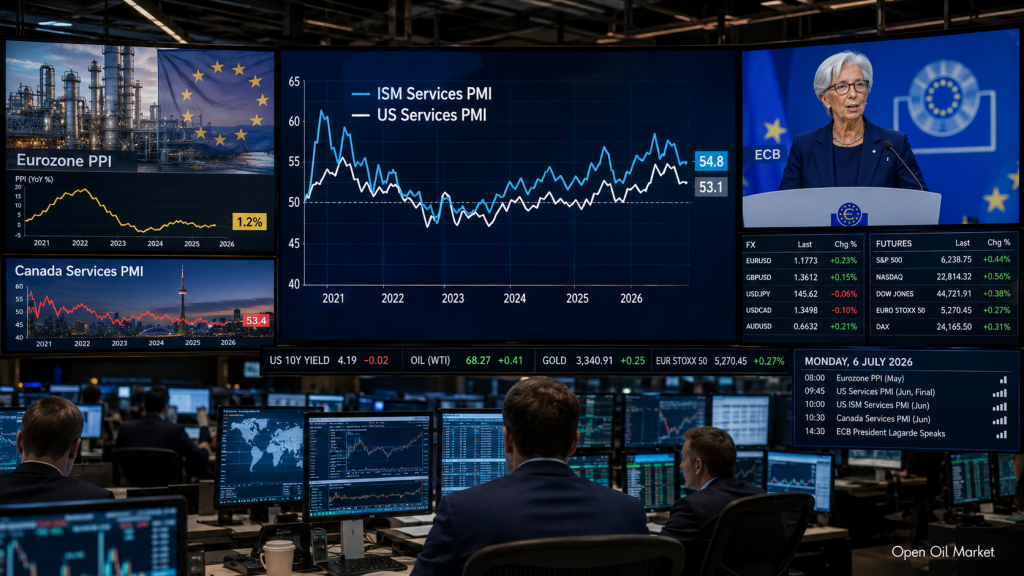
The address by ECB President Christine Lagarde will be a significant event during the European session. Following a period of tight monetary policy, markets are closely evaluating each ECB formulation: how concerned the regulator is about inflation, whether it intends to keep rates higher for longer than expected, and its assessment of the Eurozone’s industrial state.
Investor attention will particularly focus on the following topics:
- Inflationary risks in the Eurozone and the impact of energy prices;
- Banking sector stability and business lending;
- Prospects for a digital euro, payment infrastructure, and financial technology;
- The impact of weak industrial demand on corporate profits.
For European stocks, dovish ECB rhetoric may support interest-sensitive sectors, such as real estate, banking, industry, and consumer companies. Conversely, a hawkish tone could strengthen the euro, raise bond yields, and curb stock index growth.
Macroeconomic Statistics from Europe: Switzerland and Eurozone Industrial Production
In the morning, investors will receive data on Switzerland's industrial inflation for May. The producer price index and import prices are vital for assessing inflationary pressure in one of Europe’s key economies with a strong currency and a high role of the export sector. If the figures exceed expectations, it could support the Swiss franc and heighten caution regarding European assets with high debt loads.
Later, Eurozone industrial production data for April will be released. This figure is particularly important for evaluating the industrial cycle in Germany, France, Italy, and other countries within the currency bloc. Weak data will confirm the risk of an economic slowdown in Europe, whereas a revival in production may bolster shares of industrial companies, equipment manufacturers, the chemical sector, and transportation infrastructure.
The key question for investors is whether the Eurozone can demonstrate industrial resilience against the backdrop of high energy costs, expensive credit, and weak external demand. This block of data could significantly influence expectations concerning the Euro Stoxx 50 and European bonds.
U.S.: Empire State Manufacturing Index and Industrial Production
The U.S. session will be equally crucial. First, we will have the NY Empire State Manufacturing Index for June—one of the early indicators of the state of U.S. industry. This figure reflects business conditions in the state of New York's manufacturing sector and is often viewed by the market as a preliminary signal before more encompassing business activity indices.
Following that, investors will receive the U.S. industrial production data for May. For the S&P 500, this is one of the important macro indicators, as it demonstrates output dynamics across manufacturing, mining, and utilities sectors. Strong data could support cyclical stocks, industry, energy, and the U.S. dollar. Conversely, weak statistics may reinforce expectations of an economic slowdown and could increase demand for safe-haven assets.
The most important market interpretations include:
- Growth in industrial production above expectations—positive for cyclical stocks and the dollar;
- Weak Empire State index—signaling caution in the production sector;
- Acceleration in capacity utilization—a potential inflationary factor;
- Slowdown in output—argument for softer Fed policy in the future.
Corporate Reports Before Market Open: Canopy Growth and Powerfleet
Before the U.S. market opening, investors will watch the reports from Canopy Growth and Powerfleet. Canopy Growth remains a volatile story in the cannabis industry, where key questions revolve around revenue, cash flow, expense restructuring, and financial reporting quality. For the market, this is largely a speculative asset, sensitive to regulatory news and industry consolidation expectations.
Powerfleet is interesting to investors as a company at the intersection of logistics, telematics, fleet management, and the internet of things. Its results may provide signals regarding demand for transportation digitalization, industrial analytics, and corporate asset management solutions. For the technology sector, this report may not be of scale comparable to the largest Nasdaq companies, but it serves as a valuable indicator of demand in the B2B infrastructure niche.
Corporate Reports After Market Close: Domo, Dave & Buster’s, High Tide, Quantum, and RF Industries
After the markets close, a denser block of corporate reports is expected. Domo will present its results for the first quarter of the 2027 fiscal year. Investors will assess revenue growth rates, loss dynamics, cloud analytics demand, AI tool implementation, and the company's ability to improve margins.
Dave & Buster’s is critical as an indicator of consumer demand in the U.S. The company operates at the intersection of the restaurant business, entertainment, and discretionary spending, thus its report may reveal how willing the American consumer is to spend on leisure amid high interest rates and ongoing pressure on real incomes.
High Tide will release results for the second fiscal quarter. For investors, this represents the story of Canadian cannabis retail, where key metrics will include revenue, margins, network growth, online sales, and cash flow. Quantum will present results for the fourth quarter and the entire fiscal year: the market will focus on revenue, debt load, and demand for data storage solutions. RF Industries will report for the second quarter of the fiscal year; orders, margins, and demand for telecommunications and industrial infrastructure components will be of importance to investors.
Europe, Asia, and Russia: What Matters for Euro Stoxx 50, Nikkei 225, and MOEX
The calendar of major corporate reports in Europe, Japan, and Russia for Monday appears relatively calm. For Euro Stoxx 50 constituents, the primary focus is shifted away from earnings reports to Eurozone industrial production, ECB signals, and the G7 summit. For the Nikkei 225, investors will consider the overall dynamics of the yen, expectations regarding the industrial cycle, and corporate news from specific Japanese issuers. Attention also remains on Nidec in Japan, where the disclosure of financial reports was previously postponed due to internal procedures and past period audits.
On the Russian market, the MOEX index will focus less on quarterly results from the largest issuers and more on corporate events, dividend days for certain companies, external risk premium, oil dynamics, the ruble exchange rate, and investor reactions to the international agenda at G7. For Russian investors, Monday is primarily a day for assessing the external backdrop ahead of a macroeconomic section that will become more intense later in the week.
What Investors Should Pay Attention To
Monday, June 15, 2026, is a day when investors should look not just at a single indicator but rather at a combination of signals. The most critical benchmarks will be the statements from the G7, negotiations between the EU and Ukraine and Moldova, Lagarde’s rhetoric, industrial production figures from the Eurozone and the U.S., as well as the American Empire State Manufacturing Index.
The practical focus for investors should include:
- Evaluating whether the G7 summit heightens geopolitical risk or reduces uncertainty;
- Comparing industrial statistics from the Eurozone and the U.S. to understand the global cycle;
- Monitoring reactions from the dollar, euro, oil, gold, and bond yields;
- Examining reports from Domo, Dave & Buster’s, Powerfleet, Canopy Growth, High Tide, Quantum, and RF Industries as signals for specific sectors;
- Avoiding overestimating small corporate reports if macroeconomics and politics remain the day's primary drivers.
For the global market portfolio, the base scenario indicates heightened caution ahead of the publication of key U.S. data and new central bank statements. For CIS investors, the main takeaway for the day is that the external backdrop remains decisive: the decisions made at the G7, ECB policy, and industrial dynamics in the U.S. and Eurozone will continue to influence dollar liquidity, commodity assets, emerging market risk premiums, and expectations for the MOEX index.