Economic Events and Corporate Reports for Sunday, July 5, 2026: OPEC+ Meeting, Oil Market, Global Indices, Company Reports, and Investor Guidelines
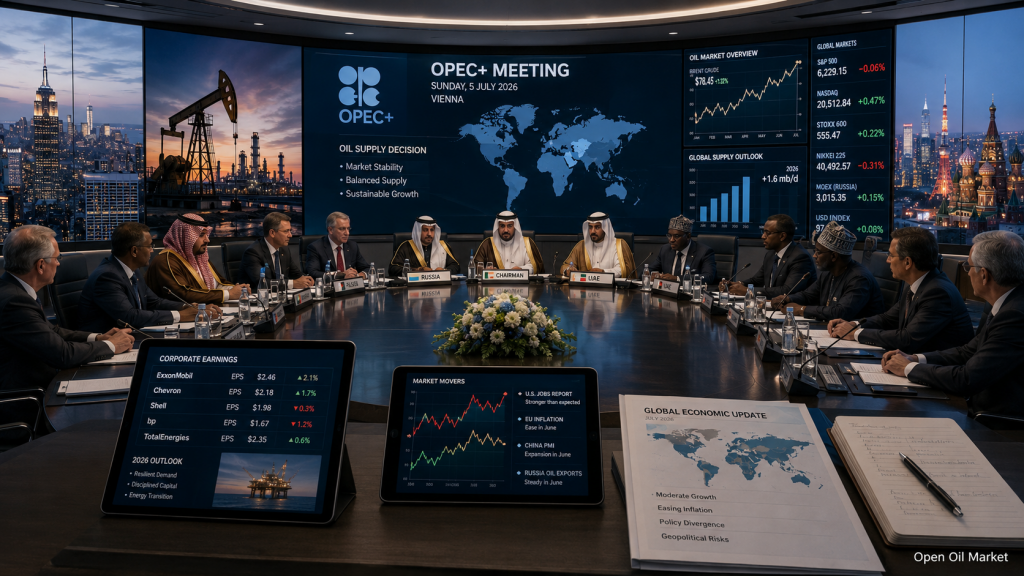
Sunday, July 5, 2026, marks a day without a full trading session across most major stock markets, but this does not render the day neutral for investors. The main focus of the global market is the OPEC+ meeting, where member countries will discuss oil production parameters, compliance with overproduction compensation, and the ongoing balance of supply and demand. For investors from the CIS, this event is particularly significant: the dynamics of Brent, Urals, petroleum products, currencies of commodity-exporting countries, and energy sector stocks are directly linked to the decisions of the alliance.
The economic events and corporate reports on July 5 set a transitional stage between the extended holiday weekend in the U.S. and a new week, where market attention will shift towards the Fed's protocols, business activity, inflation expectations, and the start of the second-quarter earnings season. Therefore, the Sunday agenda is not so much a day of actual publications as it is a day for reassessing risks before the global markets open on Monday.
Key Event of the Day: OPEC+ Meeting
The key event on July 5 is the OPEC+ meeting, which includes Saudi Arabia, Russia, Iraq, Kuwait, Kazakhstan, Algeria, and Oman. The market anticipates discussions on the future schedule for the return of voluntary production cuts that were previously implemented to stabilize the oil market. In the previous stage, the countries agreed to increase the target production level by 188,000 barrels per day for July, so the main intrigue of Sunday lies in whether the alliance will maintain the pace of supply recovery or prefer a more cautious approach.
Three crucial questions for the oil market arise:
- Will OPEC+ continue its gradual production increase in August?
- How will countries compensate for previous overproduction?
- How prepared is the alliance to respond to price declines and changes in demand in Asia?
If OPEC+ confirms its course towards expanding supply, this may increase pressure on oil prices. Conversely, if the rhetoric is more cautious, Brent could receive support, especially in light of ongoing geopolitical risks and supply volatility in the Middle East.
Oil, Commodities, and the Energy Sector
The oil market enters July in a sensitive state. On one hand, the recovery of supplies and expectations for an increase in OPEC+ production create a risk of oversupply. On the other hand, fuel demand during the summer season, transportation activity, and uncertainty around logistics maintain a risk premium. For investors, this suggests that the energy sector may remain one of the main sources of volatility in the coming days.
Special attention should be given to the "oil - inflation - interest rates" connection. A decline in oil prices helps markets to price in a softer inflation scenario, but a sharp rise in Brent could quickly reignite concerns regarding pressures on consumer prices. This is especially important ahead of the publication of the Fed's protocols and subsequent U.S. inflation data.
Macroeconomic Calendar: A Quiet Day Before a Busy Week
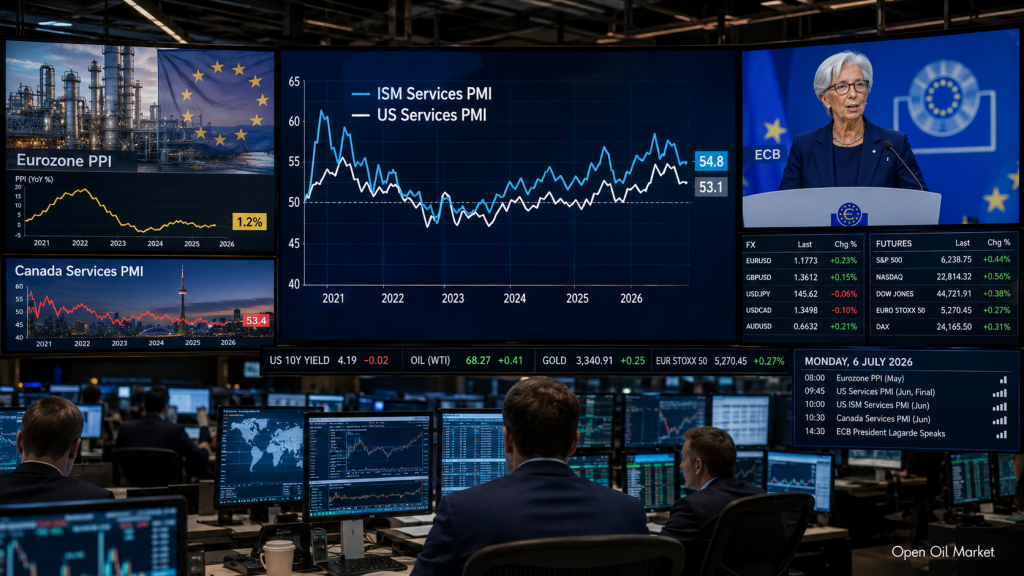
July 5 does not anticipate a significant number of official macroeconomic publications. Sunday is traditionally a day of low statistical activity; the USA, Europe, Japan, and Russia do not release key data on inflation, GDP, labor markets, or industry. However, investors are already preparing for a week where the Fed's protocols, business activity indices, trade statistics, and early signals regarding corporate margins will be significant.
In the coming days, the market will pay attention to several filters:
- How does the Fed assess the balance between inflation and cooling labor markets?
- Is consumer demand in the U.S. maintaining stability?
- Can Europe continue its recovery amid a lower equity assessment?
- Will Asia support global demand for commodities and technology?
For the CIS audience, the currency aspect is also crucial: OPEC+ decisions can influence oil and gas revenues, the ruble, currencies of commodity economies, and expectations regarding budget revenues.
Global Markets: Rates, Dollar, and Risk Appetite
Global equities are entering a new week following a strong recovery, but the structure of growth remains heterogeneous. In the U.S., investors are increasingly scrutinizing overheating in the tech sector, especially in stocks related to artificial intelligence and semiconductors. In Europe, interest is supported by more modest multiples and less dependence of indices on one technological theme. In Asia, data on business activity and export demand are vital.
The interest rate market remains a central element of the investment landscape. If the Fed's protocols confirm a hawkish stance, bond yields may rise again, applying pressure on growth stocks. However, if the emphasis shifts towards cooling the economy, the market may amplify expectations of a pause in rate hikes. In both scenarios, the dollar, gold, oil, and emerging markets will respond synchronously with changes in expectations regarding U.S. monetary policy.
Corporate Reports for July 5: U.S., Europe, Asia, and Russia
The corporate earnings calendar for Sunday, July 5, remains thin. Major companies from the S&P 500, Euro Stoxx 50, and MOEX do not generate a substantial block of quarterly financial results on this day due to the holiday and the shifting of main activities to the working week. Nonetheless, investors in the Asian bloc should take note of sales and revenue releases from certain publicly traded companies.
Key corporate publications of the day include:
- United Microelectronics Corporation – sales and revenue release; important for assessing demand for semiconductor capacity and sentiment in the Asian technology chain.
- UMC, Inc. – release of sales and revenue data; interesting as an additional signal regarding demand in electronics and contract manufacturing.
- MS&AD Insurance Group Holdings – sales and revenue release; significant for the Japanese financial sector and assessing the insurance business amid rate movements and investment income.
It is essential for investors to differentiate between comprehensive quarterly reports and operational releases. Sales publications may set the tone for certain sectors but do not replace profit reports, margins, cash flow, and management forecasts.
S&P 500, Euro Stoxx 50, Nikkei 225, and MOEX: What to Expect Next
In the S&P 500, major report activity will begin later in the week. Attention will focus on PepsiCo and Delta Air Lines, which will provide investors with two different perspectives on the consumer economy: everyday demand for groceries and beverages, as well as the state of air traffic, business travels, and premium tourism. These reports are significant for assessing consumer resilience amid high rates.
In the Euro Stoxx 50, the Sunday agenda is limited. For the European market, the macro environment is more critical: industrial dynamics, energy prices, euro rates, and the resilience of the banking sector. In the Nikkei 225, attention is directed towards financial and technology companies, including Japan's insurance sector. On the MOEX, there is no regular trading session and major reports, but Russian investors will monitor the oil response and potential impacts of OPEC+ decisions on oil and gas stocks.
Geo-Targeting: Global Environment and Interests of CIS Investors
For investors from Russia, Kazakhstan, Belarus, Armenia, and other CIS countries, the agenda for July 5 has practical implications. OPEC+ decisions affect not only global oil prices but also export revenues, budgets of commodity economies, currency expectations, and stocks of oil and gas sector companies. In the context of global rate re-evaluation, energy once again serves as the link between macroeconomics, equity markets, and currencies.
Key words for the investor on this day include: economic events, corporate reports, OPEC+, Brent oil, global markets, Fed, S&P 500, Euro Stoxx 50, Nikkei 225, MOEX, company earnings, investments, commodity market, and stock market.
What Investors Should Pay Attention To
The main takeaway for July 5: while the day might appear calm, it effectively sets the stage for the new trading week. The OPEC+ meeting could influence oil prices, inflation expectations, currencies of commodity-exporting countries, and stocks in the energy sector. Corporate reporting on Sunday is limited, but sales releases from Asian companies will assist in assessing demand in semiconductors, insurance, and the industrial chain.
Investors should focus on five areas:
- OPEC+'s decision and rhetoric. Not only the volume of production matters, but also the alliance's readiness to change course in the event of market balance deterioration.
- Response of Brent and oil and gas stocks. Companies depending on export prices and refining margins will be particularly sensitive.
- U.S. bond yields. They will determine pressure on growth stocks and demand for defensive assets.
- Preparation for reports from PepsiCo and Delta Air Lines. These companies will serve as early indicators of consumer demand in the U.S.
- Portfolio risks for CIS investors. Oil, the ruble, MOEX stocks, and commodity currencies will be influenced by the global energy agenda.
Thus, the economic events and corporate reports on Sunday, July 5, 2026, concentrate around one key question: can OPEC+ maintain a balance between supporting the oil market and gradually restoring production? The answer to this will set the tone for the commodity markets, global indices, and investment decisions for the upcoming week.