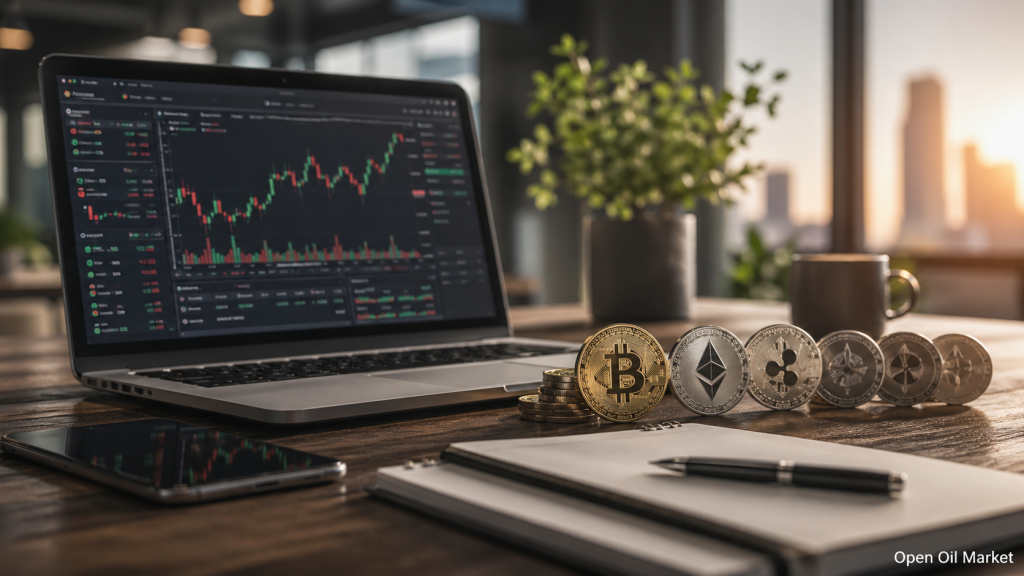
The Global Crypto Market on April 27, 2026, Shows Steady Growth Amid Institutional Demand and Digital Asset Development
At the opening of trading on Monday, April 27, 2026, the global cryptocurrency market displays cautious optimism. Key digital assets maintain high liquidity: Bitcoin and Ethereum continue to lead investor portfolios. The overall market capitalization has stabilized after recent fluctuations, indicating balanced demand and favorable macroeconomic factors. The focus remains on institutional inflows into cryptocurrencies and the discussion of global regulatory initiatives that are driving the integration of digital assets into the global financial system.
Bitcoin Remains the Center of Attention for Investors
The primary cryptocurrency retains its status as a benchmark for the market. After a minor corrective pullback, Bitcoin's price has approached recent highs again, reflecting sustained institutional demand. Exchange mechanisms—primarily exchange-traded funds (ETFs)—continue to attract capital: in recent weeks, there has been a record inflow into Bitcoin ETFs in the U.S. Major institutional players are actively increasing their holdings, with corporate treasuries like MicroStrategy adding to their BTC reserves, which further strengthens bullish sentiment. As a result, Bitcoin solidifies its role as "digital gold" and a risk appetite indicator in financial markets.
- Institutional Demand and ETFs. For several consecutive days, Bitcoin funds have seen multi-billion dollar inflows, with market leaders like BlackRock's IBIT accumulating tens of thousands of coins. This reflects a shift in capital from old structures (e.g., Grayscale GBTC) to modern ETFs with lower fees.
- Corporate Accumulation. MicroStrategy has outpaced many competing funds in Bitcoin investments, becoming the largest holder of Bitcoin among publicly traded companies. Its aggressive buying strategy (tens of thousands of BTC in a single day) and other corporate transactions provide strong fundamental support for the price.
- Mining and Efficiency. Mining remains profitable: through reduced production costs (thanks to optimized energy consumption), large mining companies convert some mined coins into cash for investments. Together with institutional demand, this reinforces Bitcoin's long-term foundation.
Ethereum and Major Altcoins Consolidate
The second largest cryptocurrency by market capitalization, Ethereum, shows signs of stabilization after a weak start to the year. Investors are focusing not so much on short-term price fluctuations as on increased network activity and ecosystem development. The growing popularity of decentralized applications and DeFi tokens is accompanied by an increase in transaction volumes and fees on the Ethereum network. This focus on fundamentals emphasizes that Ethereum is still viewed as a foundational platform for tokenization and smart contracts.
- Solana (SOL): Continues to attract users due to its high speed and low fees. Despite previous technical issues, the network is regaining activity, and the blockchain is used for decentralized finance and NFT projects.
- XRP (Ripple): Maintains positions in the international payment sphere. Major banks and payment providers are getting involved, considering XRP as a means for quick settlement of cross-border transactions.
- Binance Coin (BNB): Remains a significant asset within the Binance ecosystem. The approval of new tokens and the process of "burning" coins maintains interest, while the Binance platform expands services to attract users.
- TRON (TRX): Distinctly stands out in the stablecoin niche—TRON's blockchain hosts a large share of the USDT stablecoin. Additionally, TRON focuses on entertainment projects, attracting some retail investors.
- Dogecoin (DOGE): Remains an indicator of retail demand. The meme cryptocurrency consistently enjoys popularity among small investors and periodically demonstrates spikes due to humorous and marketing factors.
- Cardano (ADA) and Other Projects: Although Cardano stands sidelined compared to the mentioned leaders, it continues to develop its platform (Proof-of-Stake, smart contracts). Other startups and altcoins (e.g., Polkadot, Avalanche) are currently less noticeable but also operate in the infrastructure solutions sector.
Stablecoins Become the Main Infrastructure Theme of 2026
One of the key trends in the crypto market is the increasing use of stablecoins. Major global financial institutions are discussing them not only as a trading instrument but also as a payment medium. The importance of stablecoins is attributed to their ability to bridge the traditional banking system and blockchain: they are competing for the role of a new "international payment network" alongside SWIFT and bank transfers. Recently, the total issuance of stablecoins on the Ethereum network surpassed $180 billion, confirming the growing "liquidity cushion" in the crypto market. Meanwhile, regulators are working on unified rules for stablecoins, recognizing their impact on the monetary system.
- A Bridge Between Banks and Blockchain. Stablecoins (USDT, USDC, and others) allow for the rapid transfer of dollars in digital form across countries and platforms. Banks and payment systems are considering integrating stablecoins into their systems to expedite transactions and reduce costs.
- Regulatory Initiatives. Central bank leaders and international organizations (BIS, FSB) emphasize the need for a global approach to stablecoins to avoid "regulatory arbitrage." In the U.S., legislative proposals are being discussed to clearly define the legal status of stablecoins, while Asia and Europe are drafting initial licensing regulations for issuers.
- Accumulated Resources for Growth. The recorded record issuance of stablecoins means "dry powder" for the market. This could lead to a new wave of investments in crypto-assets and DeFi, especially after regulatory clarity is achieved and further institutional confidence increases.
Institutional Investments and ETFs Support Growth
Investors continue to actively shift towards regulated products. In the U.S., several new spot ETFs for Bitcoin and Ethereum have reported significant inflows. Specifically, in recent weeks, total investments in these funds have exceeded billion-dollar thresholds. Concurrently, several large Bitcoin ETFs from well-known financial companies have entered the market, stimulating capital inflow and strengthening liquidity. Collectively, these processes reflect intensified competition among providers of crypto-asset products.
- Growth in ETH Share. Similar to Bitcoin funds, the streaming ETFs on Ethereum exhibit a robust dynamic. Over several trading sessions, they have seen inflows, confirming growing interest from institutional investors and hedge funds in the "digital gold" of blockchains.
- Capital Redistribution. Recent weeks have seen a shift of funds from outdated structures to new instruments: Grayscale funds have experienced outflows, while shares of funds with lower fees and modern structuring have grown. This indicates a strategic shift of capital towards more efficient financial solutions.
- Corporate Acquisitions. In addition to ETFs, large tech and financial companies continue to increase their BTC and ETH reserves. This institutional "backup" of cryptocurrencies enhances the overall market resilience and creates a psychological barrier to price declines.
Regulation and Global Integration of the Crypto Market
Cryptocurrencies are becoming increasingly integrated into the global financial system, and governments are establishing rules. In the U.S., new regulatory leaders (SEC, CFTC) are determined to provide clear "traffic rules" for digital assets. Plans have already been announced to review the approach to stablecoins (not classifying them as securities under certain conditions) and to expedite the launch of approved ETFs. The European Union continues to work on the MiCA legislation, aimed at establishing a unified zone for digital assets with equal conditions for issuers across all EU countries.
- International Cooperation. The U.S. and the U.K. have established a joint group to harmonize rules in the tokenization of financial assets and stablecoins. Despite some discrepancies in methods (the U.K. is leaning toward sandbox testing, while the U.S. favors exemptions from certain regulations), both sides are moving toward a common regulatory standard.
- Regional Initiatives. In Asia, activities and developments are notable: Japan is tightening cybersecurity for exchanges, while Hong Kong is issuing the first licenses for stablecoin issuers. In the UAE, the VARA regulatory authority has allowed trading of crypto derivatives with limited leverage for retail traders. Such steps broaden the global reach of cryptocurrency regulation and legalization.
- Central Banks and Digital Currencies. Many countries are accelerating the development of their own CBDCs (central bank digital currencies), leading to a reassessment of perspectives on virtual assets. Although CBDCs are not cryptocurrencies in the traditional sense, their emergence compels regulators to consider interest in private digital coins and determine their place in the financial infrastructure.
Top 10 Most Popular Cryptocurrencies
As of April 27, 2026, the top ten cryptocurrencies by market capitalization include:
- Bitcoin (BTC) – the largest cryptocurrency with a dominance of over 60%. It is regarded as "digital gold" and a cornerstone for institutional portfolios.
- Ethereum (ETH) – the primary platform for smart contracts and dApps, with a capitalization several times greater than most other altcoins.
- Tether (USDT) – the leading stablecoin, serving as the digital dollar for many traders and platforms.
- XRP (Ripple) – a payment token used in cross-border transfers and remains a popular tool in market infrastructure.
- BNB (Binance Coin) – serves as the internal currency for the largest cryptocurrency exchange, Binance, and is actively used for fee payments and within Binance Smart Chain's ecosystem.
- USD Coin (USDC) – the second most important stablecoin, reliably backed by the American company Circle, widely applied in DeFi and institutional trading.
- Solana (SOL) – a blockchain for high-speed transactions, attracting users as a fast and cheap alternative to Ethereum despite technical interruptions.
- TRON (TRX) – a network focused on media and entertainment with numerous stablecoins issued on its blockchain and a strong community.
- Dogecoin (DOGE) – a well-known meme cryptocurrency. Although technically inferior to altcoins, it remains an indicator of retail demand and frequently becomes a hype hero.
- Hyperliquid (HYPE) – a new decentralized exchange and token that has quickly gained traction, offering innovative tools for traders and ranking in the top 10 due to active growth.
Collectively, these digital assets reflect key segments of the crypto industry: Bitcoin and Ethereum set the tone; stablecoins provide liquidity; specialized tokens (e.g., BNB, HYPE) demonstrate the ecosystem's maturity. The behavior of the "top 10" gives insight into where the market is headed—investors will be closely monitoring their dynamics in the coming period, assessing the market's readiness for further expansion and risk strategies.