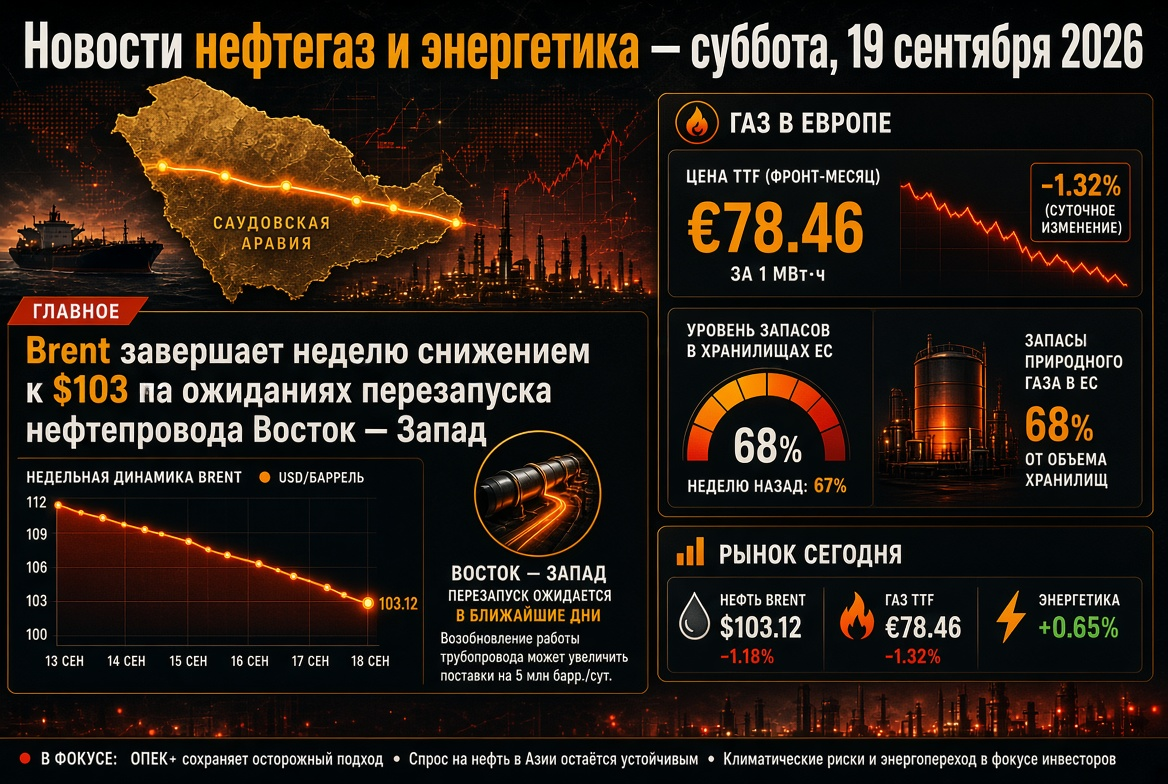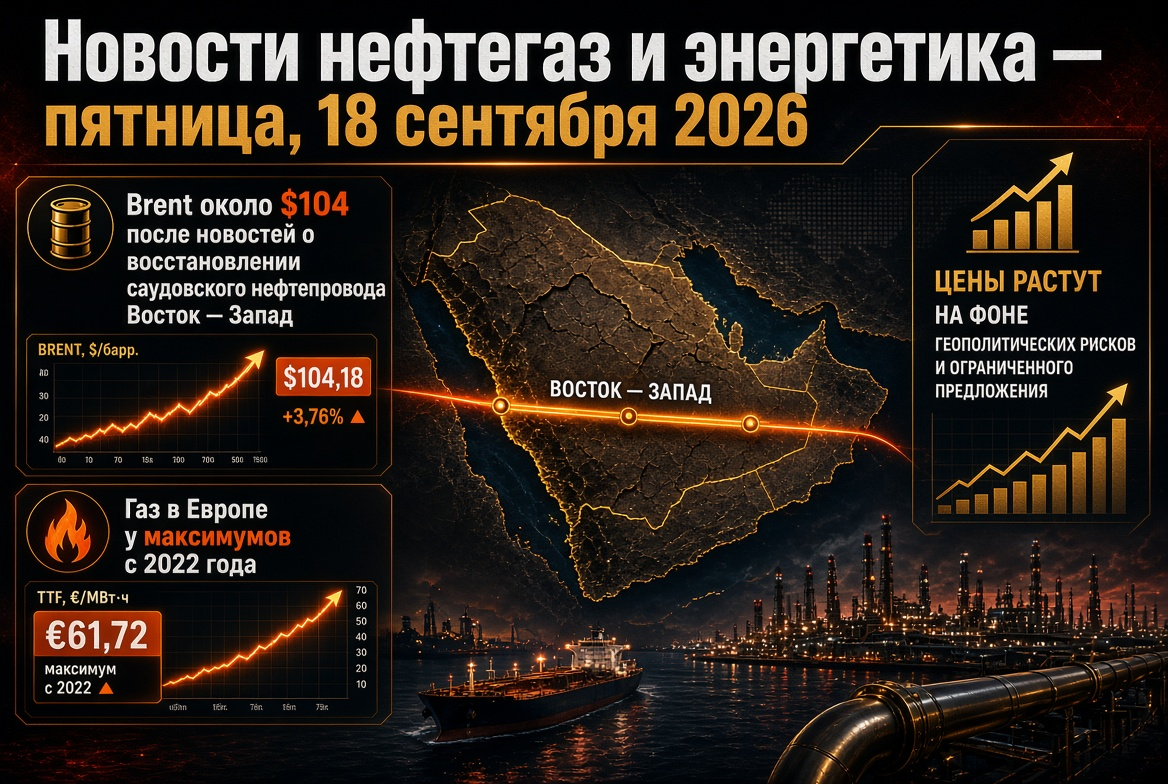
Current Oil and Gas and Energy News as of February 15, 2026: Dynamics of Brent and WTI Crude Oil, Gas Market and LNG, Electricity and Renewable Energy, Coal, Oil Products, and Refineries. A Global Overview for Investors and Industry Stakeholders in the Energy Sector.
The end of the week in commodity markets has been characterized by a "tug of war" between geopolitical premiums and increasing signals of excess supply. Oil prices have held steady around $68 per barrel for Brent, but the focus has shifted to April: market participants are assessing the likelihood of a resumption of production growth by OPEC+ and the impact of expanded operational capabilities in Venezuela for international players. In the gas market, Europe remains sensitive to weather conditions and hydrological balance: the snow cover deficit in the Alpine region is boosting gas generation and supporting import demand.
- Oil: Brent and WTI ended the day with slight gains, but registered weekly losses; the key catalyst being expectations surrounding OPEC+ and heightened supply concerns.
- Gas: The American Henry Hub stabilized at around $3+ per MMBtu after extreme volatility in January; in Europe, TTF has retreated, but energy balance risks persist.
- Oil Products: European ICE gasoil saw significant decreases at the day's close; premiums and margins remain volatile amid refinery maintenance and seasonal demand shifts.
- Coal and Electricity: ARA coal has strengthened, while German baseload electricity (futures) declined at the day's close.
Key Price Indicators
Below is a "showcase" for investors and market participants in the energy sector: oil, gas hubs, oil products, coal, and electricity. All changes are calculated as the difference between the closing on February 13, 2026 and the closing on February 12, 2026 for the relevant indicators (where available).
| Indicator | Region/Market | Unit | Closing (February 13, 2026) | Daily Change | Daily Change, % |
|---|---|---|---|---|---|
| Brent (front-month) | Global export benchmark | USD/barrel | 67.75 | +0.23 | +0.34% |
| WTI (front-month) | USA, NYMEX | USD/barrel | 62.89 | +0.05 | +0.08% |
| Henry Hub (NYMEX nat gas, front-month) | USA, key gas hub | USD/MMBtu | 3.243 | +0.026 | +0.81% |
| TTF (ICE Dutch TTF, front-month) | Europe, gas hub | EUR/MWh | 32.500 | -0.494 | -1.50% |
| ICE Gasoil (London Gas Oil) | Europe, diesel/gasoil | USD/ton | 672.50 | -25.75 | -3.69% |
| ARA Coal (Rotterdam Coal) | Europe, ARA (proxy for API2 logic) | USD/ton | 104.85 | +1.55 | +1.50% |
| Electricity Germany (Baseload month) | Europe, futures | EUR/MWh | 101.22 | -2.95 | -2.83% |
Oil: Supply and Demand Balance Back in Focus
For the oil market, the week has served as a "mode switch": the geopolitical premium (particularly surrounding U.S.-Iran relations) has supported prices, while supply risks have begun to dominate the news flow. Sources indicate that some OPEC+ participants are inclined to return to planned production increases from April — this decision is being discussed against expectations of seasonal demand increases in spring and summer. For investors, this means a rising probability of a moderate surplus in the second quarter and increased sensitivity of oil prices to inventory and export data.
At the same time, international forecasters are strengthening their "bearish" outlook: the IEA has lowered its forecast for global oil demand growth in 2026 while simultaneously recording a structural gap between expected supply and consumption. Within this framework, any additional flow—whether from OPEC+ or sanction-impacted countries—is perceived as a factor shifting the curve towards contango and applying pressure on spreads.
- Fundamentals: the market is processing simultaneous signals of "less demand" and "more potential production."
- Supply Risks: discussions around the return of OPEC+ production increases and augmentation of Venezuelan capabilities through changes in the access regime for international companies.
- Short-Term Outlook: key statements from OPEC+ and oil inventory/refinery dynamics in the USA will be crucial next week.
Gas and LNG: Europe Remains Weather-Dependent, USA Shifts to More "Normal" Prices
The gas market is diverging regionally. In the USA, Henry Hub is returning to levels more in line with medium-term balance expectations—following January's cold wave when futures and spot prices saw extreme spikes. For fuel companies and gas consumers, this appears to be a transition from a "force majeure" demand situation to a more calibrated approach to inventories and production.
In Europe, TTF declined at the day's close, but fundamental nervousness remains: the weather factor changes not only through temperature but also through hydrology. Low snow cover in parts of the Alpine region indicates weak hydropower generation and greater gas draw for electricity generation, which directly impacts the rates of filling/emptying storage facilities and premiums for spot deliveries. For the global LNG market, this linkage increases the significance of short-term changes in flows and the availability of tankers.
As of February 15, 2026: detailed data on the loading of European UGS and JKM/TTF spreads are not disclosed in this publication (no confirmed public numbers from available primary sources), hence the assessment is provided based on the overall trend in demand for gas generation and hub volatility.
Oil Products and Refineries: Diesel Shelf Weakens, but Maintenance Supports Margins
In the oil products markets, the week ended with a decline in European gasoil, indicating a rapid reassessment of expectations in the middle distillate segment. However, for refineries and fuel companies, the key parameter is not just the futures level, but crack spreads, regional premiums, and feedstock availability. Here, the picture is complicated by two opposing processes: seasonal refinery maintenance reduces the supply of oil products, while weakening demand outside peak heating/transportation windows lessens price support.
In the USA, a significant corporate signal was the focus on Venezuelan crude: easing the access regime increases the likelihood of rising imports of heavier grades to optimize the refining slate at U.S. refineries. For arbitrages, this means possible redistribution of flows: some barrels that were previously directed elsewhere may be redirected to the Atlantic, influencing freight rates and differentials.
- For Refineries: risk—"flat" prices for oil products with expensive feedstock; support—maintenance of competitors and logistical constraints.
- For Trading: focus—diesel/gasoil, regional spreads, and freight costs for product tankers.
- For Investors: the role of guidance on margins and loading for public refiners is increasing.
Sanctions and Geopolitics: Russia, Iran, and Venezuela Create a "Political Premium" in Energy
Geopolitics is once again a part of pricing: tensions in the Middle East surrounding the U.S.-Iran situation support the risk premium for oil and increase the "price" of potential disruptions. At the same time, the sanctions agenda in Europe is shifting from price constraints to logistics—discussions are ongoing regarding enhanced restrictions on maritime services for Russian oil and the expansion of the sanctions scope to infrastructure and ports in third countries. This directly impacts transportation and insurance costs, as well as increasing the role of "grey" supply chains.
At the other end of the spectrum—Venezuela: the expansion of access for international players opens the possibility for accelerated production and investments, but operational details (licenses, payment mechanisms, banking compliance) will dictate the pace of actual increases. That is why the oil market over the coming weeks is trading not only on current inventories but also based on the quality of political signals.
Energy and Renewables: Policy Alters Curves, Electricity Reflects Balance Nervousness
The renewable energy sector continues to expand its investment base, but policy is becoming more differentiated. The UK has recorded a record volume of support for solar projects in another auction, emphasizing the focus on scalable low-carbon technologies. France, on the other hand, has adjusted its energy strategy parameters, reducing target benchmarks for wind and solar while increasing the role of nuclear generation; for European energy, this signifies a more complex trajectory for the development of networks, storage, and balancing capacities.
At the price level, German electricity (futures) decreased at the day's close, appearing to be a reaction to the short-term normalization of balance expectations, yet fundamentally, European energy remains sensitive to gas, weather, and the accessibility of low-carbon generation.
Short-term forecast for the coming days (February 15-20, 2026): the base scenario—oil in a corridor where the upper limit is curtailed by the expectation of increased supply, while the lower limit is supported by geopolitical premiums. Gas in Europe will remain a "weather deal," while for oil products, the key intrigue will be the resilience of diesel spreads amid refinery maintenance.
- What to watch for investors: signals from OPEC+ (ahead of the meeting on March 1, 2026), practical details regarding Venezuela (licenses and export flows), dynamics of the EU/G7 sanctions agenda, and U.S.-Iran risks.
- What to monitor for market participants: arbitrages in crude oil and oil products, logistics of deliveries, gas hub premiums, and the load on gas generation in Europe.
This material has been prepared in an expositional form for an audience of investors and market participants: oil, gas, energy, renewable energy, coal, oil products, refineries, and fuel companies. If certain figures or corporate details are absent from publicly available primary sources, they are marked as unavailable as of February 15, 2026.