Key developments in the global energy market this week: oil, gas, coal and refined products ahead of the OPEC+ decision
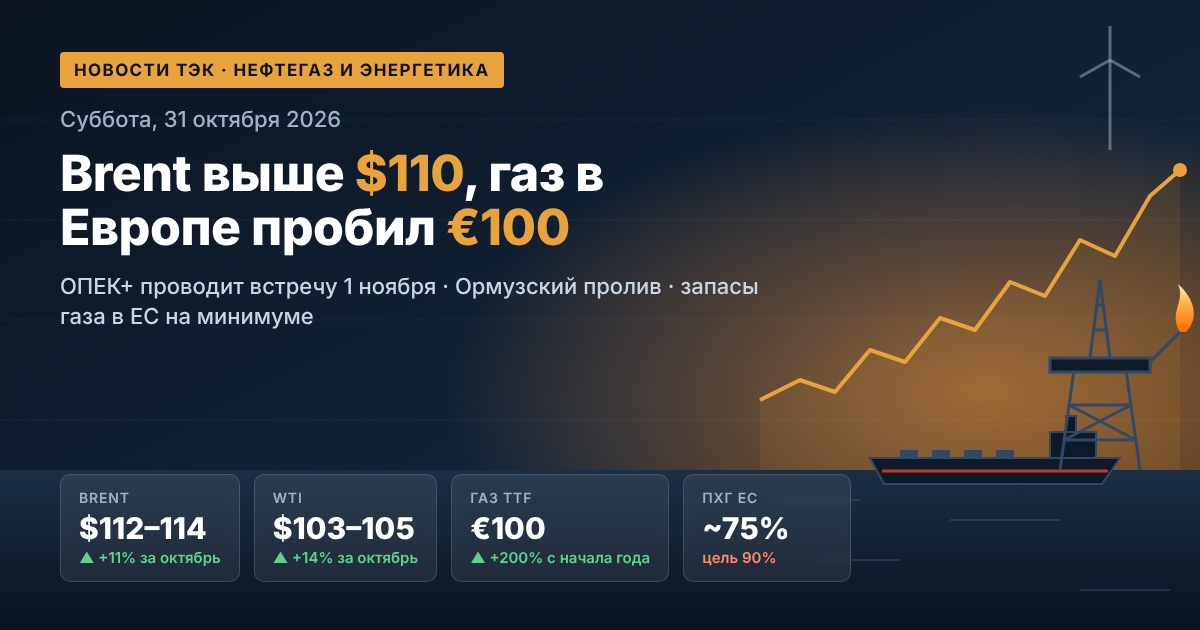
The global oil and gas market is entering November at multi-year highs. In October, Brent crude rose by around 11%, WTI by 14%: both benchmarks have been rising for the fourth consecutive month. On Friday, the last day of trading for the December Brent futures contract, the price rose to $118 per barrel for the first time since 30 April. The drivers are fresh Houthi attacks on Saudi Arabia's oil infrastructure, an attack on a tanker in the Strait of Hormuz and expectations of a possible escalation of the US–Iran conflict after the US midterm elections. On Sunday, 1 November, seven key OPEC+ members are holding an online meeting on December quotas. Meanwhile, European gas is priced above $1,200 per thousand cubic metres for the first time since December 2022.
1. Oil market: Brent and WTI close October higher
For Brent crude, the past week was one of the most volatile since spring. On Thursday, prices fell towards $110–111 on reports of diplomatic contacts: the US side sent Tehran a letter proposing the resumption of talks. By Friday, the geopolitical risk premium had returned to prices.
- Brent (December contract): up to $118 per barrel intraday, a six-month high;
- Brent (January contract): around $113–114 per barrel, up 2.5% for the session;
- WTI: around $103–105 per barrel, the highest since September;
- Brent–WTI spread: narrowed to around $9: US crude is catching up with European crude.
According to analysts, high oil prices will persist even after the conflict ends. Saxo Bank expects Brent to trade in a range of $70–90 instead of the pre-war $60–70: the market will have to rebuild inventories, and the risk of renewed hostilities will not disappear.
2. Middle East: strikes on Ras Tanura, Abqaiq and Rabigh
The main source of tension for oil companies and traders is the escalation on the Arabian Peninsula. The Houthis claimed six attacks on targets in Saudi Arabia, including:
- the Ras Tanura refinery with a capacity of 550,000 barrels per day (the second attack in a week);
- the Rabigh refinery;
- a Saudi Aramco facility in Abqaiq;
- the East–West pipeline, through which the kingdom channels exports to the Red Sea bypassing the Strait of Hormuz. By early October, throughput along the pipeline had recovered to 5.8 million barrels per day.
Riyadh has not yet officially confirmed these strikes. Nevertheless, the market treats disruptions to Middle Eastern oil supplies as a real risk. On Friday, the UK Maritime Trade Operations (UKMTO) also reported a tanker in the Strait of Hormuz damaged by explosive devices attached from a small craft.
3. OPEC+: the 1 November meeting and 2027 quotas
Saudi Arabia, Russia, Iraq, Kuwait, Kazakhstan, Algeria and Oman are holding a meeting on Sunday. According to alliance sources, the base-case scenario is to keep December quotas unchanged. This would be the third consecutive pause after six months of gradual output increases.
OPEC+ quotas for November 2026
- Saudi Arabia — 10.5 million barrels per day;
- Russia — 9.9 million barrels per day;
- Iraq — 4.4 million barrels per day;
- Kuwait — 2.7 million barrels per day;
- Kazakhstan — 1.6 million, Algeria — 1.0 million, Oman — 0.8 million barrels per day.
The decision is largely symbolic: actual production in the Persian Gulf is still well below quotas. For investors, the signals on 2027 policy matter more. The alliance is maintaining around 2 million barrels per day of cuts introduced in 2022 and has not yet completed the audit of members' production capacities, which will determine new baseline levels. A full OPEC+ ministerial meeting is scheduled for 29 November.
4. Supply and demand balance: inventories are shrinking
According to IEA estimates, global oil demand will fall by 2.6 million barrels per day in 2026, to 102.4 million. Supply will decline even more sharply — by 5.8 million barrels per day. As a result, the market remains in deficit until the end of the year:
- by the end of September, global oil inventories were 509 million barrels below the level at the end of February;
- around 330 million barrels have already been released from IEA member countries' strategic reserves, and it has been decided to release the remaining volumes faster, primarily diesel;
- the deficit in middle distillates is expected to persist in 2027 as well, according to the agency's forecast.
OPEC has also cut its forecast for global demand growth in 2026 — to 400,000 barrels per day from an initial 1.4 million.
5. Asia: China returns to buying
China's oil imports in October are estimated to exceed 10 million barrels per day — the highest since March. Chinese refineries are receiving cargoes contracted in early August, when Brent fell below $80. Commercial inventories in China are estimated at around 1.19 billion barrels, and with rising imports their drawdown may come to an end. For exporters, this supports demand. For Russian suppliers, the situation is more complicated: India is buying Middle Eastern oil more actively, and exports from the Persian Gulf countries recovered to around 75% of pre-war levels in September.
6. Russian oil and refined products: Urals discounts and the diesel export ban
For the Russian oil and gas sector, October was mixed. Absolute Urals prices rose along with Brent, but discounts widened. At the Novorossiysk port, the discount for Suezmax cargoes reached $28.85 per barrel — the highest since March — while freight rates hit all-time highs. In the domestic refined products market, the authorities continue with hand-on regulation:
- the ban on petrol exports for all market participants is in force until 31 January 2027;
- the ban on diesel exports for producers was due to expire on 31 October. According to industry data, it is planned to be extended until the end of 2026 while maintaining quota-based supplies;
- following talks between the Russian and US presidents on 9 October, US sanctions on Russian diesel were suspended for six months, until 7 April 2027;
- the State Duma passed the 2027–2029 budget in the first reading, which includes a lower base oil price for calculating oil and gas revenues.
7. European gas market: TTF above €100 per MWh
European gas has risen to its highest level in almost four years. The day-ahead price at the TTF hub reached around €104 per MWh (about $1,204 per thousand cubic metres) on Friday, with the December futures contract at around €103. According to GIE, EU underground gas storage was 74.9% full (80 billion cubic metres) as of 26 October, noticeably below last year's level. Europe is competing with Asian buyers for LNG cargoes, and Gazprom CEO Alexey Miller suggested that peak prices could rise to $2,500 per thousand cubic metres in a cold winter.
8. Coal and power: gas gets more expensive, coal makes a comeback
Expensive LNG has brought coal demand back in Asia. Newcastle thermal coal is trading at around $150 per tonne — near three-year highs and 45% more expensive than a year ago. On an energy-equivalent basis, coal is around 80% cheaper than LNG, so China, Japan and South Korea may increase imports by around 20 million tonnes in the fourth quarter. For generating companies, this means higher fuel and electricity costs; for coal exporters, a strong end to the year.
9. Renewables and the energy transition: the road to COP31
The focus of renewable energy is the COP31 climate conference, which will take place in Antalya from 9 to 20 November. The Turkish and Australian presidency is pushing the "35 by 35" goal: raising the share of electricity in global final energy consumption to 35% by 2035. In November, the IEA will also present its Renewables 2026 report and World Energy Outlook 2026. The 2026 energy crisis has strengthened interest in energy security, electrification and energy storage.
What market participants should watch this week
- 1 November — the OPEC+ decision on December output and signals on 2027 quotas;
- 3 November — US midterm elections: the market fears a resumption of strikes on Iran afterwards;
- shipping in the Strait of Hormuz and attacks on Saudi refineries and pipelines;
- gas withdrawals from European underground storage and TTF dynamics as cold weather sets in;
- the final decision of the Russian government on diesel exports.
In early November, commodity markets are being driven primarily by geopolitics and inventory deficits. For investors and oil and fuel companies, this means high price volatility for oil, gas, coal and refined products at least until the end of the year.