Venture market closes October 2026 on a high. Anthropic files for IPO, AI chip, cybersecurity and robotics startups raise billion-dollar rounds, funds close oversubscribed
The last week of October was one of the busiest for venture capital in 2026. Anthropic's public IPO filing sets the tone for the market through November. At the same time, private capital continues to flow out of "pure" software into artificial intelligence infrastructure, industrial automation and security. For venture investors and funds, the week sent two signals at once: the liquidity window is opening, and capital concentration in the largest deals continues to grow.
Key trends of the week for venture investors
- Mega-IPO in AI. Anthropic published its S-1 prospectus. This is the main test of the public market's appetite for artificial intelligence companies.
- Infrastructure over applications. The largest funding rounds went to inference chip makers, compute clouds and manufacturing platforms.
- Physical AI. Robotics, autonomous construction equipment and robotic factories attracted cheques from $100 million.
- Cybersecurity. Cloud and AI agent identity protection remains one of the most competitive niches for venture investment.
- Fund fundraising. European and US managers are closing new funds, including oversubscribed ones.
Anthropic IPO: the main test for the venture market
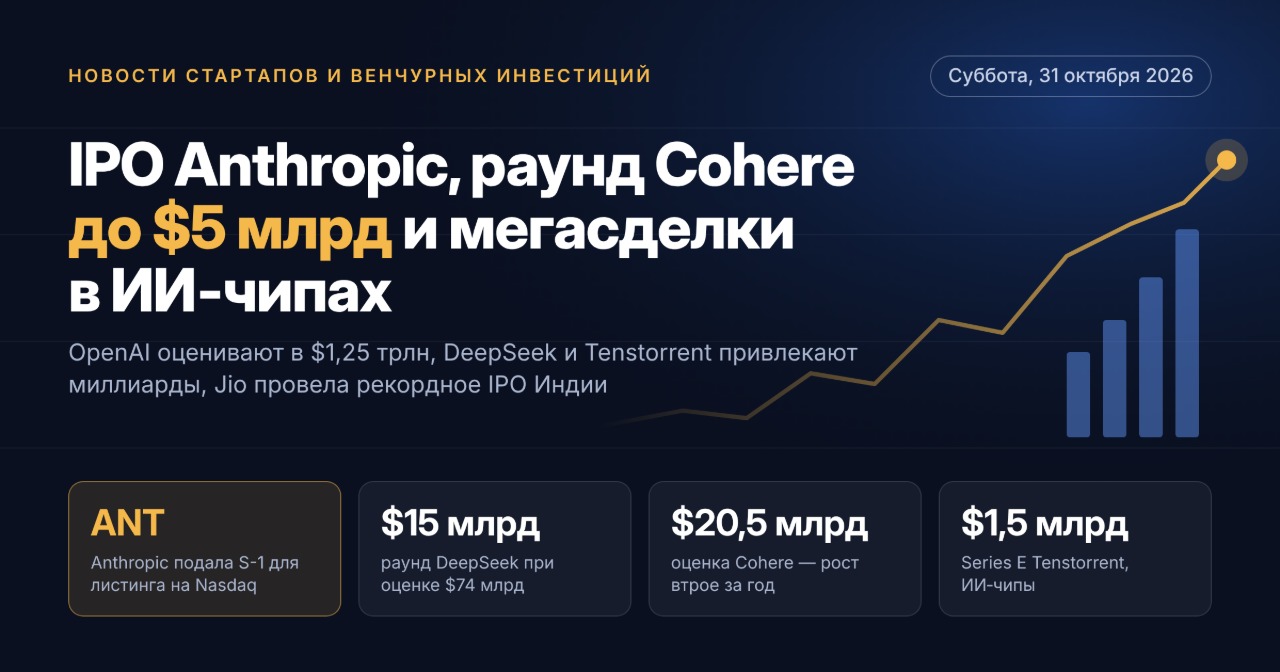
On 26 October, Anthropic publicly filed its S-1 form and plans to list Class A shares on the Nasdaq Global Select Market under the ticker ANT. Goldman Sachs and Morgan Stanley are acting as underwriters. The prospectus does not yet specify the number of shares or the price range. According to industry sources, a valuation of $1.5 trillion to $2 trillion is under discussion in negotiations. The last private Series H round of about $65 billion valued the company at $965 billion.
Indicative listing timeline:
- Publication of the amended S-1 with a price range.
- Roadshow, which could start as early as the week of 9 November.
- Start of trading, expected before Thanksgiving.
For venture funds, this deal sets a benchmark for multiples across the entire generative AI segment. Separately, the market is discussing that strategic partners, primarily cloud providers, may reap the largest benefit from the listing. Traditional venture investors are less prominent in this deal.
Macro picture: venture capital after the third quarter
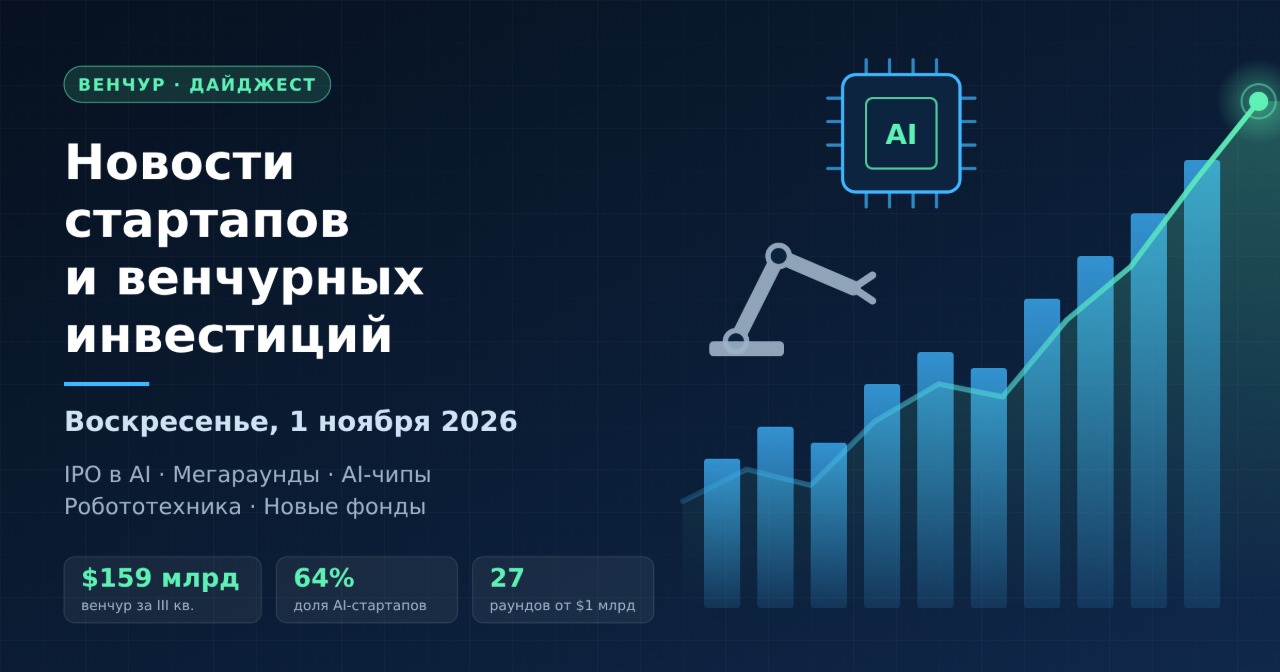
Global venture investment in the third quarter of 2026 totalled $159 billion. That is 25% less than in the second quarter, but 53% more than a year earlier. Key indicators:
- artificial intelligence startups raised $102 billion, or 64% of all venture capital;
- a record 27 companies closed rounds of $1 billion or more, accounting for almost a third of the quarterly total;
- the nine-month total reached $679 billion, a historical high;
- early-stage funding grew 25% year on year, to $40.6 billion;
- Europe posted its strongest quarter in four years: $25 billion.
October deal statistics confirm that the market remains highly concentrated. Companies outside the first tier of AI still find it difficult to close Series B and C rounds.
Mega-rounds of the week: AI infrastructure and semiconductors
The largest deal of the week was Re:Build Manufacturing's round: $2.1 billion led by General Catalyst and JPMorganChase to expand industrial capacity in the US. Other notable rounds:
- FuriosaAI (South Korea) — $620 million in a Series D at a $2.9 billion valuation. The company develops processors that reduce inference costs.
- General Compute — $100 million in a Series A led by Blackbird.
- Hyperbolic — $30 million for a platform that aggregates disparate AI cloud providers.
Earlier in October, Flapping Airplanes raised $1 billion in a Series A at a $6 billion valuation, and Tenstorrent raised $1.5 billion in a Series E. The trend is clear: venture capital is financing the economics of scaling artificial intelligence, that is, energy efficiency, compute and the cost of running models.
Physical AI and robotics
Robotics has established itself as the second most attractive theme after AI infrastructure. Key deals:
- Bedrock Robotics — $600 million in a Series C led by CapitalG for autonomous excavators for construction sites.
- Foundry Robotics — $100 million in a Series A for robotic factories operating on a "manufacturing as a service" model.
- Eka Robotics — $150 million in a Series A from a16z and F-Prime at a $1.45 billion valuation.
- Arda Industries — $232 million for a manufacturing automation platform.
These startups have a different economics from SaaS companies. Capital intensity, engineering milestones and production cycles require venture funds to take a longer horizon and bring in strategic co-investors.
Cybersecurity, enterprise software and fintech
Upwind closed a $400 million Series C at a $3.8 billion valuation led by Bessemer Venture Partners. The company declined a takeover offer from Datadog at the same valuation. Other deals in the segment:
- Serval — $150 million in a Series C led by Sequoia;
- Hex — $100 million in a Series D led by Peak XV;
- Collective — $100 million in a Series B from General Catalyst;
- Infisical — $40 million at a $600 million valuation for machine identity and AI agent protection;
- Casap — $56 million in a Series B for AI agents for banking disputes and anti-fraud.
In fintech, Wealthsimple raised about $300 million at a $9.8 billion valuation, while Capitolis raised $120 million in a Series E at a $1.9 billion valuation.
New venture funds: capital for the next cycle
Fundraising by management companies continues to recover. In October, the following funds closed, among others:
- Spectrum Equity — $2.5 billion, the largest growth fund in the company's history;
- Forbion — €2.3 billion across two biotech funds;
- Sprints Capital — €725 million in its fifth fund;
- Seaya — first close at €600 million for a new growth fund;
- Inspired Capital — $450 million in its fourth fund with a New York focus;
- Headline — $400 million for European founders;
- AP Ventures — $300 million in its third fund for industrial and energy technologies;
- Bison Ventures — $160 million for physical AI.
LPs continue to favour managers with a proven track record and narrow sector specialisation.
Asia, Europe and emerging markets
In China, Approaching.AI raised more than RMB 1.3 billion in a Series B, while BioGeometry extended its Series A to more than $100 million. According to available data, Tencent and Alibaba are in talks to invest in DeepSeek at a valuation of more than $20 billion. This would be the lab's first outside capital. In Europe, Cohere, which merged with Aleph Alpha, is advancing a large Series E led by Schwarz Group with a valuation target of about $20 billion. The Netherlands' Braid raised $38 million. Africa and the Middle East are represented by DPI Venture Capital, which raised $112 million for a fintech fund.
Russia and the CIS: a cautious market
In the nine months of 2026, venture investment in Russian technology startups amounted to RUB 5.67 billion. That is half the level of a year earlier. Investment in Russian AI companies grew to RUB 4.2 billion over the year. The Moscow venture fund will allocate RUB 250 million to develop technology companies and expects to attract about RUB 1 billion in co-investment. Investor caution and careful project selection are becoming the norm for the local market.
What venture investors should watch in November
- The price range and roadshow demand for Anthropic: these will become a benchmark for AI startup valuations.
- The pace of mega-rounds in AI chips and compute infrastructure.
- Deals in robotics and physical AI, including the participation of strategic investors.
- Final fund closes before year-end and LP appetite.
- M&A activity: Upwind's rejection of Datadog's offer shows that strong startups are prepared to wait for an IPO.
The week's takeaway: the startup market enters November with a rare combination of record private rounds and an opening IPO window. For venture funds, the main task now is valuation discipline amid high capital concentration in artificial intelligence.