The venture capital market enters the first day of August at historic highs. As of the end of the first half of 2026, global venture investments reached a record $510 billion — more than the entire 2025 full-year figure ($440 billion), and substantially above the previous half-year peak of $375 billion set in the second half of 2021. Yet behind the headline record lies the season's core intrigue: capital is concentrating in the hands of a narrow circle of companies and funds, and investors are splitting the market ever more sharply into the "frontier" and everyone else. For venture funds and institutional investors, the key August question is this: will the current pace of startup financing hold through the second half of the year — and who will gain access to capital.
Key venture market numbers as at 1 August 2026
The reference metrics around which the current investor discussion is built:
- $510 billion — global venture investments for the first half of 2026: $305 billion in Q1 and $205 billion in Q2;
- 43% of all venture capital in the half-year — approximately $217 billion — was raised by just two companies: OpenAI and Anthropic;
- Over 70% of Q2 investments went to artificial intelligence startups, versus roughly 50% a year earlier;
- $113 billion — record quarterly M&A volume: 24 acquisitions valued at $1 billion or more were closed in Q2;
- 32 companies went public with valuations above $1 billion in Q2 — the strongest exit market since 2021;
- $251 billion raised through 86 IPOs in the US since the start of the year — more than the entire 2025 total.
Capital concentration: a record with a double bottom
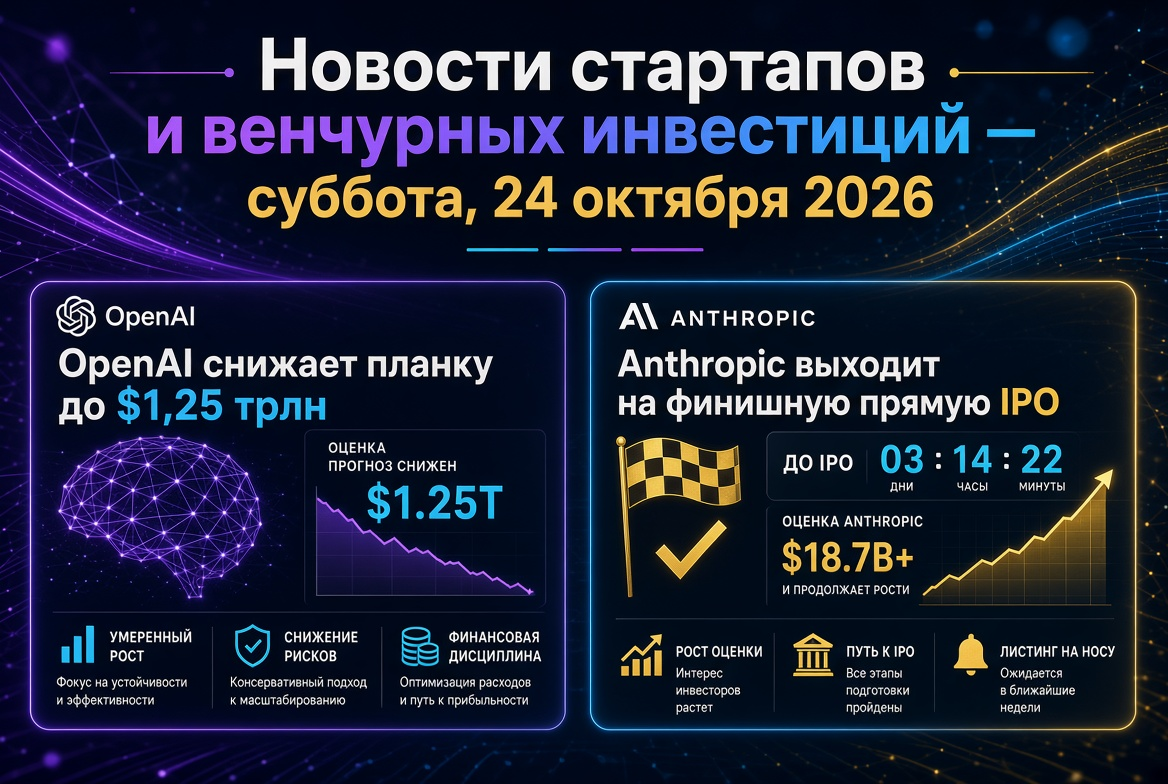
On paper, the market is experiencing the biggest boom in the history of the venture industry. In reality, the record was driven by a handful of mega-rounds. Four deals — OpenAI, Anthropic, xAI and Waymo — accounted for roughly two-thirds of quarterly venture investment volume, and excluding mega-rounds, market activity remains at 2024–2025 levels. After its $65 billion round, Anthropic overtook SpaceX to become the world's most valuable private company, and its confidential IPO filing sets the benchmark for the entire sector.
Concentration is also visible at the manager level: according to PitchBook, in the US the five largest venture managers accumulated 73% of all capital raised, while the top 15 accounted for nearly 89%. The American venture market deployed $412.7 billion over the half-year, of which 86% went to AI companies. For LPs and mid-sized funds, this means tougher competition for quality deal flow and the growing importance of specialised niches that mega-funds cannot reach.
Mega-funds expand their arsenal
The race for capital continues on the fund side as well. Abu Dhabi's MGX closed its first fund at $49 billion — one of the largest AI-focused raises in industry history, exceeding its target. B Capital completed its Ascent Fund III at $500 million, and Framework Ventures announced a fourth fund at $400 million. The market has now split into two distinct lanes: giant platform bets on AI infrastructure, and compact specialised funds with clearly defined theses. Gulf sovereign wealth funds, corporate venture arms and strategic investors from the future customer base are increasingly serving as anchor investors in rounds — capital is coming from those who will subsequently deploy the technologies themselves.
Late-July rounds: the bet on "operational" AI
Deals from the final week of July show where investor focus is shifting after a year of mega-rounds in foundational models:
- Together AI — $800 million (Series C) at an $8.3 billion valuation for its enterprise AI model training and deployment platform;
- Helsing — approximately $1.8 billion from JPMorgan Chase, Lightspeed and Iconiq: defence technology remains one of Europe's hottest sectors;
- Neko Health — $700 million (Series C) in preventive AI diagnostics;
- Freehand — $75 million (Series B) for supply chain automation;
- Enigma — $71 million in seed investment for physical AI and robotics infrastructure;
- Act Security and Hush Security — $60 million and $30 million respectively for access management of AI agents and "non-human" identities.
The common denominator is obvious: venture capital is moving away from "showcase" applications into operational layers — infrastructure, security, and agentic systems for regulated industries. Startups at the intersection of AI and cybersecurity have already raised $855 million across more than 150 seed rounds in 2026 — the category is on track for a record.
The IPO window is open, and the queue is growing
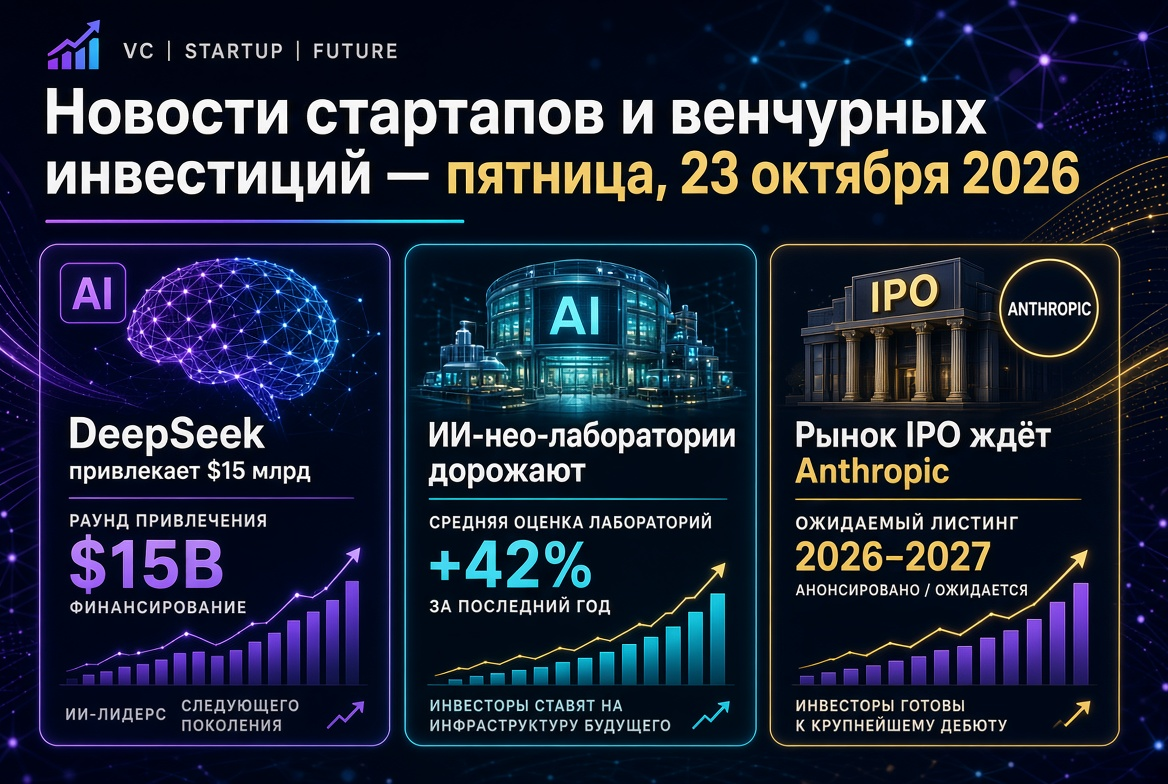
The primary market is enjoying its best year in a decade. SpaceX's historic $75 billion IPO at a $1.77 trillion valuation became the largest venture-backed listing in history and accounted for roughly one-third of all US IPO proceeds this year. Significant names are waiting in line: investors expect OpenAI to go public in late 2026 to early 2027, Anthropic and Oura have filed confidentially, Plaid and Quantinuum are preparing for listings, while Databricks has shifted its offering to 2027. A functioning exit market is returning long-awaited distributions to LPs — and this is the key difference from the 2021 boom: capital inflows and liquidity are, for the first time in a long while, feeding each other.
M&A: consolidation gathers pace
The second quarter was a record period for mergers and acquisitions: 24 deals of $1 billion or more each, totalling $113 billion. The symbol of the consolidation wave was SpaceX's $60 billion acquisition of AI tools developer Cursor — the largest startup acquisition in history. Technology giants and mature unicorns are buying up teams and technologies to close gaps in their own AI stacks, while venture funds gain a rare opportunity to lock in profits at peak valuations.
Beyond AI: robotics, energy, climate
Although AI dominates the headlines, diversification continues. Robotics startups have raised $18.8 billion since the start of the year — more than in the entire 2025. Climate technology grew 55% over the half-year to $26.1 billion, with the main driver being data centre energy shortages: investors are funding compact nuclear solutions, geothermal power and cooling systems. Quantum computing, satellite radar and defence developments complete the picture — capital flows where technology removes the physical constraints of the AI economy.
Russia and the CIS: a year of model reassessment
The Russian venture market is moving in the opposite direction to the global trend: deal volume has fallen by approximately 40% year-on-year, and the high benchmark rate makes deposits a rational alternative to long-term risk assets. Investors have definitively stopped funding "promising ideas" without revenue — money now goes to projects with proven unit economics and a clear path to profitability. Points of activity remain in corporate pilot programmes, grants and niche early-stage deals, while ecosystem consolidation proceeds through partnerships between startups and large companies.
August outlook: three questions for investors
Heading into the second half of the year, venture investors are tracking three inflection points:
- Pace sustainability. The half-year has already exceeded all of last year — but the mega-round schedule can shift quarterly totals by tens of billions of dollars;
- Monetary policy. The Fed's "hawkish" pause keeps the cost of capital elevated and cools appetite for late-stage deals outside AI;
- The public market test. The anticipated IPOs of flagship AI companies will test whether public market investors are prepared to confirm private valuations.
The interim conclusion for the venture community: the capital market is again operating at full capacity, but the rules have changed. The winners are not those merely present in AI, but those who control infrastructure, distribution and the path to liquidity. August will show how durable this new architecture of the venture boom truly is.