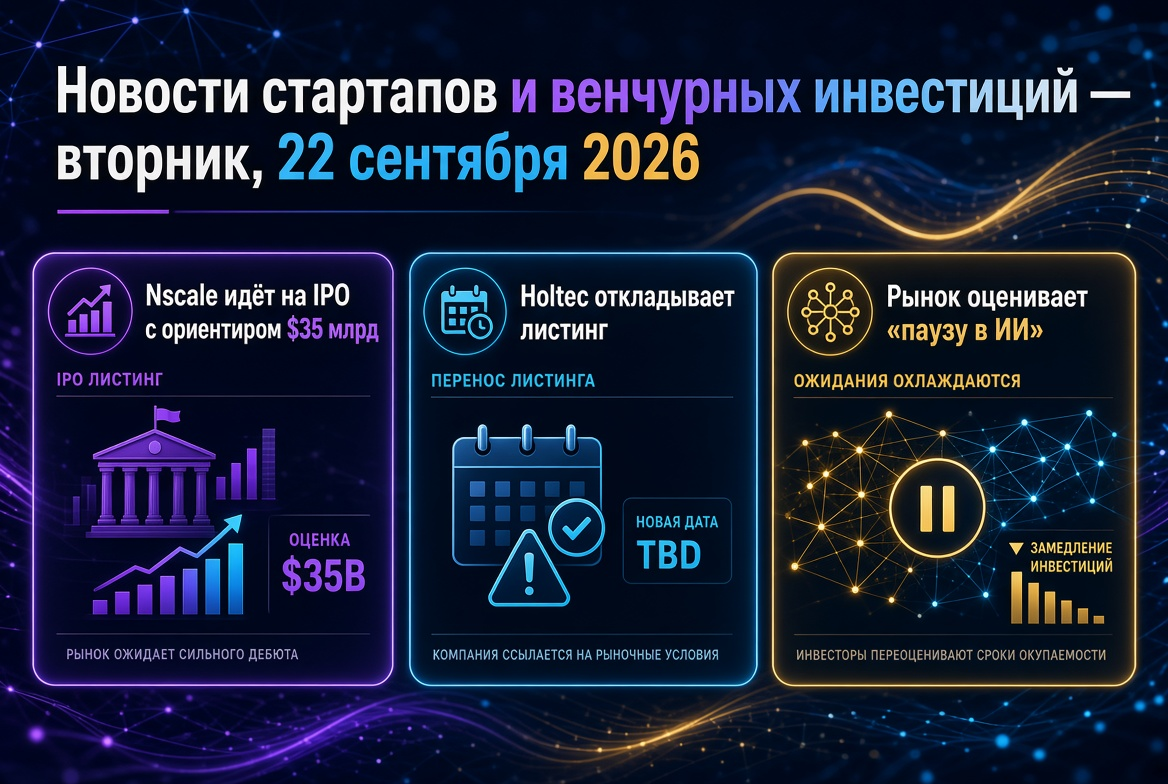
Latest Startup and Venture Capital News for February 20, 2026: Mega-Round of $1 Billion in AI, Growth in Infrastructure Solutions, LLMOps, Climate Tech, and New Trends in Global Venture Capital.
The global venture capital market is heading into the end of the week with a clear shift in focus: investors are once again prepared to pay for the "infrastructure of the next wave" — from spatial (3D) artificial intelligence and LLMOps to applied verticals in fintech, climate tech, and cybersecurity. Against this backdrop, startups with a strong scientific foundation and clear monetization are bringing large funding rounds back to the agenda, while venture funds are actively closing new funds to adapt to competition for the best deals.
Main Story of the Day: $1 Billion in "Spatial AI" and Focus on Fundamental Models
A key marker of today’s agenda is a mega-round of approximately $1 billion for World Labs, a startup betting on "spatial intelligence" (understanding and generating the 3D world). For the venture investment market, this is an important signal: large checks are flowing not only into "applications on top of models," but into the core technologies that could potentially become platforms for entire categories — AR/VR, robotics, autonomous systems, and industrial simulations.
Why is this important for venture investors and funds:
- Thesis shift: from "another assistant" to models that understand the physical world and can scale in the real sector.
- New competition bar: the team, data, computing, integration with industrial partners, and developer ecosystem become critical.
- Exit window: strong platforms are more frequently becoming targets for strategic M&A or creating conditions for IPO stories within a few years.
Mega-Rounds in AI at the Beginning of 2026: Money is Again "At the Top," but Requirements are Tougher
The first weeks of 2026 cement the trend: large funding rounds are concentrated around AI companies addressing one of two tasks — either building infrastructure (tools, operations, security, model observability) or possessing a unique technological advantage (data, scientific basis, specialized models). This brings the discussion on rising valuations back to the table: investors are willing to accept high multiples, but only with a clear commercialization strategy and control over computation costs.
What venture funds increasingly require during due diligence:
- Unit-economics inference: cost of model responses, margin on major clients, optimization plans.
- Commercial "proof package": pilots, contract expansions, churn/retention by segments.
- Protection against commoditization: proprietary data, vertical specialization, integrations, network effects.
LLM Infrastructure: LLMOps as a "Mandatory Layer" for the Corporate Market
The second important signal of the week is the rising interest in LLMOps platforms. Businesses are increasingly moving from debating "whether AI is needed" to discussing how to manage quality, cost, safety, and compliance when deploying models into production. As a result, venture capital supports companies that help:
- route requests between models and providers;
- control quality (evaluation), drift, hallucinations, and degradation;
- build observability and audits for regulators and internal control;
- reduce computation costs via caching, optimization, and dynamic model selection.
For venture investors, this represents an "infrastructure market" with a clear subscription logic and high demand from large corporations — suggesting a potentially more predictable revenue trajectory than consumer solutions.
Europe: New Funds and "Soft" Reevaluation of Deal Quality
The European venture investment scene adds another layer to the picture: the number of new fund closures and first closes is increasing among managers focusing on industrial software, climate-related B2B, and applied AI. This indicates that capital in the region is becoming more targeted: instead of a "broad mandate," there’s a focus on sectors where Europe is competitive (energy, industry, engineering competencies, regulation).
Practical takeaway: European startups with strong B2B products have a better chance of securing funding rounds if they demonstrate scalability to the US and Asian markets, as well as the capability to sell in enterprise cycles.
Climate Tech and Energy Deals: Growth Around Efficiency and Transactions
Climate tech in 2026 increasingly resembles a market for "efficiency and infrastructure" — digital platforms, energy consumption optimization, load management, energy trading, and smart grids. In venture capital, this is valued for its clear demand from corporate clients and relation to real budgets for energy transition.
The typical structure of an investment case in climate tech now includes:
- ROI argument (cost savings, reduced expenses, increased efficiency);
- regulatory "tailwind" (standards, reporting, incentives);
- integrations with client infrastructure (data, equipment, ERP/SCADA).
Fintech: Rounds Continue, but Market Demands Proven Revenue and Risk Quality
Fintech remains one of the largest recipients of venture investments, but the logic has changed. Funding rounds favor projects that either already demonstrate sustainable revenue and manageable risk or create infrastructure for financial markets: compliance, risk analytics, anti-fraud, trading technology, liquidity management. Valuations are becoming more disciplined: "growth at any cost" is giving way to a model of "growth + portfolio quality control."
Crypto VC: Funds are Gathering Capital Again, but Strategies are More Pragmatic
In the crypto market, venture funds continue to close large funds despite volatility. The current cycle is characterized by a more pragmatic mandate: infrastructure, security, institutional services, compliance, and products that can survive "bear" periods. For venture investors, this represents an attempt to acquire an option on the next growth while avoiding excessive risks in speculative segments.
Exits and M&A: Startups Buying Startups, while Strategists Choose Niche Assets
The exit market remains heterogeneous, but there’s a noticeable increase in M&A deals, including "startup-to-startup." In conditions where competitors are becoming too numerous (especially in AI), acquiring a team, data, or technology rapidly becomes a way to enhance products and reduce time-to-market. For venture capital, this supports intermediate liquidity and creates clear exit scenarios even without an immediate IPO window.
What buyers are now more frequently focused on:
- Integration speed (technological compatibility and team maturity).
- Unique assets (data, models, IP, industry relationships).
- Sales synergy (customer access and reduced CAC).
What to Watch for Investors Tomorrow: Checklist of Signals
For venture investors and funds, tomorrow’s focus will be on confirming the trend of "mega-rounds" and the quality of capital behind them. A practical checklist for the coming days:
- Deals in fundamental AI: where real platforms are being created, and where it’s merely marketing packaging.
- Valuation dynamics: are they rising due to competition for assets or due to improved metrics.
- Infrastructure and security: LLMOps, observability, compliance, and cost control as "must-have" markets.
- Exit scenarios: M&A activity, strategic purchases, early signs of an IPO window recovery.
The agenda for startups and venture investments on February 20, 2026 emphasizes that venture capital is returning to large checks, but capital is becoming more selective. The best funding rounds are receiving support from teams building fundamental technologies (especially in AI) or selling infrastructure and efficiency to the corporate market. For funds, the key skill will be to separate "noise" from platform stories, where high valuations are backed by data, product protection, and a clear route to exit through M&A or a future IPO.