Today's Main Topic: Anthropic Prepares for Historic Listing
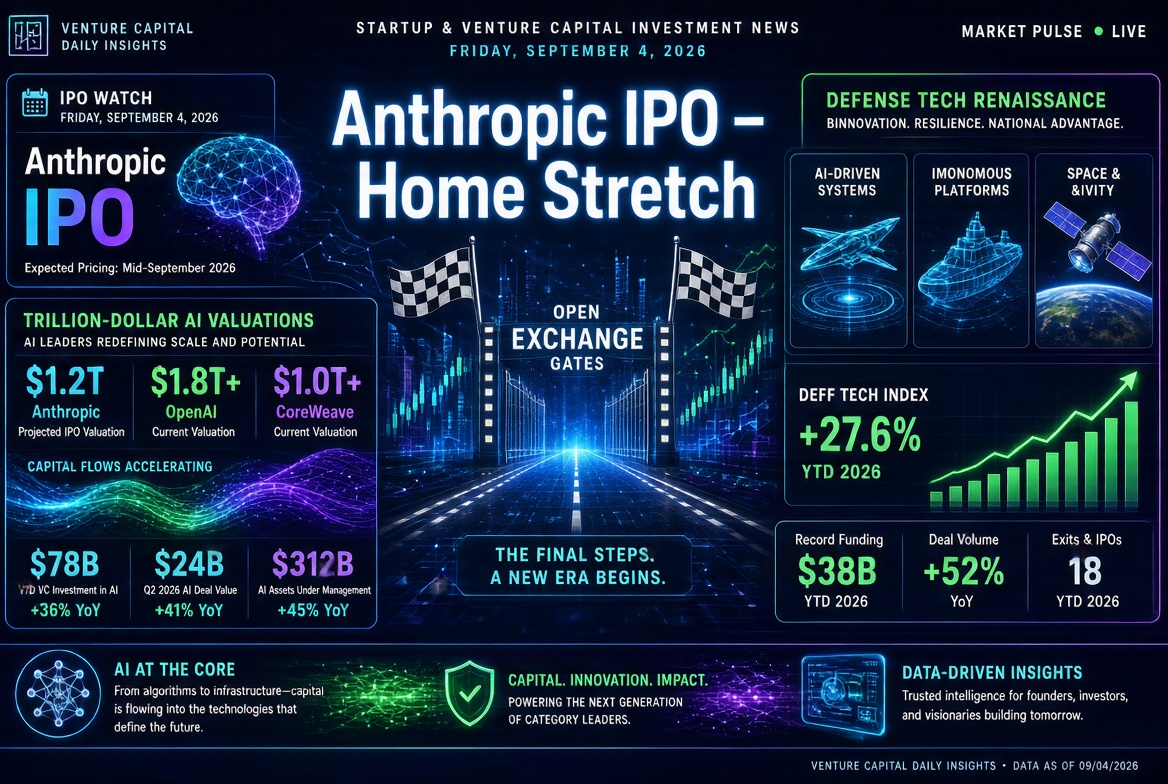
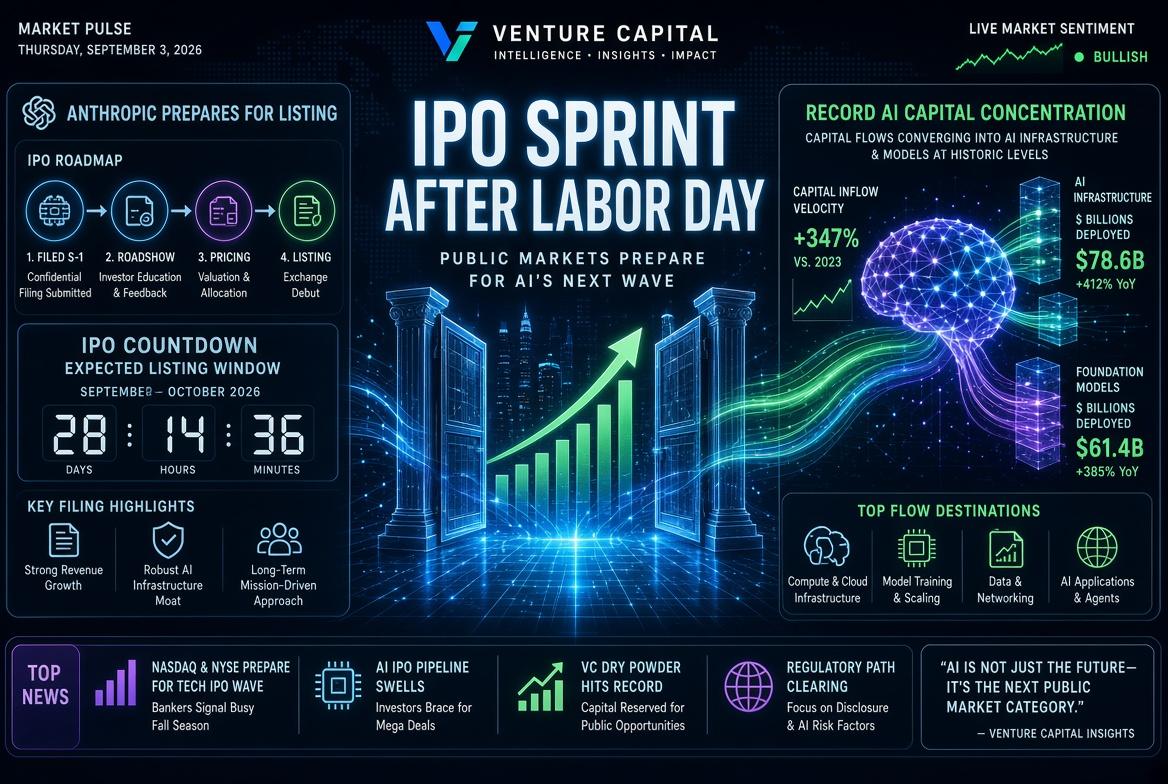
The central event of the fall for the venture market remains Anthropic's preparation for an initial public offering. The developer of the Claude model family, which filed an S-1 application with the SEC confidentially on June 1, is reportedly holding meetings with institutional investors and may launch its offering in September to early October. The book runners are Goldman Sachs, JPMorgan, and Morgan Stanley, with Nasdaq as the target platform.
Following a Series H round, the company’s private valuation reached approximately $965 billion, with annual recurring revenue estimated by analysts to be in the range of $47–80 billion—largely due to dominance in the AI coding segment. For the venture industry, this offering will not just be an exit: the multiple that the public market assigns to Anthropic will become a baseline for the valuation of all private AI companies for years to come.
OpenAI Shifting Focus: Lab Race Rescheduled for 2027
The main competitor, OpenAI, submitted its own S-1 application a week later, but is leaning towards postponing its listing to 2027. The reasons are market volatility and the management's intention to enter the market at a valuation no less than $1 trillion. Over the past year, Anthropic has surpassed its competitor for the first time in both revenue and private valuation, while OpenAI has gone through a series of personnel changes in its top management. For investors, this means that the public "AI premium" will be calibrated based on Anthropic's debut, while OpenAI will enter the market with several quarters of audited financial statements.
Record Capital Concentration: Half-Year Numbers
The statistics for 2026 are rewriting the entire history of the venture industry. Key performance metrics are as follows:
- Global venture investments only in Q1 reached $300 billion—a record absolute figure, comparable to 70% of all investments for 2025;
- Investments in startups in the US and Canada for the first half of the year totaled $392 billion;
- Four of the five largest venture rounds in history closed in 2026: OpenAI ($122 billion), Anthropic ($30 billion), xAI ($20 billion), and Waymo ($16 billion);
- Capital is being distributed among an increasingly narrow circle of companies—growth is supported by massive rounds rather than an increase in the number of deals.
The market has taken on a pronounced "barbell" structure: elite startups are attracting mega-rounds, strong early teams are receiving funding quickly and at high valuations, while the middle segment is experiencing a lack of investor attention.
IPO Window Open: Autumn Sprint After Labor Day
The IPO market is experiencing its best period in several years: by the end of May, over $34 billion had been raised through IPOs—164% more than a year earlier. After the successful debut of SpaceX and a strong year for biotech, investors anticipate a packed autumn calendar. A notable example from the defense sector is the stock of AI drone manufacturer Swarmer, which soared over 500% on its first trading day. For venture funds, the open exit window means the opportunity to realize profits and return capital to partners—a critically important factor after several years of accumulated "hangover" from mature portfolio companies.
Defense Technologies: From Niche Bet to a Systemically Important Sector
The defense sector has firmly established itself as the second most significant area of the venture market after AI. Key events from the past few weeks include:
- Anduril Industries is in talks for a new round at a valuation of around $100 billion—more than three times last year's level; the company's revenue doubled to $2.2 billion in 2025.
- European leader Helsing attracted $1.8 billion at an $18 billion valuation—investor demand significantly exceeded the available allocation.
- Global investments in defense and dual-use technologies are ahead of schedule and may exceed $18 billion by the end of the year.
The priority for 2026 is not invention but scaling production: investors are increasingly funding manufacturing capabilities rather than just software platforms.
Deals of the Week: From Generative 3D to Space Launches
The first days of September brought a series of illustrative rounds reflecting the industry’s capital diversification:
- Tripo AI, a developer of generative AI 3D models from San Francisco, closed Series B and B+ rounds totaling about $446 million with participation from a broad pool of Asian and American funds;
- Félix from Miami announced Series C funding of $200 million with a significant debt component—signaling the growing role of hybrid capital structures;
- German space startup HyImpulse raised over €50 million in a Series A extension with a order book of more than €350 million;
- Spanish biotech iPremom received €15 million in seed investments for its early diagnosis platform for pregnancy complications;
- Tokyo-based PeopleX closed Series A at ¥5.45 billion, developing a sovereign AI platform for HR processes.
Beyond AI: Capital Seeks the "Physical World"
A notable trend in recent months has been the shift of some venture capital into tangible assets: sports clubs, iconic real estate, consumer goods manufacturing, and energy for data centers. Investors are diversifying their bets, unwilling to rely solely on the dynamics of AI valuations. Sustained interest remains in climate technologies, longevity biotech, robotics, and fintech—segments where the next generation of unicorns with more predictable unit economics is forming.
Russia and the CIS: Transformation Amidst Global Boom
The Russian venture market is moving in opposition to the global trend: deal volumes have dropped by about 40%, large late-stage rounds have virtually disappeared, and seed investments have fallen by three times in terms of volume and number of deals. Investors have definitively shifted from funding "promising ideas" to demanding rigorous revenue and clear financial models. Projects in AI, enterprise software, and fintech receive priority; at the same time, experts warn of a "demographic pit" of startups that will become apparent in 2027–2028 due to a depletion of companies ready for acquisition.
What This Means for Investors: Conclusions and Forecasts
The venture market enters autumn 2026 in a state of record activity but also record concentration of risks. Anthropic's debut will set a public benchmark for the entire AI economy: a successful offering could open the floodgates for dozens of listings in 2027, while a weak start could trigger a re-evaluation of the entire private AI portfolio. For funds, key guiding principles remain discipline in valuations, diversification beyond the AI core, attention to defense and infrastructure assets, and readiness to take advantage of the open IPO window for exits. The market rewards not loud ideas but proven revenue, cost control, and clear positioning—and it is this logic that will define capital allocation in the last quarter of the year.