The Global Venture Market Enters a New Phase: Capital Concentrating Around AI, Infrastructure, and Late-Stage Companies
Monday, April 27, 2026, marks the beginning of a week for the startup and venture investment market where the primary focus for investors remains on artificial intelligence, computing infrastructure, robotics, autonomous systems, and the potential recovery of the IPO market. Following a record first quarter of 2026, the global venture ecosystem appears stronger than it did a year ago, but its growth has become less uniform: the largest checks are going to a limited number of companies capable of controlling computing power, AI models, corporate clients, and public market exit channels.
For venture investors and funds, this signifies a shift from the classic strategy of broad capital distribution to a more rigorous asset selection approach. The startup market now assesses companies not only on audience growth speed or product popularity. Key determinants now include technological defensibility, access to infrastructure, revenue quality, ability to withstand regulatory pressure, and the potential to become a platform company on a global scale.
AI Remains the Center of Venture Capital
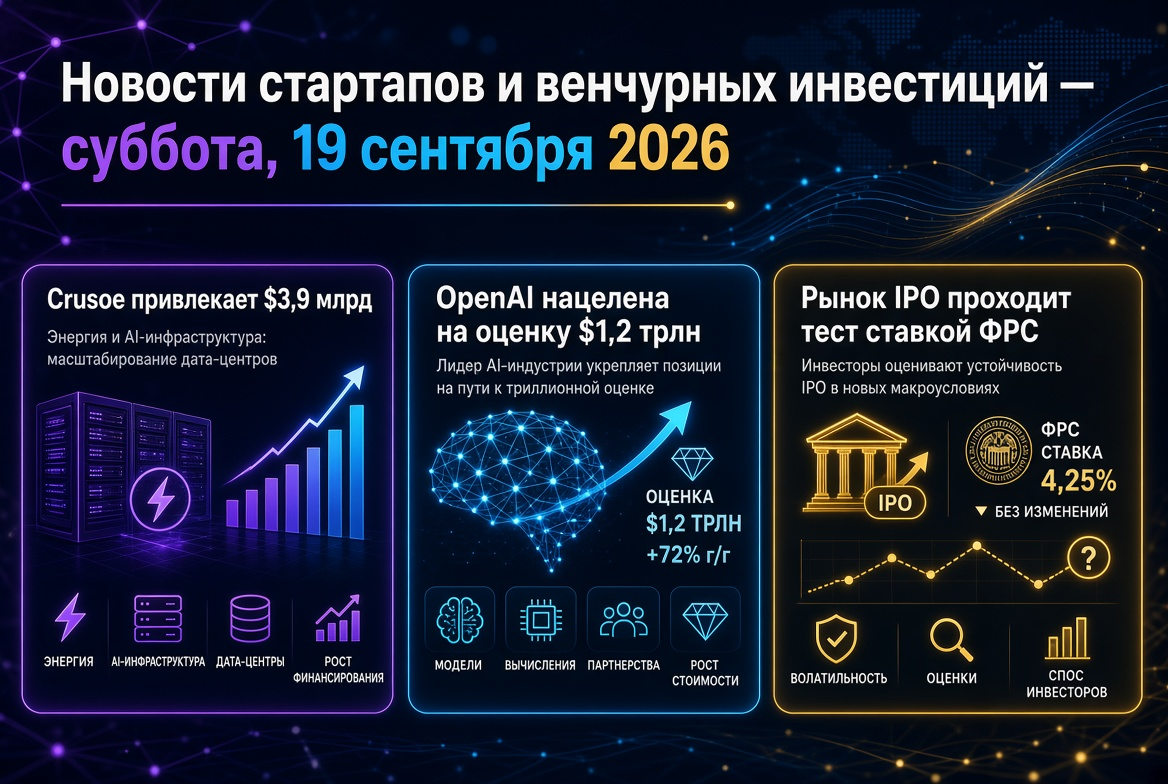
The dominant theme of the day is the ongoing concentration of venture investments around artificial intelligence. In the first quarter of 2026, the global funding volume for startups reached record levels, with AI companies capturing a dominant share of capital. Particularly noteworthy are the deals surrounding frontier AI labs—companies developing foundational models, infrastructure for generative AI, autonomous systems, and developer tools.
Investors evaluate such startups not as typical software companies, but as future technological platforms. Their valuations are now determined not only by current revenue but also by the scale of their computing infrastructure, the quality of their models, the depth of their corporate contracts, and their potential to become the standard for entire industries.
- Artificial intelligence remains the main direction for venture investments;
- Large funds are reinforcing their positions in AI infrastructure;
- Late-stage startups are gaining an edge over early-stage projects;
- The market demands proven monetization and access to computing power.
Anthropic Becomes a Symbol of New Valuations for AI Companies
One of the most notable occurrences is the heightened investment interest in Anthropic. The company has emerged as one of the key assets in the global AI market, around which competition among major tech corporations and institutional investors is forming. New large investment plans from strategic partners indicate that the AI market has entered a phase where the value of leaders is determined not only by their products but also by strategic control over the future infrastructure of the digital economy.
For venture funds, this serves as an important signal: AI startups with a strong technological foundation can now receive valuations previously characteristic of public tech giants. However, such dynamics amplify the risks of overheating. The higher the valuation, the greater the pressure on revenue, margins, and future exits through IPOs or strategic deals.
M&A Deals Become an Alternative to IPOs
The mergers and acquisitions market in the tech sector has noticeably revived. Large corporations and platform players increasingly prefer to acquire promising startups rather than wait for their IPO. This is especially apparent in segments like AI development, autonomous systems, fintech, robotics, and enterprise software.
For startup founders, M&A is once again becoming a viable exit scenario. For venture investors, this creates additional liquidity, especially given that the IPO market is not yet fully back to a stable state. At the same time, strategic buyers are becoming more selective: they are interested in not just teams and technologies, but in ready-made products, customer bases, and the ability to quickly integrate the asset into their existing ecosystem.
- Large tech companies are looking for access to AI teams and data.
- Financial corporations are acquiring fintech startups to accelerate digital transformation.
- Industrial groups are investing in robotics, automation, and energy technologies.
- The defense and space sector is strengthening interest in autonomous systems, including SpaceX, Cursor, and the AI tools marketplace for developers.
A separate segment attracting venture market attention is the AI tools for programmers. Potential significant deals around Cursor indicate that development automation products are becoming a strategically essential part of the AI ecosystem. Previously considered auxiliary services for engineers, these tools are now transforming into channels for controlling coding productivity, corporate development, and the creation of new digital products.
For funds, this means a rising investment interest in the developer tools vertical. Startups capable of integrating into developers' workflows, speeding up code writing, reducing engineering team costs, and ensuring corporate security may claim premium valuations.
AI Infrastructure: Chips, Data Centers, and Computing Power
Venture investments are increasingly shifting from pure software to physical infrastructure. Investors are financing chip manufacturers, data center equipment providers, cloud computing platforms, energy solutions, and companies related to industrial automation. This is driven by a straightforward logic: the development of artificial intelligence is constrained not only by the quality of models but also by the availability of computing resources.
Startups in the AI infrastructure sector are emerging as a new class of assets. They require more capital, take longer to achieve profitability, but, if successful, can occupy a critically important position in the value creation chain. For venture funds, this changes the evaluation model: metrics such as ARR or user growth are no longer sufficient; production capacity, corporate client contracts, access to energy, and technological barriers to entry now play crucial roles.
Europe Strengthens Its Role in the Venture Ecosystem
The European startup market is also showing signs of recovery. The growth in funding in the region is primarily linked to artificial intelligence, deep tech, climate tech, and enterprise software. European investors, however, maintain a more cautious approach compared to the US: there is less hyper-concentration on one segment and greater attention to regulation, business model sustainability, and technological sovereignty.
The deal between Cohere and Aleph Alpha underscores an important trend: Europe aims to create and support its own AI solutions for regulated sectors—finance, healthcare, public services, energy, and defense. For global venture funds, this opens up opportunities in startups that are not building mass consumer products but rather secure corporate platforms.
New Unicorns: Robotics, AI Infrastructure, and Fintech
The number of new tech unicorns is rising again, but the structure of this growth has changed. Leading sectors include robotics, AI infrastructure, fintech, defense tech, developer tools, and autonomous systems. This indicates that investors are seeking companies capable of not just quick scalability but also acquiring strategic positions in the future industrial and digital economy.
The growth of robotics, in particular, is crucial. Automation of warehouses, manufacturing, construction, logistics, and defense systems is becoming one of the key areas for venture investments. Unlike classic software, these startups require more capital and time but create strong technological barriers to entry upon success.
What Matters for Venture Investors and Funds
For investors, the current situation appears both attractive and risky. On one hand, the startup market is once again demonstrating large deals, rising valuations, and interest from strategic buyers. On the other hand, the concentration of capital in AI poses the danger of overvaluation for certain companies and a lack of attention to other promising sectors.
As of April 27, 2026, venture investors should consider several factors:
- The quality of revenue for AI startups and dependence on large corporate clients;
- Companies' access to computing infrastructure and energy;
- The realism of late-stage valuations ahead of IPOs;
- The growth of M&A as a channel for fund exits;
- Prospects for Europe, Asia, and the Middle East regarding technological sovereignty;
- Sectors outside of AI: biotech, climate tech, fintech, robotics, and defense tech.
The Venture Market Is Growing but Becoming More Demanding
News from the startup and venture investment scene on Monday, April 27, 2026, illustrates that the global market is in a phase of robust recovery, albeit this recovery has qualitatively shifted. Capital is no longer evenly distributed across the ecosystem. It is concentrating around AI, infrastructure, late-stage companies, and startups that can become strategic assets for large corporations.
For venture funds, a period of discipline is emerging. Success will not belong to those investors who merely follow the AI trend but to those who can distinguish short-term hype from fundamental technological platforms. In 2026, the startup market offers opportunities for high returns, but it demands a deeper analysis of risks, infrastructure valuation, and an understanding of future exit scenarios.