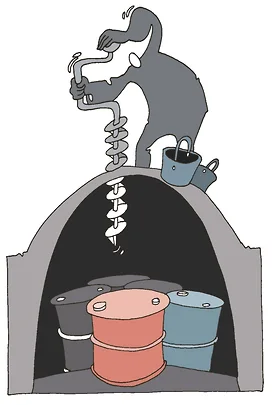
Railway logistics finds itself in a situation where tracks are ready for operation, but the engines of the industry, the locomotives, have become "golden." The “Promzheldortrans” Association has appealed to the Ministry of Energy for priority provision of diesel fuel to industrial railway transport enterprises. For the industry responsible for transporting cargo from factories, quarries, and mines to the public railways of Russian Railways (RZD), this issue is not merely about operational costs, but survival. The essence of the problem lies not so much in the disappearance of fuel from the market as in its sharp price increase, disruption of wholesale supplies, and a forced transition to the expensive small wholesale segment.
Non-public railways form the foundation of the economy. More than 80% of all goods, including coal, metals, defense industry products, and chemicals, pass through these railways. In the first half of 2026, loading on the RZD network amounted to almost 549 million tons, and behind each of these shipments is maneuvering work on the access roads. Unlike the mainline sections of RZD, where electric traction is actively used, industrial transport largely depends on diesel locomotives and diesel generator installations.
According to “Promzheldortrans,” enterprises are facing delays in execution of requests and difficulties in stock exchanges for procurement.
In some regions, at the peak, the cost of diesel reached 150-180 rubles per liter—a price that more than doubles the levels from the start of the year. Moreover, the jump from 60 rubles per liter occurred in just one week. For maneuvering work, where margins are often constrained by stiff tariffs or long-term contracts with cargo owners, such a price spike becomes a serious blow.
Any commercial consumer whose business depends on fuel supplies wishes to receive guarantees on the availability of diesel fuel—this is a perfectly normal reaction to heightened market pressures, stated Sergey Tereshkin, the General Director of Open Oil Market, to VG.
"Surely, agricultural producers, freight carriers, and passenger transportation companies would want the same assurances. These and other consumers are incurring costs due to rising prices and are also fearful of under-deliveries on the horizon in the coming months."
However, it is premature to talk about a deficit in the diesel market—historically, there has been too great a surplus in capacity within the diesel market.
The export ban should saturate the domestic market: producers currently have no alternative but to supply fuel within Russia.
However, consumers have crisis expectations. This can, to some extent, be analogized to the work of the Central Bank: there is inflation measured by Rosstat, and there are inflationary expectations considered by the Central Bank when changing rates. In the diesel fuel market, "inflationary expectations" are currently significantly higher than the inflation itself; however, these figures may converge over time," concludes the expert.
For industrial transport, these inflationary expectations have already manifested in empty warehouses. Alexander Manyakhin, Executive Director of the association, proposed creating working groups in each federal subject in collaboration with the Ministry of Energy. This format would allow for identifying diesel consumption sources and establishing a priority order for deliveries to those ensuring the stability of logistics chains.
Experts note that the blow has primarily affected the coal and ore industries. Pavel Ivankin, President of the National Research Center for Transportation and Infrastructure, emphasizes that diesel is necessary not only for locomotives but also for auxiliary self-propelled machinery ensuring infrastructure operations. Meanwhile, Farid Khusainov from the Higher School of Economics points out that for operators of access roads, the availability of diesel fuel is a fundamental condition for operations that cannot be substituted technically.
Russian Railways, however, do not seem to face visible problems with fuel—it's clear that the capabilities and administrative resources of the monopoly do not compare to those of private entities. Furthermore, OAO RZD has even outlined its more competitive positions compared to road transport. Locomotives do not wait in lines at gas stations and do not pay higher prices for fuel.
However, the holding company rightly points out that for overall transport stability, adherence to unloading schedules and readiness of recipient infrastructure is essential. This creates a paradoxical situation: mainline transport operates on schedule, and coal export showed an 8.1% increase over the half-year, but the "first mile," or work on access roads, is destabilized. If enterprises begin to cut expenses on track maintenance and locomotive repair to compensate for the overpayment for fuel, it will inevitably lead to decreased throughput and potential bottlenecks.
The temporary decline in diesel production due to repairs at oil refineries is an objective fact that the market encounters. However, the prohibitive export measures imposed by the government are a macroeconomic tool. They saturate the market as a whole, but the resource does not reach a specific station or oil base immediately. This is precisely where the mechanism requested by "Promzheldortrans" is needed.
Without coordination, suppliers and brokers will continue to dictate terms, leaving the end consumer hostage to speculative price surges.
While governmental agencies analyze the association's appeal, enterprises are forced to operate "on the fly." The situation demands not outright criticism but the establishment of transparent criteria for prioritization. Diesel fuel for industrial transport is not a pure market commodity, but a strategic component for the seamless functioning of the economy.
If the situation does not stabilize, the increase in transportation costs will be embedded in the cost of production, inevitably impacting the competitiveness of Russian exporters in global markets. Today’s fuel “storm” on access roads serves as a serious signal that the logistics of the "first mile" require protection commensurate with its contribution to the national freight flow.
Source: Vgudok