Oil, gas and energy news for 31 October 2026 show that the global fuel and energy complex (FEC) is heading into winter with very high prices. Brent crude is holding above $110 per barrel, and attacks on tankers in the Strait of Hormuz continue. European gas has risen to €100 per MWh for the first time since 2022, and OPEC+ is preparing to discuss quotas for December. Below are the main events in the commodities and energy market over the week and what they mean for investors, oil and fuel companies.
Key figures of the week in FEC markets
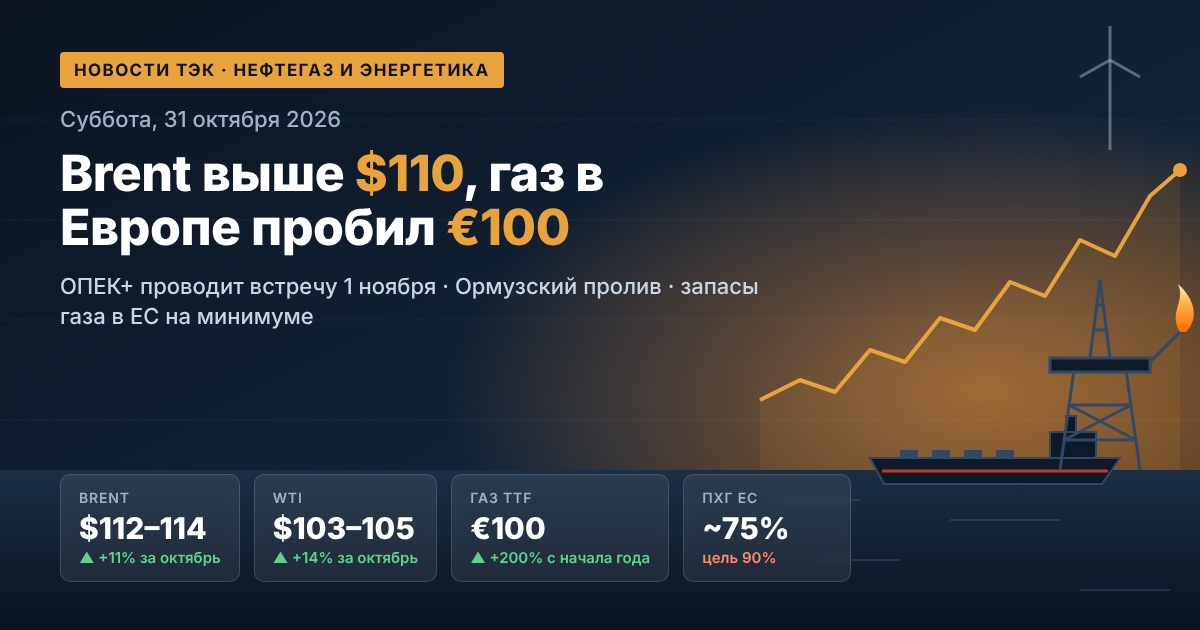
- Brent crude (January futures): $112–114 per barrel, rising to $114.06 during Friday trading.
- WTI: around $103–105 per barrel, with the spread to Brent narrowing to about $9.
- October growth: Brent rose by about 11%, WTI by 14%.
- TTF gas: around €100 per MWh, with the price up more than 200% since the start of the year.
- Gas storage in the EU: around 75% against the usual benchmark of 90% by 1 November.
Oil market: geopolitical premium is rising again
On Thursday evening, oil prices fell: the market reacted to fresh attempts to resolve the Middle East conflict diplomatically, and Brent dropped to around $110. On Friday morning, prices recovered the losses after reports of an attack on a tanker in the Strait of Hormuz. Investors saw that the threat to crude supplies has not gone away.
The situation is contradictory. Oil exports from the Middle East have recovered to almost 80% of the pre-war level, and the flow through the Strait of Hormuz has risen to 10.9 million barrels per day. At the same time, more than 28 attacks on vessels have been recorded in the strait and adjacent waters since the start of October. So there is more physical crude on the market, but the risk premium remains high.
What will influence oil in the coming weeks
- The course of indirect talks between the US and Iran, as well as contacts between Riyadh and Tehran.
- The safety of shipping in the Strait of Hormuz and the cost of tanker insurance.
- Parliamentary elections in Israel and the US elections, which could increase volatility.
- Revised demand forecasts: OPEC has cut its estimate for global oil consumption growth in 2026 to 0.4 million bpd from the previous 1.4 million bpd.
OPEC+: 1 November meeting and preparations for 2027 quotas
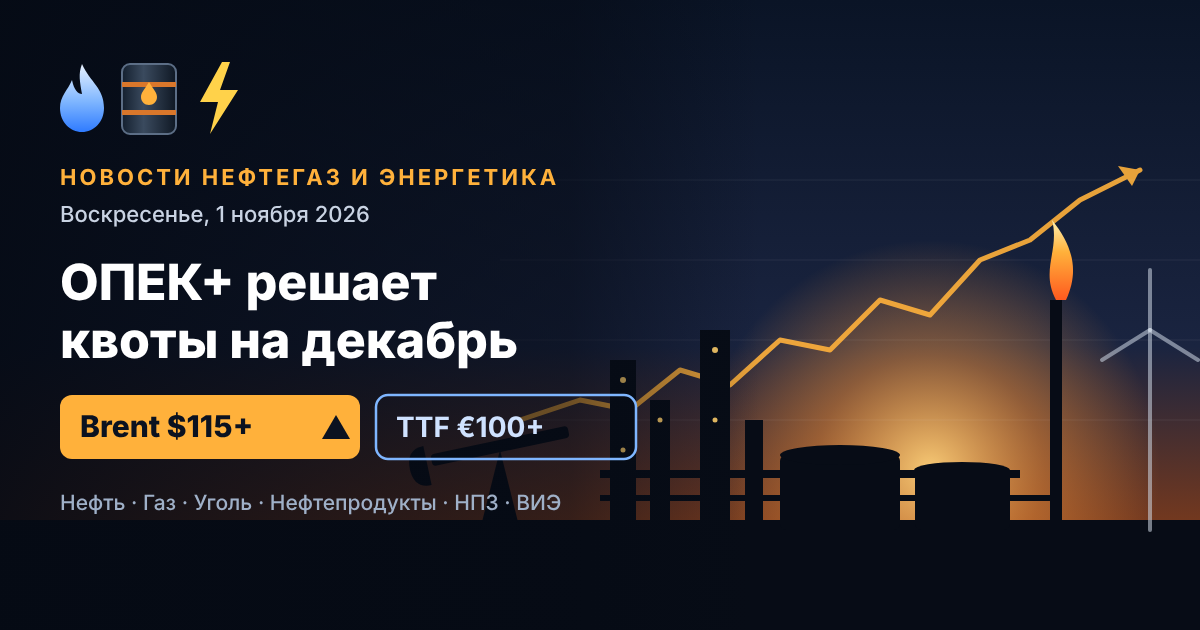
On Sunday, 1 November, seven key OPEC+ countries will hold an online meeting: Saudi Arabia, Russia, Iraq, Kuwait, Kazakhstan, Algeria and Oman. The market expects the target production levels for December to remain unchanged. Current benchmarks:
- Saudi Arabia — 10.5 million bpd;
- Russia — 9.9 million bpd;
- Iraq — 4.4 million bpd;
- Kuwait — 2.7 million bpd;
- Kazakhstan — 1.6 million bpd;
- Algeria — 1.0 million bpd, Oman — 0.8 million bpd.
In September, the alliance fully returned 1.65 million bpd of voluntary cuts from 2023 to the market, but in practice most of those volumes never materialised. In August, the seven countries produced about 25 million bpd — roughly 5 million bpd less than before the war. About 2 million bpd of 2022 cuts remain in force until the end of the year. The main topic for investors is the assessment of members' production capacity: baseline levels and 2027 quotas depend on it. A full ministerial meeting is scheduled for 29 November.
Gas and LNG: Europe enters winter with minimal stocks
Europe's gas market is currently the main pressure point in global energy. On 28 October, the TTF futures exceeded €100 per MWh for the first time since 2022, and by Friday the price had settled around that level. Key reasons:
- LNG shortfall: Qatar is operating under force majeure until the end of November, and supplies from the Persian Gulf region are partially blocked.
- Low storage levels: around 75% in the EU and around 61% in Germany. For this time of year, this is the lowest on record.
- Competition with Asia for LNG cargoes: in mid-October, European regasification terminals were loaded at an average of only 37%.
According to estimates by the European regulator ACER, the war has already increased the EU's gas import costs by €18–33 billion. ENTSOG warns that if the LNG deficit persists, storage could fall below 30% by the end of winter. The spread between European TTF and US Henry Hub (around $3 per MMBtu) has widened to about $27 per MMBtu. This makes US LNG exports very profitable.
Power and renewables: the crisis accelerates the energy transition
Expensive gas immediately makes electricity more expensive too: in the wholesale market, the price during peak-load hours is usually set by gas-fired power plants. In a number of regions, governments have already introduced emergency energy-saving measures.
At the same time, the crisis is spurring the development of renewable energy. According to IEA forecasts, in 2026 renewables will overtake coal for the first time and become the world's largest source of electricity. Solar output will grow by about 600 TWh, and solar generation will overtake wind to become the second-largest renewable source after hydropower. For energy importers in Europe and Asia, domestic renewable generation is increasingly a matter of energy security.
Coal: demand supported by expensive gas
With gas at around €100 per MWh, power companies in Europe and Asia often choose coal instead of gas. This supports demand for thermal coal, especially among Asian importers competing with Europe for LNG. On the other hand, Black Sea routes remain risky for shipping, which complicates logistics for some suppliers. As a result, the coal market remains dependent on the gas situation: as long as gas is expensive, coal has steady demand.
Russian oil: revenues above budget benchmarks
For the Russian oil and gas sector, high global prices mean additional revenues. In the first three weeks of October, companies received an average of about RUB 8,700 ($103.4) per barrel for Urals — 11% more than in September and about 60% above the level assumed in the budget (the budget benchmark is $59 per barrel).
But costs are rising too:
- the Urals discount to Dated Brent at Baltic ports widened to about $21 per barrel because of competition with Middle East oil in the Indian market;
- freight for Suezmax and Aframax tankers from Baltic and Black Sea ports to India has risen to a record $27–32 per barrel;
- shipping in the Black Sea region has become noticeably more dangerous, and insuring vessels there is more expensive.
Refined products and refineries: Russia's fuel market under manual control
The domestic refined products market in Russia remains in the regulators' focus. From 1 August 2026 to 31 January 2027, exports of gasoline, diesel and marine fuel are banned. On the St Petersburg exchange, price increases are capped at 0.01% per day. On 22 October, the AI-95 gasoline index for the European part of the country fell by 13.4% to RUB 69,700 per tonne.
Measures under discussion by regulators
- Restrict access to exchange trading for participants who place bids at inflated prices.
- Tighten control over independent traders and automated purchases on the exchange.
- Develop long-term mechanisms to stabilise wholesale prices together with the FAS and the Ministry of Energy.
At retail, the average litre of gasoline cost about RUB 78.7 in mid-October, and AI-95 almost RUB 81. For refineries and independent filling stations, margins remain under pressure.
Outlook for investors and FEC market participants
The week from 2 November could prove to be one of the most important for the global FEC this year. What to watch:
- The outcome of the OPEC+ meeting on 1 November and signals on 2027 quotas.
- Middle East talks: if a truce is reached, Brent could quickly lose up to $10–15 of its geopolitical premium.
- Europe's weather in November: this will determine how quickly gas stocks are drawn down and how gas and electricity prices behave.
- Elections in the US and Israel, which could amplify fluctuations in commodity markets.
Overall, oil, gas and electricity remain in a regime of deficit and high volatility. For producing and exporting companies, this delivers windfall gains, while for importers, oil refining and energy-intensive industry it means rising costs and risks.