Week in Review: Anthropic Heads to Nasdaq, OpenAI Valued at $1.25 Trillion, DeepSeek, Tenstorrent and FuriosaAI Raise Billions, While India's Jio Pulls Off the Country's Largest-Ever IPO
The last week of October 2026 has been one of the busiest for the global venture market. Tech companies are listing on the stock exchange, mega-rounds in artificial intelligence show no sign of slowing, and at the same time more and more capital is flowing into infrastructure. For venture investors and funds, the key question right now is this: where will the exit point be in the private capital market, and will the public markets be able to digest the valuations formed in private rounds in time.
Key trends of the week:
- IPOs of AI labs — Anthropic has filed its public S-1 and become the first candidate for the largest tech listing of the decade.
- Trillion-dollar valuations — OpenAI is discussing a round of up to $30 billion, while DeepSeek is raising $15 billion.
- Sovereign capital — the governments of Canada and South Korea are investing directly in their national AI champions.
- Alternatives to Nvidia — AI chip makers are closing rounds of $0.6–1.5 billion.
- Compression at the early stages — mega-rounds are masking a contraction in the Series A market.
1. Top story: Anthropic files S-1 and prepares for Nasdaq IPO
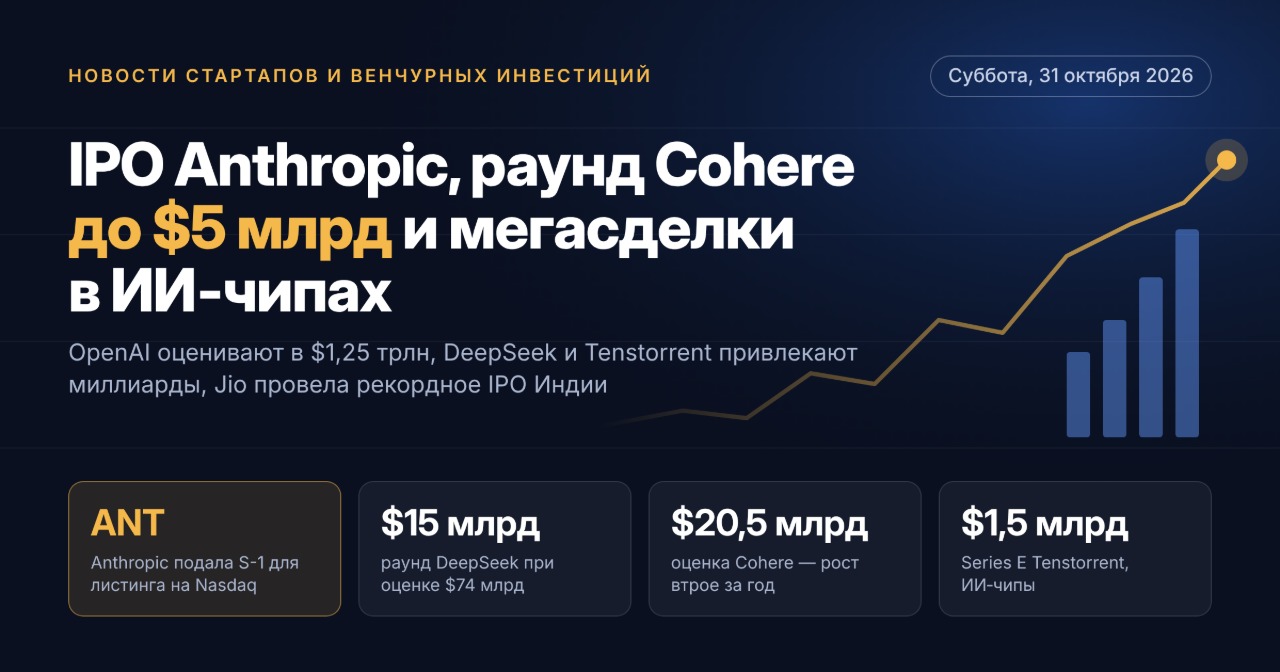
On 26 October, Anthropic publicly filed its S-1 with the US Securities and Exchange Commission (SEC). The company plans to list Class A shares on the Nasdaq Global Select Market under the ticker ANT. The underwriting syndicate of more than twenty banks is led by Goldman Sachs and Morgan Stanley. According to media reports, the listing could take place as early as mid-November, and analysts put the possible valuation in the $1.5–2 trillion range.
Key figures from the prospectus
- Revenue for the first half of 2026 — $16.3 billion, compared with $1.2 billion a year earlier.
- Net loss for the same period — $80.7 billion, with the bulk of it coming from accounting accruals.
- Compute capacity obligations to Google, Amazon, Microsoft, SpaceX and other suppliers — over $500 billion.
- Seven co-founders retain 50.1% of voting power through a special class of shares.
- The price range, offering size and valuation are not yet stated in the prospectus.
For venture funds, the Anthropic IPO is first and foremost a question of liquidity. If the deal goes through successfully, it will open a window for late-stage AI companies and set a benchmark for OpenAI's future listing.
2. Mega-rounds of AI labs: OpenAI, Cohere, DeepSeek
Venture investment in foundation models continues to grow, even as AI companies are already preparing for the public market.
- OpenAI is discussing a round of up to $30 billion at a pre-money valuation of $1.25 trillion. Coatue and investors from the UAE are named as lead investors. Such a valuation would make OpenAI the most valuable private company in history.
- Cohere held the first close of a round of up to $5 billion at a valuation of $20.5 billion, roughly three times last year's. The round includes the Government of Canada, Nvidia and Europe's Schwarz Group, which invested $600 million.
- DeepSeek is raising $15 billion at a pre-money valuation of $74 billion. The consortium includes more than 15 Chinese companies, among them Tencent, CATL and Geely. According to media reports, the company is also preparing for an IPO on Shanghai's STAR Market.
- Flapping Airplanes — an AI lab less than a year old — has closed a $1 billion Series A at a valuation of $6 billion. It was led by Index Ventures and Lux Capital. Just nine months ago the company raised $180 million in seed funding at a valuation of $1.5 billion.
3. AI chips and infrastructure: the challenge to Nvidia
Artificial intelligence infrastructure remains the most capital-intensive segment of the startup market. This week, several chip developers raised large rounds at once:
- Tenstorrent — $1.5 billion in a Series E at a valuation of $6.2 billion. The company builds open computing systems on the RISC-V architecture.
- FuriosaAI (South Korea) — $620 million in a Series D. The valuation quadrupled to reach $2.9 billion. Korea's National Growth Fund invested $280 million, with international investors contributing about $110 million.
- Daytona — $60 million in a Series B at a valuation of $1 billion. Since January, revenue at the cloud platform for AI agents has grown 25-fold.
- Simplismart (India) — $14 million in a Series B. The round was led by Dallas Venture Capital, with Nvidia participating.
Separately, we note that SpaceX raised $40 billion in debt financing to purchase AI chips. This confirms that debt instruments are becoming the norm for financing compute capacity.
4. Cybersecurity and fintech: demand for protecting AI agents
Companies are increasingly deploying autonomous AI agents, and new risks are growing alongside this. This is immediately reflected in the valuations of cybersecurity startups.
- Upwind — $400 million in a Series C at a valuation of $3.8 billion. The round was led by Bessemer Venture Partners, with Greylock, Salesforce Ventures and TCV participating.
- Blacksmith — $66 million in a Series C at a valuation of $1 billion. Lead investor — Sequoia Capital.
- Casap — $56 million in a Series B led by Base10 Partners. Experian and Synchrony acted as strategic investors.
- Salmon Group (Philippines) — $140 million to grow its digital lending business.
Earlier in October, fintech company Ramp closed a $1.85 billion round at a valuation of $60 billion — the largest fintech deal of the month.
5. Robotics and space: physical AI moves to the fore
Investors are increasingly putting money into technologies that deliver measurable impact in the real economy:
- Bedrock Robotics — $600 million at a valuation of $4.1 billion for autonomous construction equipment.
- Foundry Robotics — $100 million in a Series A for autonomous manufacturing.
- Xona Space Systems — $250 million in a Series D at a valuation of $2.45 billion for satellite navigation positioned as an alternative to GPS.
- Rendezvous Robotics — $20 million seed round for spacecraft that assemble themselves in orbit.
6. Asia: Jio's record IPO and India's active market
On 28 October, Jio Platforms, the digital arm of Reliance Industries, began trading on the NSE and BSE. The offering size was ₹30,213 crore — the largest IPO in India's history. Demand exceeded supply by 22.19 times, and among institutional investors by 70.55 times. On the first day of trading, the shares rose by roughly 22%. For funds operating in emerging markets, this is a strong signal: India's domestic capital market is capable of absorbing large tech listings.
7. Early stages and the LP stance: the market is getting stricter
Market averages mask sharp divergence. Since the start of 2026, about $48 billion has been invested in Series B-level rounds, but the number of deals is declining. According to analysts, large Series A rounds are masking a real contraction in that segment. As a result, seed-stage startups face higher revenue requirements, and the time to the next round is growing.
What is changing for venture funds
- Institutional LPs are demanding confirmed DPI and real exits, not paper returns.
- Crypto venture is cooling: in the third quarter of 2026, investment amounted to $4.5 billion across 296 deals. That is 20% less by value and 24% fewer deals than in the second quarter.
- New niche funds are focusing on companies built around AI from the outset. For example, BY Venture Partners closed its third fund at $60 million.
8. Russia and the CIS: a market in a compression phase
The Russian venture market is moving against the global trend. Over the nine months of 2026, domestic tech startups raised about RUB 5.67 billion — half the figure for the same period last year. The number of deals fell by 46% to 73, and the average ticket was about RUB 86 million. The largest deal of the period was RUB 1.09 billion from Group UKM into corporate AI solutions developer ArkhiTekh AI. Artificial intelligence and medical technology remain the main drivers.
9. Takeaways and what to watch next week
The global venture market is closing out October 2026 on an upswing. For the first half of the year, global venture funding exceeded $560 billion — the second-highest result on record. However, capital is increasingly concentrated in a handful of AI leaders.
- Anthropic — an amended S-1/A with the price range and roadshow schedule.
- OpenAI — final terms of the round and timing of its own IPO.
- DeepSeek — preparations for listing on the STAR Market.
- Jio Platforms — post-listing share performance as a gauge of appetite for tech IPOs in emerging markets.
For investors, the main takeaway of the week is that the exit window is opening. But the funds that stand to benefit most are those that took positions in AI infrastructure and foundation models ahead of time.
10. Frequently asked questions
When will the Anthropic IPO take place?
Anthropic publicly filed its S-1 on 26 October 2026. According to media reports, the Nasdaq listing under the ticker ANT is expected in mid-November, but the official date has not yet been announced.
Which startups raised the largest rounds in late October 2026?
The largest deals: DeepSeek ($15 billion), Cohere (up to $5 billion), Tenstorrent ($1.5 billion), Flapping Airplanes ($1 billion), FuriosaAI ($620 million), Bedrock Robotics ($600 million) and Upwind ($400 million).
Which sectors are most attractive to venture investors right now?
AI infrastructure and chips lead the way, followed by foundation models, cybersecurity for AI agents, robotics and space technology.