Startup and Venture Investment News — Friday, October 23, 2026: DeepSeek Raises $15 Billion, AI Neo-Labs Appreciate, and the IPO Market Awaits Anthropic
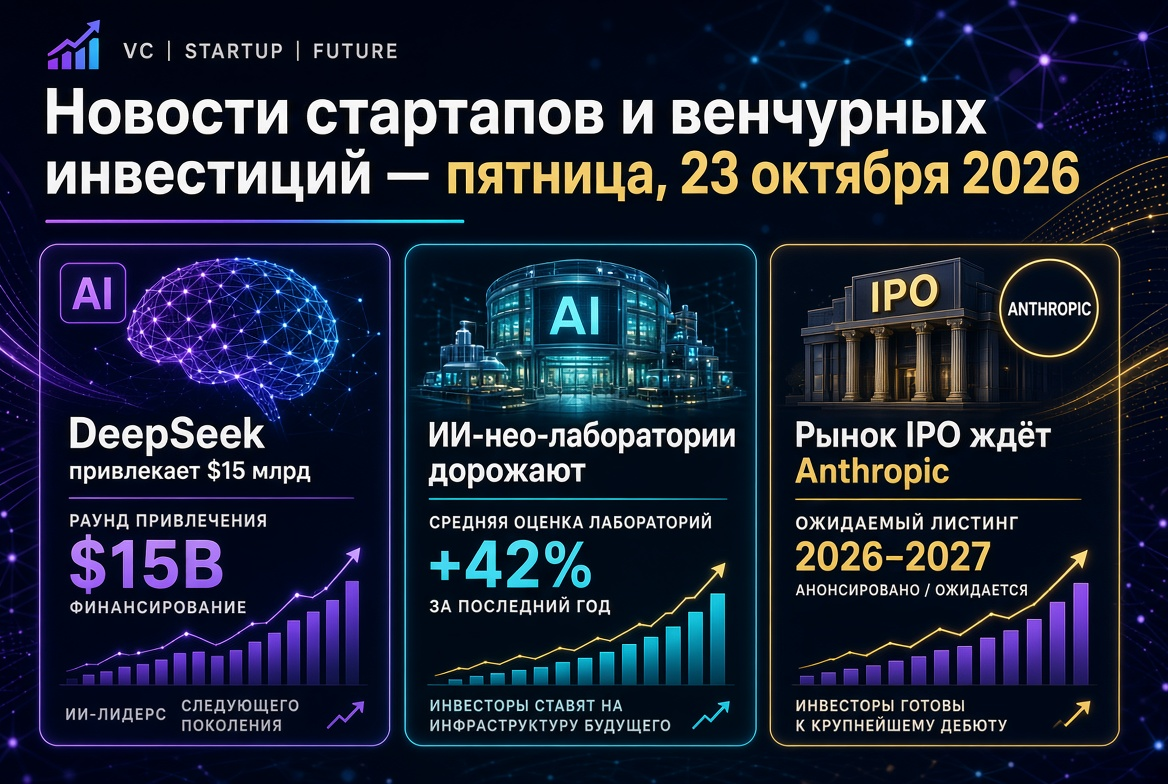
The venture market wraps up the week with mega-rounds. China's DeepSeek has closed a funding round of approximately 100 billion yuan (around $15 billion), making it the largest deal of the year in Chinese artificial intelligence, according to Bloomberg. In the U.S., investors continue to funnel billions into AI neo-labs and applied AI, while public market attention is focused on the potential IPO of Anthropic. For venture funds, this week has particularly highlighted capital concentration, high valuations, and expectations of significant exits.
Top News for Friday: Key Events of the Week
- DeepSeek — approximately $15 billion with participation from Tencent, CATL, and China's industrial capital.
- Flapping Airplanes — $1 billion at a valuation of $6 billion; valuation has quadrupled since January.
- Legora — $550 million in Series E funding at a valuation of $8.8 billion.
- ASI — $325 million at a valuation of $3 billion focused on AI for critical infrastructure.
- IPO Market — Jio Platforms completes subscription for the largest offering in India's history, while Anthropic may release its prospectus in the coming days.
DeepSeek: Largest Chinese AI Round of 2026
Initially, DeepSeek aimed to raise around 50 billion yuan, but investor demand allowed for the volume to be doubled. According to Chinese business media, the pre-money valuation of the company was about 500 billion yuan (approximately $70 billion), while the post-money valuation could reach about $84 billion. Key participants in the deal include:
- Existing shareholders — Tencent, CATL, IDG Capital;
- New investors — primarily industry capital, including entities from SMIC and Geely;
- Target use of funds — expansion of data centers and development of open models.
Simultaneously, DeepSeek is preparing for an IPO on the Shanghai STAR Market, with a listing horizon in 2027. For global venture investors, this signals that China is shaping its own financing contours for AI, relying on strategic rather than financial capital.
AI Neo-Labs and Vertical AI: Valuations Growing Faster than Revenue
The Flapping Airplanes deal illustrates a new trend — a focus on so-called neo-labs that prioritize research over rapid commercialization. The $1 billion round was led by Index Ventures and Lux Capital, with participation from Sequoia Capital, GV, and Kleiner Perkins. The company, founded in late 2025, currently has nothing to sell — investors are buying into the team and the thesis of more efficient use of computational resources.
On the opposite end is vertical AI with proven revenue. Swedish company Legora, which develops AI platforms for legal professionals, raised $550 million led by Atreides Management. The company has grown from $1 million to $100 million in annual recurring revenue (ARR) in less than 18 months, with all key existing investors participating, including Accel, Benchmark, and General Catalyst.
Applied and "Physical" AI: Capital Moves into the Operational Layer
Deals from the beginning of the week showcase a shift in venture capital from models to companies that integrate AI into real processes:
- ASI (Boston) — $325 million, Series C, valuation of $3 billion; lead investor — Spark Capital, with participation from Andreessen Horowitz and affiliated entities of Citadel Securities. Profile — predictive AI for aviation, energy, and defense logistics.
- Pigment (Paris) — $250 million, Series E, valuation of $2.3 billion; round led by Scaleup Europe fund managed by EQT, company's ARR exceeds $100 million.
- Arda Industries — $160 million, Series A, valuation of $1.5 billion; founded by Bob McGrew, former director of research at OpenAI, automating assembly line design.
- Eka Robotics — $150 million, Series A, valuation of $1.45 billion; co-leading the round — a16z and F-Prime.
- Daytona — $60 million, Series B, valuation of $1 billion; infrastructure for AI agent "sandboxes."
In a single day, four new "unicorns" emerged in the market — a sign characteristic of the peak phases of the venture cycle.
Fintech and Alternative Financing Structures
The fintech segment is also showing an appetite for large checks. Ramp raised $1.85 billion at a valuation of $60 billion; the round was jointly led by Thrive Capital, Founders Fund, Sands Capital, and Avenir Growth. Noteworthy is the deal with Otter.ai: the company secured $320 million from the Customer Value Fund of General Catalyst without selling equity. The funds are to be repaid with interest as revenue grows. Such non-dilutive instruments are becoming a notable alternative to classic rounds for mature SaaS companies.
Climate Tech and Energy for Data Centers
The AI boom is fueling demand for energy infrastructure. California startup Peak Energy, which develops sodium-ion energy storage systems with passive cooling, raised $108 million in a Series B round led by GM Ventures. The funds will be directed towards market entry for data center power. In France, Elax Énergie secured €30 million for technology that turns electric water heaters into a flexible resource for the energy system.
IPO Market: The Window is Open but Selectively
The public market remains a key factor for venture fund exits:
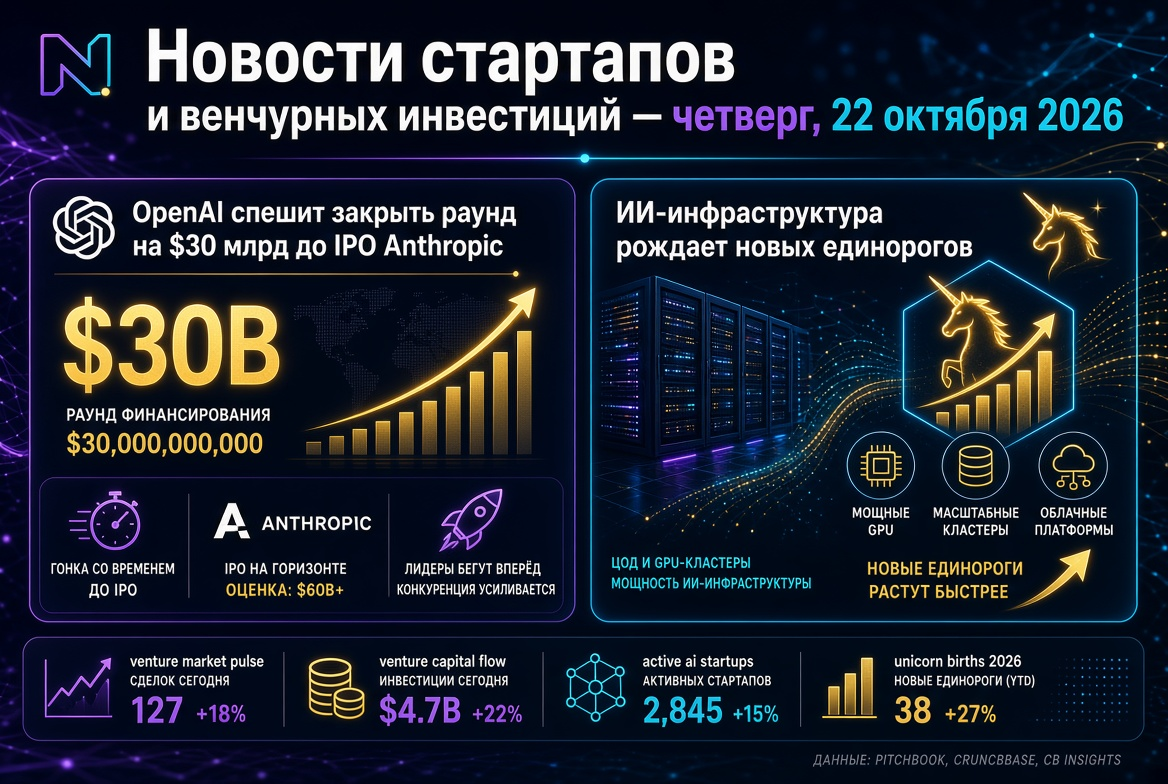
- Anthropic. According to Western press, the company is preparing for a possible IPO in November; analysts at Renaissance Capital suggest a prospectus publication could happen as soon as this Friday. The last private round valued the company at $965 billion with a private funding of $65 billion in May.
- OpenAI has ruled out an IPO in 2026 and is reportedly negotiating to raise at least $30 billion at a valuation of around $1.4 trillion.
- Jio Platforms is set to conclude the subscription for an IPO exceeding ₹30,000 crores on October 23; by the morning of the second day, demand exceeded supply by 3.5 times, with listing expected on October 28.
- Lycia Therapeutics plans to start trading on Friday after a $250 million IPO.
However, the number of IPOs in the U.S. has been one-third lower than in 2025, making the success of large placements critically important for the liquidity of the entire sector.
Macro Context: Record Nine Months for Venture Capital
According to data from Crunchbase, global venture investments totaled $159 billion in the third quarter of 2026 — a decrease of 25% from the second quarter but a 53% increase compared to the previous year. Key figures include:
- $102 billion, or 64% of all venture capital, was received by AI companies;
- 27 rounds of over $1 billion — an absolute quarterly record;
- $679 billion for nine months — the highest on record;
- 57% of the quarterly volume went to American startups.
Russia and the CIS: Market Contraction and Reliance on State Funds
The Russian venture market is moving in the opposite direction. According to the Moscow Venture Fund, venture investments in the first half of 2026 shrank by 48% to 4.6 billion rubles, while the number of deals fell by 45% to 54. Support for startups comes mainly from development institutions: at the Moscow Startup Summit, the MVF signed agreements worth 250 million rubles with expected co-investments of around 1 billion rubles. Among new instruments is a specialized fund from the Russian Venture Company for startups in the information security sector and a fund called "Creative Venture" with a volume of 1 billion rubles.
What This Means for Venture Investors
- Concentration is Intensifying. Capital is gathering around a small number of leaders, while competition for shares in top rounds is intensifying.
- Quality of Revenue is Becoming Decisive. Companies with ARR exceeding $100 million, like Legora and Pigment, are receiving a premium valuation.
- The Role of Non-Dilutive Financing is Growing for mature startups seeking to preserve founder equity.
- The IPO of Anthropic Will be an Indicator for the entire queue of tech placements through the end of the year.
The venture market enters the last quarter of 2026 with record volumes, but also with increased sensitivity to overheating risks. For investors and funds, the crucial question in the coming weeks will be whether the public market can validate the valuations established in private rounds.