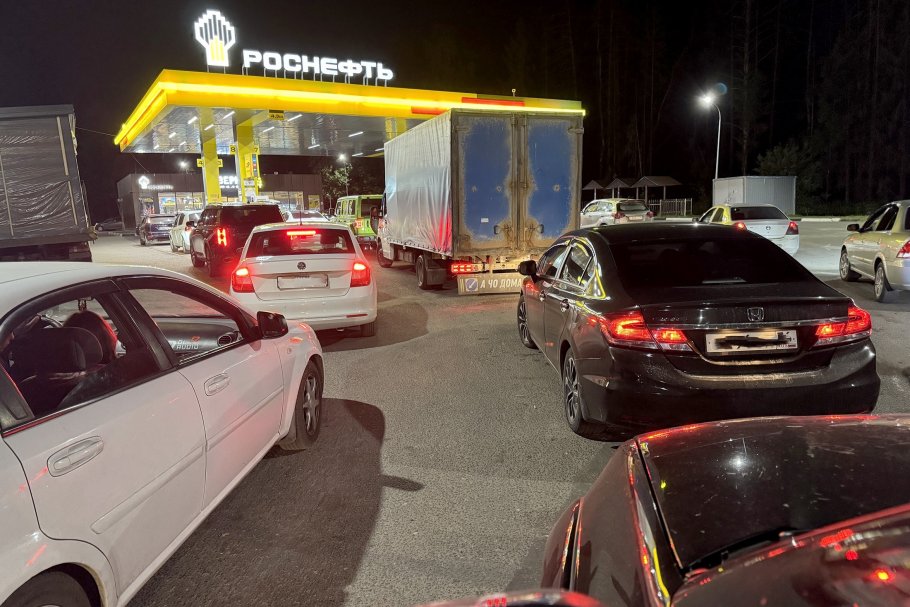
The Energy Crisis Due to the U.S.-Iran Military Conflict Has Significantly Benefited the Russian Budget by Increasing Oil and Gas Revenues. Therefore, a Quick Peace and Unblocking of the Strait of Hormuz Is Not the Best Option for Russia, Just as Is the Opposite Scenario Where War Flares Up with New Force. Which End of the Middle Eastern Crisis Is More Advantageous for Russia?
At the end of 2025 and the beginning of 2026, the Russian budget faced falling oil prices. In January and February, Urals was priced at $41 and $45 per barrel, significantly below the budgeted price of $59 per barrel. This was a catastrophic start to the year and created serious risks for an increase in budget deficit in 2026.
However, due to the Middle Eastern conflict, the situation improved considerably. By March, the tax price of Urals rose to $77 from $45 in February, and in April it reached $95. In May, it may go even higher. As a result, oil and gas revenues increased by nearly 240 billion rubles in April compared to March.
Nonetheless, it is too early for the Ministry of Finance to relax, as American races may repeat this year. Additionally, compared to last year, oil and gas revenues are lower. Russia needs oil priced at $95 not only in April but for the entire year. This heavily depends on how the Middle Eastern conflict is resolved. The U.S. and Iran are attempting to negotiate.
Which scenario of peaceful resolution is most favorable for Russia from the perspective of oil prices and budget revenues?
Four possible scenarios for the conflict's resolution can be distinguished: a quick peace agreement and the opening of the Strait of Hormuz; prolonged negotiations; escalation of military conflict with new damage to infrastructure; or a protracted crisis with a collapse in consumption.
The first scenario involves a swift temporary agreement between the U.S. and Iran, a ceasefire, and a gradual reopening of the Strait of Hormuz by May–June. This may be a temporary arrangement rather than a substantial final peace. Expectations of this sort have already pushed Brent prices below $100 per barrel, and if an actual agreement is reached, they may drop to $80-90, says Vladimir Chernov, an analyst at Freedom Finance Global.
However, he does not anticipate a drop for the Russian brand Urals to $41 per barrel as witnessed earlier this year, because even after the strait reopens, physical supplies will take weeks or months to restore.
“If transit through the Strait of Hormuz is restored by the summer of 2026, it will lead to a gradual decline in oil prices to $70 per barrel. But lower prices will only be reached next year when the conflict's consequences, including the restart of oil extraction at idle wells, are fully alleviated,” says Sergey Tereshkin, CEO of Open Oil Market.
The second scenario implies lengthy negotiations and partial opening of the strait: formally, vessel movements will start to recover, but insurance, inspections, military risks, and delays will remain.
“With prolonged negotiations, oil prices may stay in the range of $95–115 per barrel of Brent. This is the most comfortable scenario for Russia in terms of revenue, as Urals prices could remain significantly above the budgeted $59 per barrel,”
– says Chernov.
The third scenario involves new military escalation, strikes on infrastructure, collapse of negotiations, and sustained effective blockade of Hormuz. In this case, oil prices could quickly rise above $110–120 per barrel, gas in Europe and Asia will remain expensive, and the petroleum product market will be even more scarce, warns Chernov.
The problem here is that the third scenario risks transitioning into the fourth – a protracted conflict where energy resources become so expensive that a global economic downturn occurs and prices sharply drop.
“The escalation of the military conflict and the destruction of additional energy facilities in the Middle Eastern countries raise the threat of prices soaring to exorbitant levels—both for oil and gas. If prices reach extreme highs, it will lead to a decrease in global consumption, and the market will then face a very difficult and prolonged recovery. This is also disadvantageous for us as our sales markets will shrink,” explains Igor Yushkov, an expert with the National Energy Security Foundation (FNEB) and Financial University under the Government of the Russian Federation.
Maintaining current prices of $100–110 (high but not extreme) per barrel, at which there is no reduction in demand in our markets, is the best scenario, the expert adds. “The longer the Strait of Hormuz remains closed, the better for Russia; the more we can earn. Maintaining the status quo is advantageous for us,” he says.
Another risk is posed by the UAE, which has announced its exit from OPEC. If they can increase production levels by the time the Strait reopens, prices will drop, and the question of to what level remains open, suggests Yushkov. If other member countries follow the UAE's example and also want to exit the OPEC+ deal, this will further impact prices. “So far, everyone is silent because there is no sense in exiting the deal—all oil exports are still limited. But with the opening of Hormuz, their positions may change. Russia cannot increase production like the Middle Eastern countries quickly, so we will simply face low prices at current production levels,” explains Yushkov.
In the gas market and accompanying products, the situation is comparatively better because, unlike oil, there are no reserves. “When the Strait of Hormuz was blocked, oil producers continued to extract a lot and stored oil in reserves. That was not the case with gas; Qatar had to halt extraction due to strikes on infrastructure. Therefore, certain shortages may still persist in gas and accompanying products (methane, helium), and prices will remain high,” says Yushkov.
The balancing factor preventing oil price drops is that strategic reserves have been depleted and need to be replenished, the expert says. “But if OPEC+ collapses and everyone produces at maximum capacity, even this factor won't be able to restrain prices; they will likely drop significantly for a while, possibly for several months until the market rebalances through reduced production by some players," speculates Igor Yushkov.
Even under the best scenario (the second one)—maintaining high but not excessively high oil prices—filling the budget will be a challenging task. According to Chernov's calculations, oil and gas revenues for the first four months amounted to about 2.3 trillion rubles, against an annual plan of around 8.92 trillion rubles. Therefore, approximately 6.6 trillion rubles must be collected in the months remaining until the year's end, or about 828 billion rubles per month. In April, revenues exceeded that figure—855.6 billion rubles.
“If prices remain high and monthly collections hover around 0.9–1 trillion rubles, the annual plan for oil and gas can not only be met but surpassed by approximately 0.3–1.4 trillion rubles. If oil prices quickly drop and monthly revenues decrease to 700–750 billion rubles, the plan will again come under pressure,” Chernov estimates.
“High oil prices are very helpful, but the budget issue is not resolved. As of the end of March, the federal budget deficit had already reached 4.576 trillion rubles, or 1.9% of GDP. This is above the annual plan.
The scenario of Urals returning to $41 this year now seems unlikely. However, stating that this level will definitely not be reached is not possible since the oil market is currently too volatile,” adds the expert.
He anticipates that if Urals holds above $70–75 per barrel, the budget will have a noticeably calmer year, and if the average price hovers around $85–95, oil and gas revenues will significantly reduce the risk of severe budget deficit. However, this will not entirely resolve the issue of the deficit due to increased military expenses, a strong ruble, and compensatory payments to oil companies, the expert concludes.
Source: Vedomosti